How to Write a Resume With No Experience (And Actually Get Callbacks)
You're staring at a blank document, cursor blinking, and the thought loop starts: I have nothing to put on this. No job titles. No company names. No bullet points about "exceeding quarterly targets by 23%."
Here's what I need you to understand after 11 years of recruiting: the phrase "no experience" is a lie you're telling yourself. You have experience. You just haven't learned to translate it into resume language yet. That's a skill gap, not an experience gap — and this article closes it.
Why "No Experience" Doesn't Mean What You Think It Does
When hiring managers post an "entry-level" role, they're not expecting a polished professional with five years of corporate accomplishments. They're looking for signals: Can this person show up reliably? Can they learn? Can they communicate? Have they done anything that proves they can function in a structured environment?
A student who organized a campus fundraiser that raised $4,200 has demonstrated project management, budgeting, and stakeholder communication. A person who babysat three kids every weekend for two years has demonstrated time management, responsibility, and conflict resolution. Someone who built a personal blog with 500 monthly readers has demonstrated content creation, basic analytics, and self-direction.
These are transferable skills — and they're exactly what entry-level employers are screening for. The problem isn't that you lack experience. The problem is that you've been comparing yourself to mid-career professionals instead of reframing what you've already done through the lens of what employers actually need.
Choose the Right Resume Format When You're Starting Out
The standard chronological resume (listing jobs in reverse order) works poorly when you have no jobs to list. Instead, use a skills-based resume — sometimes called a functional resume format — that leads with what you can do rather than where you've worked.
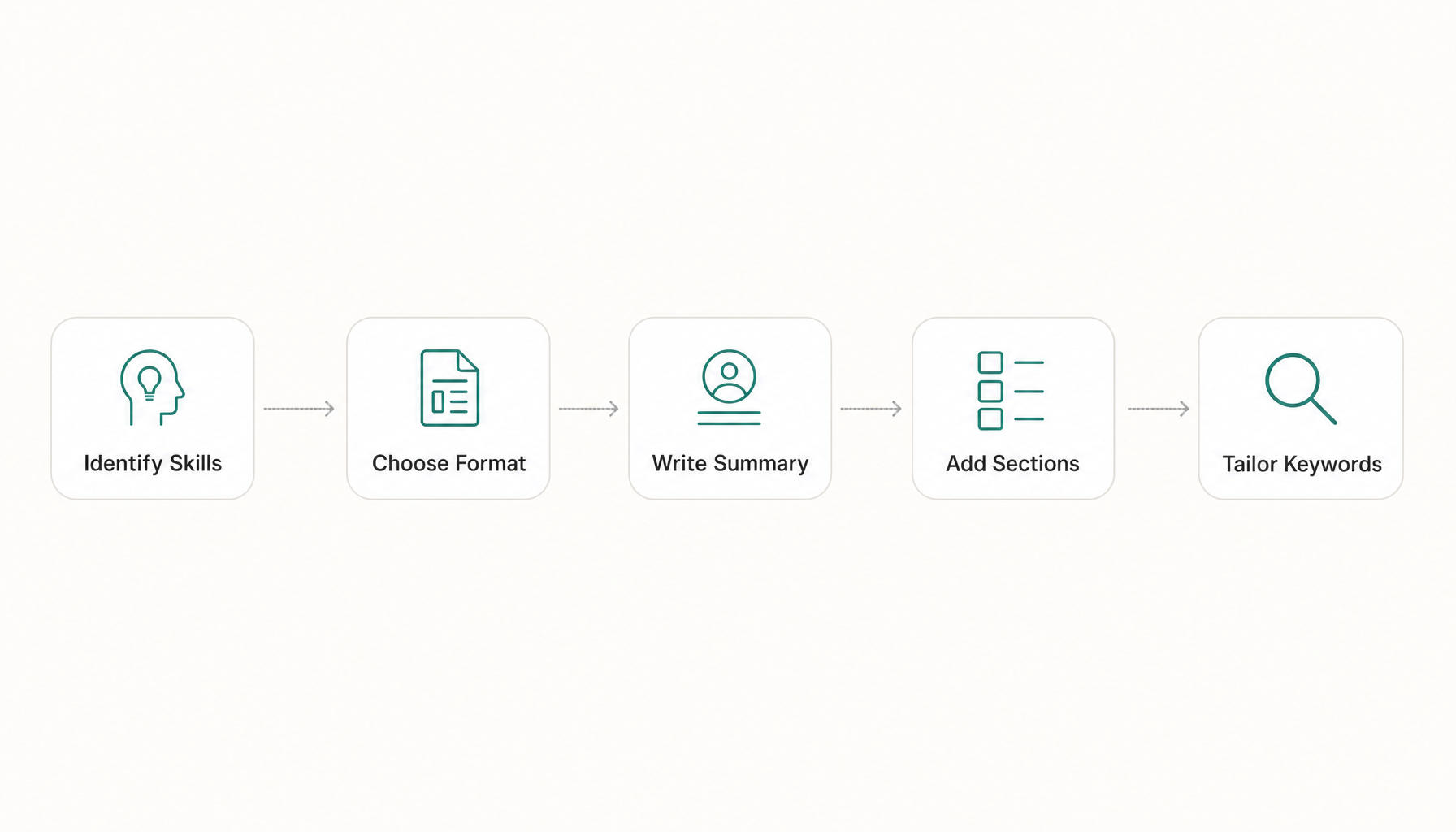
Structure it like this:
- Header (name, contact info, LinkedIn URL)
- Resume summary (3 lines max)
- Skills section (grouped by category)
- Relevant experience (volunteer work, projects, coursework)
- Education
This format puts your strongest material at the top of the page, where recruiters spend 80% of their 6-second initial scan. For more on choosing the right layout, see this guide on the best resume format for 2026.
What to Put on a Resume With No Work Experience
Here's a non-exhaustive list of what legitimately belongs on a first job resume:
- Volunteer work — food bank shifts, church event coordination, animal shelter duties
- School projects — group presentations, research papers, capstone projects
- Extracurriculars — club leadership, sports team captain, student government
- Freelance or informal work — tutoring, lawn care, Etsy shop, social media management for a family business
- Certifications — Google Analytics, HubSpot Inbound Marketing, CPR/First Aid, food handler's card
- Relevant coursework — especially if it directly maps to the job you're applying for
The key: every item needs at least one bullet point with a specific result or responsibility. "Volunteered at food bank" becomes "Sorted and distributed 200+ food packages weekly to 75 families, maintaining inventory accuracy above 95%."
How to Write a Resume Summary With No Experience
Your summary replaces the outdated "objective statement." It's 2–3 lines that tell the hiring manager what you bring and what you're targeting. Here's the formula:
[Descriptor] + [relevant skill/knowledge area] + [what you're seeking] + [proof or differentiator]
Example for a retail position:
Detail-oriented communications student with hands-on customer service skills developed through two years of volunteer event coordination. Seeking a retail associate role where strong interpersonal skills and schedule flexibility create immediate value.
Example for an administrative assistant role:
Organized self-starter with advanced proficiency in Google Workspace and experience managing scheduling for a 40-member campus organization. Looking to apply administrative and communication skills in a fast-paced office environment.
Notice: no fluff like "hard-working team player." Every word earns its spot. For more on this, check out these resume summary examples.
Turning School, Volunteering, and Side Projects Into Resume Gold
The secret is writing about non-professional experience exactly like you'd write about a job. Use strong action verbs, quantify where possible, and focus on outcomes.
Before: "Helped with school newspaper" After: "Wrote and edited 15+ articles per semester for a 2,000-reader student publication, consistently meeting weekly deadlines"
Before: "Volunteered at hospital" After: "Greeted and directed 50+ patients and visitors daily across three hospital departments, reducing front-desk wait times by an estimated 20%"
Before: "Made a website for fun" After: "Designed and launched a personal portfolio site using HTML/CSS, achieving 400+ monthly visitors within three months of launch"
How to Tailor Your Resume to a Specific Job (Even as a Beginner)
This is the step most first-time resume writers skip — and it's the one that matters most for getting past ATS screening.
Here's the process:
- Copy the job description into a separate document.
- Highlight repeated words and phrases — these are the ATS resume keywords the system will scan for.
- Map your experience to those keywords. If the posting mentions "attention to detail," make sure that exact phrase appears in your resume (but only if you can back it up).
- Mirror the language. If they say "customer engagement" and you wrote "talking to people," rewrite your bullet to say "customer engagement."
You don't need different resumes for every application, but you need to adjust 20–30% of the content each time. The job description is literally a cheat sheet telling you what to write.
Once you have a draft, paste the job description into Resume Inspector — it's free, no credit card needed — and you'll see in under a minute which keywords your resume is missing and how well it matches what the employer is actually looking for. Think of it as a spell-check for relevance: fix the gaps before you hit submit.
For deeper guidance on this process, read the full walkthrough on how to tailor your resume to any job description.
Common Mistakes First-Time Resume Writers Make
- Using an objective statement instead of a summary. "Seeking an opportunity to grow" tells the employer nothing about your value.
- Listing duties instead of accomplishments. "Responsible for social media" vs. "Grew Instagram following from 200 to 1,100 in four months" — one gets callbacks, one doesn't.
- Including a photo, age, or "References available upon request." Wastes space and looks dated.
- Choosing a creative template with columns, icons, and graphics. Most ATS software can't parse these correctly. Stick to a clean, single-column format.
- Writing more than one page. For a resume with no work history, one page is not a limitation — it's a requirement. See the breakdown on resume length.
A Simple No-Experience Resume Template You Can Use Today
FULL NAME
City, State | email@email.com | (555) 123-4567 | linkedin.com/in/yourname

SUMMARY
[2-3 lines using the formula above]

SKILLS
Communication: Public speaking, written correspondence, active listening
Technical: Google Workspace, Canva, basic HTML, social media management
Organization: Event planning, scheduling, inventory tracking

RELEVANT EXPERIENCE
Volunteer Event Coordinator | Local Nonprofit | Jan 2025 – Present
• Planned and executed 4 community events with 100+ attendees each
• Managed $2,500 event budget, coming in under budget for 3 of 4 events
• Recruited and coordinated 12 volunteers per event

Social Media Manager (Volunteer) | Campus Club | Aug 2024 – Dec 2025
• Created 3 posts per week across Instagram and TikTok
• Grew follower count from 340 to 1,200 in one academic year
• Designed promotional graphics using Canva, maintaining brand consistency

EDUCATION
Bachelor of Arts in Communications | State University | Expected May 2026
Relevant Coursework: Business Writing, Digital Marketing, Public Relations

CERTIFICATIONS
Google Digital Marketing & E-commerce Certificate | 2025
Try our free Job Keyword Scanner to see how your resume stacks up.
What to Do After You Submit: Setting Yourself Up for the Interview
Submitting is not the finish line. Here's what to do next:
- Write a tailored cover letter. Even when optional, it differentiates you from candidates who skip it. Here's a guide on how to write a cover letter — or if you have zero professional experience specifically, start with this no-experience cover letter guide.
- Follow up within 5–7 business days if you haven't heard back. A short, polite email reaffirming your interest puts your name back at the top.
- Prepare for the interview immediately. Don't wait for a response. Research the company now so you're ready when the call comes.
Before you hit send on your next application, run your resume through a free ATS compatibility check. Seeing your actual match score against a real posting takes 60 seconds and eliminates the guesswork about whether your resume will survive the software filter. That confidence alone changes how you approach the rest of your search.
You have more to offer than a blank page suggests. Now your resume proves it.