Resume Length: One Page or Two Pages? How to Know Which Is Right for You
The resume length debate has been going on for decades, and most advice boils down to some version of "it depends." That's not helpful when you're staring at a document that's either cramped into one page with 9pt font or limping onto a second page with three bullet points hanging alone.
Here's what I learned reviewing thousands of resumes as a recruiter: the wrong page count actively hurts candidates. Not because hiring managers count pages, but because the wrong length signals either inexperience dressed up as more or genuine expertise buried under artificial constraints.
Let me give you a concrete framework so you can stop guessing.
Why Resume Length Actually Matters (And When It Doesn't)
Resume length matters for two reasons that have nothing to do with arbitrary rules:
ATS parsing. Applicant tracking systems don't care whether your resume is one page or two. They parse text. But formatting tricks used to force content onto one page — text boxes, columns, compressed margins, tiny fonts — can break ATS parsing entirely. A clean two-page resume beats a mangled one-page resume every time.
Recruiter attention. The average initial resume review takes 6–8 seconds. Recruiters scan for relevance, not length. A focused one-page resume and a well-organized two-page resume both survive this scan. What doesn't survive: a two-page resume where the second page is padding, or a one-page resume where relevant experience got cut to fit.
Length stops mattering when the content is strong and relevant to the role. Length starts mattering when it signals a mismatch between your experience and how you're presenting it.
The One-Page Resume: Who It's For and When It Wins
A one-page resume is the right choice when:
- You have fewer than 8 years of professional experience
- You're targeting a single role type (not combining unrelated careers)
- Your most relevant experience fits in 3–4 positions
- You're entry-level, a recent graduate, or making a career change where older experience isn't relevant
Concrete example: A marketing coordinator with 4 years of experience across two companies doesn't need a second page. Their relevant skills, education, and accomplishments fit cleanly in one page with proper formatting — 10.5–11pt font, standard margins, and 3–5 bullet points per role.
One-page resumes also win for internships, part-time roles, and any position where the job posting explicitly says "one-page resume preferred" (common in consulting, banking, and some government roles).
The Two-Page Resume: When More Space Works in Your Favor
A two-page resume works when:
- You have 10+ years of relevant experience across multiple roles
- You hold technical certifications or licenses that the role requires
- Your career includes leadership progression that demonstrates growth
- The role requires demonstrated expertise across multiple domains (e.g., a VP of Engineering who also managed P&L)
Concrete example: A senior project manager with 14 years across four companies, a PMP certification, Agile certifications, and experience managing portfolios worth $50M+ would be doing themselves a disservice by cutting to one page. Their progression from individual contributor to portfolio management tells a story that requires space.
The key: every line on page two must earn its place. If your second page contains roles from 15+ years ago that aren't relevant to the target position, that's not a two-page resume — that's a one-page resume with an appendix nobody asked for.
The Real Rule: Let Your Experience — Not a Page Count — Guide You
The actual rule is this: include every piece of information that strengthens your candidacy for the specific role, and nothing else.
That means your resume length might change between applications. A software engineer with 12 years of experience might use two pages when applying for a principal engineer role (showing technical depth across multiple stacks) but cut to one focused page when applying for a startup CTO role (where leadership and business outcomes matter more than every technical project).
This is why the "one-page rule" and the "two pages are fine" crowd are both wrong in absolute terms. The right length is whatever contains your strongest, most relevant evidence — and nothing weaker.
Industries and Roles That Have Their Own Length Expectations
Some fields have settled this debate internally:
| Industry/Role | Expectation | Why |
|---|---|---|
| Investment banking | One page, strictly | Industry norm; shows concision |
| Consulting (MBB) | One page for associates | Firm-specific culture |
| Federal government | 3–5 pages (federal resume) | Requires detailed duty descriptions |
| Academia | CV format, unlimited | Publications and grants need space |
| Engineering (10+ yrs) | Two pages acceptable | Technical depth requires detail |
| Entry-level anything | One page | Limited relevant content |
| Executive (C-suite) | Two pages standard | Career narrative requires scope |
If you're in one of these categories, follow the industry norm regardless of general advice. A two-page resume for an analyst position at Goldman Sachs signals that you don't understand the culture — and culture fit matters at the screening stage.
Common Mistakes That Force the Wrong Page Count
Mistakes that inflate to two pages unnecessarily:
- Listing every job since high school (your barista role from 2011 doesn't help your product management application)
- Including "References available upon request" (everyone knows this; it wastes a line)
- Using an objective statement instead of a concise summary
- Describing job duties instead of accomplishments (duties take more words to say less)
- Including full addresses, outdated skills (Microsoft Word proficiency in 2026), or irrelevant certifications
Mistakes that force everything onto one page at the cost of readability:
- Shrinking font below 10pt
- Reducing margins below 0.5 inches
- Eliminating white space between sections
- Cutting quantified accomplishments that directly match the job posting
- Removing your skills section entirely
Both directions create the same problem: a resume that works against you instead of for you.
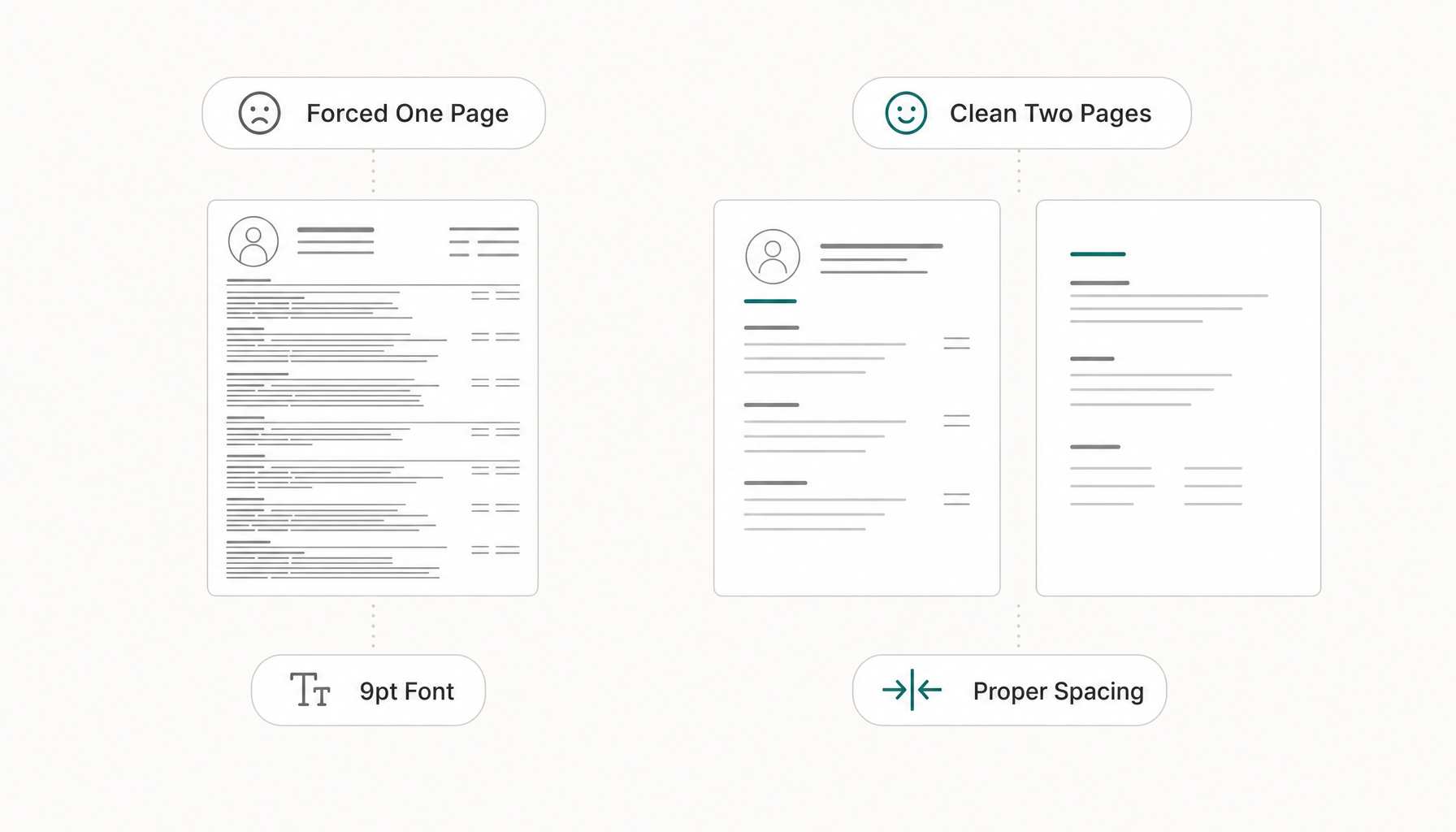
Getting the page count right is only half the challenge. The content inside still needs to match the specific job you're targeting. If you want a quick gut-check, paste your target job description into Resume Inspector — it's free, no signup needed — and you'll see exactly which keywords you're missing and how well your resume aligns with what the role actually requires.
How to Cut a Two-Page Resume Down to One (Without Losing Impact)
If you've determined one page is right for your situation but you're currently at 1.5 pages, try this in order:
- Remove roles older than 10 years unless they're directly relevant or show unique qualifications
- Consolidate bullet points — combine two weak bullets into one strong, quantified statement. "Managed social media accounts" and "Increased follower count" becomes "Grew social media following 340% in 8 months through targeted content strategy"
- Cut the skills section to essentials — only include skills mentioned in the job description or that genuinely differentiate you
- Remove coursework, GPA, and academic details if you graduated more than 3 years ago
- Use strong action verbs that convey more meaning in fewer words — "Spearheaded" over "Was responsible for leading"
If you've done all five and it's still over one page, you probably need two pages — and that's fine.
How to Fill a Second Page Without Padding or Fluff
If you've decided two pages is right but your content runs thin on page two, these additions are legitimate (not filler):
- Technical proficiencies section with specific tools, platforms, and versions relevant to the role
- Key projects section with scope, your role, and measurable outcomes
- Professional development — certifications completed in the last 3 years, relevant training
- Leadership or volunteer experience that demonstrates skills the role requires
- Publications, patents, or speaking engagements if relevant to the industry
What's NOT legitimate filler: hobbies (unless directly relevant), soft skills lists without context, repeating the same accomplishment in different words, or graphics that exist purely to occupy space.
A rule of thumb: page two should be at least half full. If you can only fill a quarter of the second page, restructure to fit on one.
What Hiring Managers and Recruiters Actually Say About Resume Length
I asked. Repeatedly. Over years. Here's the consensus from hiring managers across tech, healthcare, finance, and manufacturing:
"I've never rejected someone for having two pages. I've rejected people for wasting my time on the second page." — Engineering Director, Series C startup
"Entry-level candidates with two pages make me wonder if they can prioritize." — HR Manager, Fortune 500 retail
"I want to see 10 years of progressive growth? That takes two pages. Give me the full picture." — VP of Sales, SaaS company
The pattern: no one counts pages. Everyone evaluates relevance density. A tight two-page resume with 100% relevant content outperforms a one-page resume that cut relevant material to fit.
Quick Decision Guide: One Page or Two Pages?
Answer these five questions:
- Do you have more than 8 years of relevant experience? (Not total career length — relevant to this specific role)
- Does the role require demonstrating depth across multiple competency areas? (Technical + leadership + domain expertise)
- Do you have certifications, licenses, or credentials that the job posting specifically requires?
- Is the role senior-level (director+) or does it require showing career progression?
- After removing irrelevant content, does your strongest material still exceed one page with 11pt font and 0.5" margins?
If you answered YES to 3+ questions: Two pages. If you answered YES to 1–2 questions: Probably one page, but test both versions. If you answered NO to all: One page, confidently.
Try our free Job Keyword Scanner to see how your resume stacks up.
Try our free Job Description Analyzer to see how your resume stacks up.
Now that you know your ideal resume length, make sure the content inside is actually working. Paste the job description you're targeting into Resume Inspector — it takes under 60 seconds, it's free, and you'll see your fit score plus the exact keywords the role demands that you might be missing. No signup required, just a clear picture of where your resume stands before you hit apply.