Resume Summary Examples That Actually Get You Interviews (With Templates)
I reviewed roughly 200 resumes per day during my recruiting years. The summary was the first thing I read—and the reason I kept reading or moved on. Most summaries I see today are still bloated with meaningless phrases like "results-driven professional" and "team player with a passion for excellence." Recruiters skim these in under six seconds. You need something that makes those seconds count.
Here's what actually works, broken down with real examples you can steal.
What Is a Resume Summary (And When You Actually Need One)
A resume summary is a 2–4 sentence block at the top of your resume that tells a hiring manager three things: who you are professionally, what you're best at, and why you're relevant to this role.
You need one if:
- You have 3+ years of experience
- You're changing careers and need to reframe your background
- Your job titles don't clearly communicate your skill set
Skip it if:
- You're a new graduate with no relevant experience (use an objective instead—more on that below)
- Your resume is already one page and space is tight
The Anatomy of a Strong Resume Summary: 3 Elements Recruiters Look For
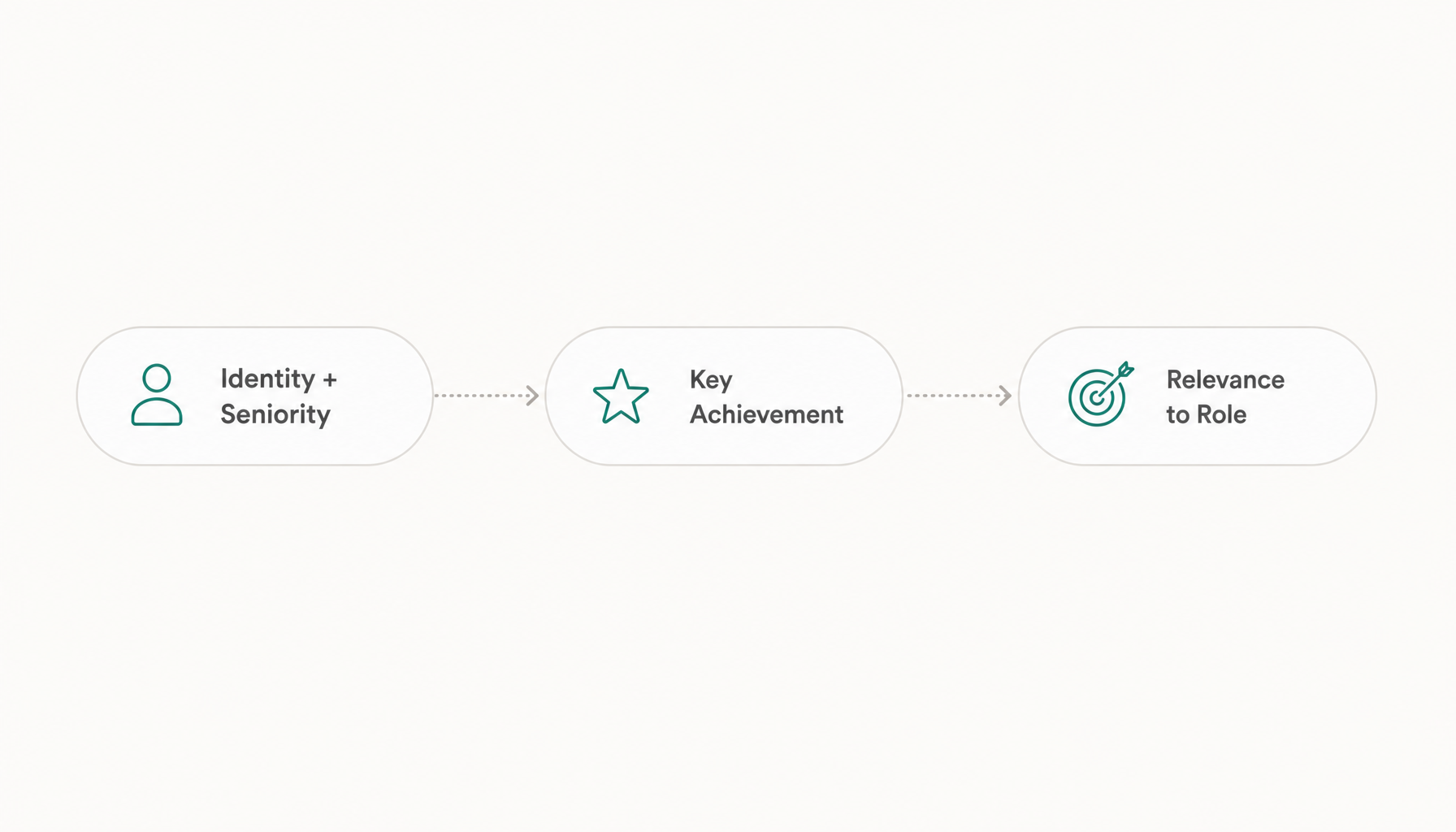
Every summary that made me keep reading had these three components:
- Identity + experience level — Who are you and how senior are you?
- Specific skill or achievement — What measurable thing have you done?
- Relevance to the target role — Why should this hiring manager care?
Weak example:
"Motivated marketing professional seeking a challenging position where I can leverage my skills and grow with a dynamic company."
This says nothing. No specifics, no proof, no connection to any job.
Strong example:
"Digital marketing manager with 6 years leading paid acquisition for B2B SaaS companies. Scaled pipeline from $2M to $11M ARR at [Company] through paid search and LinkedIn campaigns. Looking to bring that playbook to a growth-stage fintech team."
Same person. Completely different impact.
Resume Summary Examples by Career Stage
Entry-Level (0–2 years)
"Recent computer science graduate from UT Austin with internship experience building REST APIs in Python/Django. Contributed to a production feature used by 40K+ daily users during summer 2024 internship at [Company]. Seeking a backend engineering role where I can ship code on day one."
Mid-Career (3–8 years)
"Operations manager with 5 years optimizing fulfillment workflows for e-commerce brands doing $10M–$50M in annual revenue. Reduced order-to-delivery time by 22% at [Company] by redesigning warehouse pick paths and renegotiating carrier contracts."
Senior/Executive (10+ years)
"VP of Product with 12 years building B2B platforms from zero-to-one. Led the product org at [Company] through Series B to acquisition ($340M), growing from 3 to 28 product managers. Focused on AI-native enterprise tools for the next chapter."
Resume Summary Examples by Job Type and Industry
Software Engineer:
"Full-stack engineer (React/Node.js/PostgreSQL) with 4 years at high-traffic consumer apps. Architected the checkout rewrite at [Company] that cut cart abandonment by 18% and handled 12K concurrent sessions during peak sales."
Registered Nurse:
"BSN-prepared RN with 7 years in Level I trauma ICU. CCRN-certified. Managed ventilator-dependent patients with 98% compliance on VAP bundle protocols. Precepted 15+ new graduate nurses."
Project Manager:
"PMP-certified project manager with 6 years delivering enterprise software implementations on time and under budget. Managed a $4.2M ERP migration at [Company] with zero unplanned downtime during cutover."
Sales:
"Enterprise AE with 5 years selling cybersecurity solutions to Fortune 500 CISOs. Closed $3.8M in new ARR in 2024 (142% of quota). Consistently ranked top 3 on a 22-person team."
Human Resources:
"HR business partner with 8 years supporting engineering orgs of 200–500 employees. Reduced voluntary attrition from 24% to 14% at [Company] by redesigning the manager feedback loop and comp philosophy."
Resume Summary Examples for Career Changers
Career change summaries need to bridge your old world and your new one. The trick: lead with transferable skills, not your old job title.
Teacher → Instructional Designer:
"Former high school biology teacher (6 years) transitioning to instructional design. Built a blended curriculum adopted by 12 schools across the district. Completed Google UX Design Certificate and built 3 e-learning modules in Articulate Storyline for portfolio clients."
Military → Operations:
"Former Army logistics officer with 8 years managing supply chains across 4 continents under zero-error-tolerance conditions. Coordinated movement of $28M in equipment across 14 time zones. Pursuing civilian operations roles in manufacturing or distribution."
Retail Manager → Account Management:
"Customer-facing leader with 5 years managing a $6M retail location and a team of 35. Grew store NPS from 62 to 84 by rebuilding the client follow-up process. Translating that relationship-building approach to B2B account management."
What Makes a Resume Summary Weak (Real Before-and-After Examples)
Problem: Buzzword soup, zero specifics
Before:
"Dynamic, results-oriented professional with excellent communication skills and a proven track record of success in fast-paced environments."
After:
"Account executive with 4 years selling HR tech to mid-market companies (200–2,000 employees). Averaged 118% quota attainment across 8 consecutive quarters at [Company]."
Problem: Too long, reads like a paragraph from a cover letter
Before:
"I am a dedicated and hardworking software developer who has spent the last several years honing my skills in various programming languages including Java, Python, and JavaScript. I am looking for an opportunity to join a team where I can continue to grow and make an impact while also contributing my expertise in backend development and cloud architecture to meaningful projects."
After:
"Backend engineer (Python/AWS) with 4 years building microservices for fintech platforms processing 500K+ daily transactions. Reduced API latency by 40% at [Company] through caching layer redesign."
Problem: Generic objective masquerading as a summary
Before:
"Seeking a challenging role in data analytics where I can apply my skills."
After:
"Data analyst with 3 years in retail analytics. Built the demand forecasting model at [Company] that reduced overstock by $1.2M annually. Proficient in SQL, Python, and Tableau."
How to Tailor Your Resume Summary to a Specific Job Description
This is where most people fail. They write one summary and blast it to 50 jobs. Recruiters can tell immediately.
Here's the process that works:
- Pull 3–5 keywords from the job description — Look at required skills, tools, and the team description
- Match them to your actual experience — Don't fabricate; find the real overlap
- Rewrite your summary to lead with those keywords — ATS software scans from top to bottom, so frontloading matters
Example: If a job description says "experience with Salesforce, pipeline management, and mid-market SaaS sales," your summary should hit those exact phrases:
"Mid-market SaaS AE with 4 years managing full-cycle pipeline in Salesforce. Averaged $2.1M in annual closed-won revenue selling to VP-level buyers at companies with 500–5,000 employees."
The challenge is knowing which keywords matter most for any given job. You can guess, or you can check. Want to see how your resume actually scores against a specific job? Paste any job description into Resume Inspector — it's free, no signup needed — and you'll see exactly which keywords your summary is missing in under a minute. That feedback loop turns summary-writing from guesswork into a targeted exercise.
Resume Summary vs. Objective Statement: Which Should You Use?
| Resume Summary | Objective Statement | |
|---|---|---|
| Best for | Anyone with relevant experience | New grads, career changers with no relevant experience |
| Focus | What you've done | What you want |
| Example | "Data engineer with 5 years building ETL pipelines..." | "Recent CS graduate seeking an entry-level data engineering role..." |
| ATS impact | High (keyword-rich by nature) | Low (usually too generic) |
My rule: If you can write a summary with real numbers and relevant skills, always pick the summary. Objectives are a last resort for when you genuinely have nothing to summarize.
Try our free Job Keyword Scanner to see how your resume stacks up.
Quick-Start Templates You Can Customize in 5 Minutes
Copy these, fill in the brackets, and delete anything that doesn't apply.
Template 1: Experienced Professional
"[Job title] with [X years] in [industry/specialization]. [Key achievement with a number] at [Company]. Skilled in [2–3 tools or skills from the job description]. Seeking [specific type of role or team]."
Template 2: Career Changer
"[Transferable skill] professional with [X years] in [current field] transitioning to [target field]. [Relevant achievement that bridges both worlds]. Completed [certification/training relevant to target role]."
Template 3: Entry-Level
"Recent [degree] graduate from [University] with [internship/project] experience in [relevant area]. [One specific accomplishment with a number]. Seeking [specific role type] where I can [value you'd add on day one]."
Template 4: Technical Role
"[Specialization] engineer/developer with [X years] building [what you build] using [tech stack]. [Performance or scale metric from your most impressive project]. Looking to [specific goal] at a [company type]."
Once you've filled in your template, a quick ATS check can show you whether the right keywords made it in. The free analysis takes less than 60 seconds and shows you exactly what a recruiter's software would flag before you hit submit.