How to Tailor Your Resume to Any Job Description (Step-by-Step)
Sending the same resume to 50 jobs and hearing nothing back isn't a strategy—it's a lottery ticket with terrible odds. I spent six years as a recruiter reviewing thousands of applications, and I could spot a generic resume within three seconds. The candidates who landed interviews? They made me feel like they wrote their resume for this specific role.
Here's the thing: tailoring your resume doesn't mean rewriting it from scratch every time you apply. It means running a repeatable process that takes 15–20 minutes per application and dramatically increases your match rate. This guide gives you that process.
Why Tailoring Your Resume Actually Matters (The Data Might Surprise You)
A 2023 Jobscan study found that resumes tailored to a job description received 63% more interview callbacks than generic versions sent to the same roles. That's not a marginal improvement—it's the difference between getting ghosted and getting scheduled.
Here's why it works mechanically: over 98% of Fortune 500 companies use an applicant tracking system (ATS) to filter resumes before a human ever sees them. These systems score your resume based on keyword overlap with the job posting. A generic resume might match 40% of a job's requirements. A tailored one hits 75–90%. That gap determines whether you clear the filter or disappear into a digital void.
Beyond ATS, hiring managers spend an average of 7.4 seconds on initial resume review. When your summary, skills, and top bullet points directly echo their posted priorities, you pass the "is this person relevant?" gut check instantly.
Step 1: Decode the Job Description Before You Change Anything
Don't open your resume first. Open the job description and dissect it like a case study.
Split the posting into three categories:
- Must-haves — qualifications listed first, repeated, or marked "required"
- Nice-to-haves — mentioned once, listed under "preferred," or buried at the bottom
- Cultural signals — adjectives about work style (e.g., "fast-paced," "collaborative," "autonomous")
Example: A posting for a Product Marketing Manager that lists "go-to-market strategy" three times, mentions "competitive analysis" once, and uses phrases like "cross-functional stakeholder alignment" is telling you exactly what to lead with.
Write these categories down. You now have a blueprint for every edit you'll make.
Step 2: Identify the Keywords That ATS Systems Are Scanning For
ATS resume optimization comes down to matching specific terms. These systems aren't sophisticated readers—they're pattern matchers. They look for:
- Hard skills — tools, platforms, certifications (e.g., "Salesforce," "Google Analytics 4," "PMP")
- Job-specific phrases — multi-word terms the role requires (e.g., "demand generation," "sprint planning," "regulatory compliance")
- Action verbs tied to responsibilities — "managed," "developed," "implemented" matter less than the objects attached to them
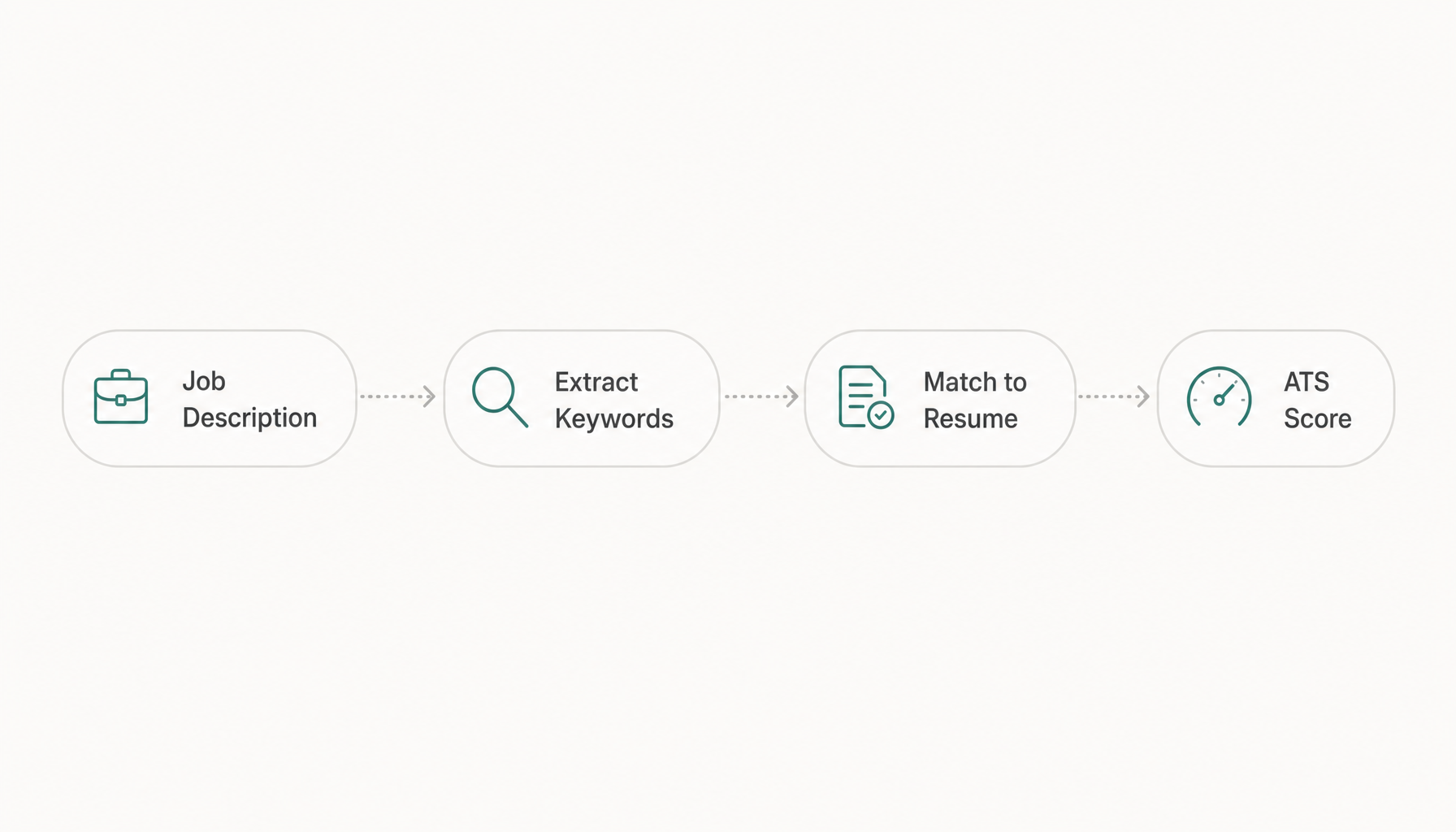
Pull every noun phrase from the job description that represents a skill, tool, or responsibility. I typically find 12–20 distinct keywords per posting. These are the terms your resume must contain—naturally, not stuffed into white text.
Step 3: Mirror the Job's Language in Your Summary and Skills Section
Your resume summary (those 2–3 lines at the top) should read like a direct response to the posting. If the job says "B2B SaaS demand generation," don't write "marketing professional with digital experience." Write "B2B SaaS marketer specializing in demand generation and pipeline acceleration."
For your skills section:
- Use the exact phrasing from the job description. If they say "project management," don't write "program management" unless the posting uses both.
- Organize skills into categories that mirror the job's priority order. Lead with what they emphasize most.
- Drop skills irrelevant to this role. Your proficiency in Adobe InDesign doesn't help a data engineering application.
This isn't deception—it's translation. You're ensuring the ATS and the hiring manager recognize your qualifications in their vocabulary.
Step 4: Reorder and Rewrite Bullet Points to Match the Role's Priorities
This is where most people stop too early. Tailoring your resume means more than swapping keywords into your summary—it means restructuring your experience section.
Reorder: Put bullet points addressing the role's top priorities first under each job. Recruiters read top-down. If the role prioritizes "client relationship management" but your first three bullets cover internal reporting, you've buried the lead.
Rewrite: Transform generic accomplishments into targeted ones.
- Before: "Managed a team of 5 and delivered projects on time"
- After: "Led cross-functional team of 5 through agile sprint cycles, delivering 12 product launches on schedule with 98% stakeholder satisfaction"
The second version works for a product management role because it mirrors language the job description likely uses: "cross-functional," "agile," "product launches," "stakeholders."
Quantify everything. Numbers survive ATS filters and catch human eyes.
Step 5: Adjust Your Job Title and Headline to Align With the Posting
If your actual title was "Client Success Ninja" but the role you're applying for is "Customer Success Manager," use a format like:
Customer Success Manager (internal title: Client Success Ninja)
Or simply use the industry-standard equivalent. Recruiters search ATS databases by job title. If yours doesn't match, you won't appear in searches even after you've applied.
Your LinkedIn headline and resume headline should also reflect the target role's language. "Senior Marketing Manager | B2B SaaS | Demand Generation & ABM" tells both humans and algorithms exactly what you do.
Step 6: Trim What's Irrelevant (Less Is More When Tailoring)
Every line on your tailored resume should serve one purpose: proving you can do this specific job. Anything else is noise.
Cut ruthlessly:
- Skills you have but the role doesn't need — Remove them entirely for this version
- Bullet points about irrelevant achievements — That event you planned doesn't belong on a data analyst application
- Old roles with no connection — Your 2009 retail job can shrink to one line or disappear if you have 10+ years of relevant experience
- Objective statements — Replace with a targeted summary
I've seen candidates go from two-page generic resumes to tight one-page tailored versions that tripled their callback rate. Density of relevance beats volume of history.
How to Tailor Your Resume Faster Without Starting From Scratch Each Time
Build a "master resume" — a 3–4 page document containing every role, every bullet point, every skill you've ever used. This is your internal reference, not something you send.
For each application:
- Duplicate the master
- Run through steps 1–6 using the job description as your filter
- Delete everything that doesn't serve this role
- Reorder what remains
- Adjust language to match
This process takes 15–20 minutes once you've practiced it. You're not writing new content—you're selecting and adapting existing content. Most professionals can realistically tailor 2–3 resumes per day at this pace, which is enough for a focused job search targeting quality over quantity.
Common Tailoring Mistakes That Hurt Your Chances
Keyword stuffing: Repeating "project management" 14 times doesn't help. ATS systems flag unnatural repetition, and humans notice immediately.
Tailoring only the summary: If your bullet points still describe a different role's responsibilities, the summary becomes a hollow promise.
Lying about skills you don't have: Tailoring means presenting real experience in relevant language. Claiming proficiency in Kubernetes when you've never used it will collapse in a technical screen.
Ignoring the "preferred" qualifications: These aren't throwaway lines. They're often what separates shortlisted candidates from the first-round pile. Include them if you genuinely have them.
Using one tailored version for similar-sounding roles: "Marketing Manager" at a 50-person startup versus a Fortune 100 company requires completely different emphasis. Read each posting individually.
How to Know If Your Tailored Resume Is Actually Working
Tailoring without validation is guessing. You need a feedback loop.
Track your numbers: If you're tailoring properly and applying to roles you're genuinely qualified for, expect a 15–25% interview callback rate. Below 10%? Your tailoring isn't hitting the mark.
Try our free ATS Resume Checker to see how your resume stacks up.
Try our free Job Keyword Scanner to see how your resume stacks up.
Test against the job description: Not sure if your changes actually moved the needle? Paste the job description into Resume Inspector — free, no signup needed — and you'll see your fit score plus exactly which keywords are still missing. Takes under a minute. That immediate feedback tells you whether to send or keep editing.
A/B test versions: When two similar roles are open, try different emphasis in your summary or skills order. Track which version gets responses.
The goal is a repeatable system: decode, tailor, validate, send. Each cycle takes less time than the last as you build pattern recognition for what different roles actually want.
Want to gut-check your next tailored resume before you hit apply? Paste any job description into the free analysis tool and see exactly where your resume matches—and where it doesn't—in under 60 seconds. No signup required.