How to Write a Cover Letter That Actually Gets Read (Step-by-Step Guide)
I reviewed thousands of cover letters during my years as a recruiter. Most of them blurred together within seconds. Not because the candidates were unqualified — but because they wrote cover letters for an imaginary audience instead of the actual person scanning applications at 4:47 PM on a Tuesday.
Here's how to write a cover letter that survives that scan and earns a real read.
What Hiring Managers Actually Want From a Cover Letter
Hiring managers don't want your autobiography. They don't want a restatement of your resume. They want the answer to one question: "Why should I interview this person for this specific role?"
That's it. Every sentence in your cover letter should build toward that answer. When I was hiring for a marketing manager role, the letters that stood out weren't the longest or most polished — they were the ones that referenced our actual campaign challenges and explained how the candidate had solved similar problems elsewhere.
What gets a cover letter read:
- A clear connection between your experience and their stated needs
- Evidence you've researched the company beyond skimming the About page
- Specificity — numbers, project names, outcomes
What gets it skipped:
- Generic enthusiasm ("I'm passionate about this opportunity!")
- A paragraph restating your resume's work history section
- Any version of "I believe I would be a great fit"
Cover Letter Format: The Structure That Works
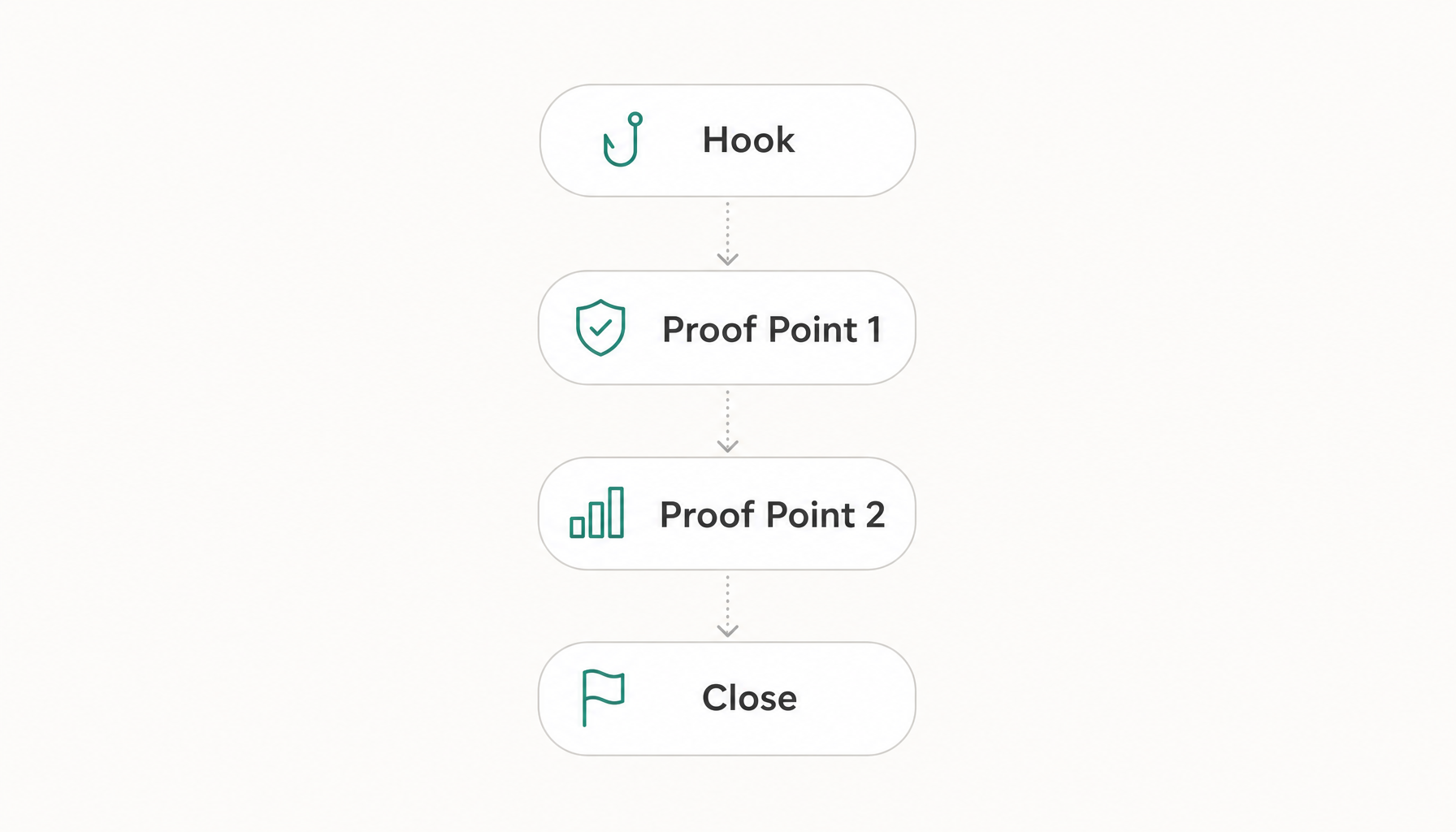
Forget everything you learned about five-paragraph essays. A professional cover letter that works in 2024 follows this structure:
- Opening line — Hook them with relevance (2-3 sentences max)
- Body paragraph 1 — Your strongest proof point connected to their top requirement
- Body paragraph 2 — A second proof point or a demonstration of company knowledge
- Closing — Clear ask, no groveling (2-3 sentences)
Total cover letter length: 250-350 words. That's roughly three-quarters of a page. Anything longer gets skimmed; anything shorter feels like you didn't try.
How to Write a Strong Opening Line (Without "I Am Applying For...")
The opening line is where 90% of cover letters fail. "I am writing to express my interest in the Marketing Manager position" tells the reader nothing they didn't already know. They're holding your application — they know what you applied for.
Instead, open with one of these approaches:
Lead with a result: "In my last role, I grew organic traffic from 12K to 89K monthly visitors in 14 months — and I notice your team is hiring specifically to scale content marketing."
Lead with a connection: "When I saw your VP of Engineering speak at DevCon about reducing deployment time, I knew this was the team I wanted to join — I spent the last two years solving that exact problem at Acme Corp."
Lead with company knowledge: "Your Q3 earnings call mentioned expanding into the European market. I've launched three products in EU markets and navigated GDPR compliance for two of them."
Each of these works because it answers "why you, why here, why now" in the first breath.
The Middle Paragraphs: Connecting Your Experience to the Job
Your body paragraphs are where you make your case. The mistake most people make: they write about themselves instead of writing about the intersection of their experience and the company's needs.
Here's the formula for each body paragraph:
Their need → Your proof → The result
Example: "Your job description emphasizes building cross-functional alignment between product and engineering teams [their need]. At DataFlow, I established a weekly sync process between our 8-person product team and 22 engineers [your proof], which reduced feature miscommunication bugs by 40% over two quarters [the result]."
Don't use more than two body paragraphs. Pick your two strongest proof points — the ones that map most directly to the role's top requirements — and let them carry the weight.
How to Close Your Cover Letter With Confidence
Bad closes beg: "I would be grateful for the opportunity to discuss..."
Good closes assume the conversation will happen:
"I'd welcome the chance to walk you through how I'd approach your Q1 pipeline goals. I'm available for a conversation anytime this week or next."
That's it. State your interest in talking, make it easy to schedule, and stop. No "thank you for your time and consideration" — it's filler, and it ends your letter on a weak, deferential note instead of a confident one.
Tailoring Your Cover Letter to the Job Description (This Is the Part Most People Skip)
Here's the highest-leverage thing you can do: write your cover letter from the job description, not from your resume.
Most people do it backwards. They start with their own experience, then try to make it sound relevant. Flip it. Start by identifying the three most important requirements in the job description, then select experiences that directly address those requirements.
This matters for two reasons:
- Human readers immediately recognize when you're speaking their language — using the same terminology and priorities they used in the posting.
- ATS systems scan cover letters for keyword matches. If the job description says "stakeholder management" and you wrote "working with different teams," you're leaving points on the table.
Before you start writing, try this: paste the job description into Resume Inspector — it's free, no signup needed — and you'll see exactly which keywords and skills are weighted most heavily. Use that as your outline. You'll know which terms to mirror in your cover letter before you write a single sentence.
The tailoring process takes 15-20 extra minutes per application. It's the difference between a 2% response rate and a 15% response rate. I've seen this shift happen repeatedly with candidates I coached.
Common Cover Letter Mistakes to Avoid
Addressing it "To Whom It May Concern" — If you can find the hiring manager's name on LinkedIn (and you usually can), use it. If you genuinely can't, "Dear Hiring Team" works.
Apologizing for what you lack — "Although I don't have direct experience in..." immediately highlights a gap that might not have been a dealbreaker. Never volunteer weaknesses.
Using the same letter for every application — Recruiters can tell. The language is too broad, the connections too vague. A generic cover letter is barely better than no cover letter.
Writing in a different voice than you actually speak — If your letter sounds like a Victorian telegram, the disconnect in the interview will be jarring. Write like a professional version of yourself, not like a template.
Repeating your resume line by line — Your cover letter's job is to contextualize your experience, not restate it. If the hiring manager could get the same information from your resume, the cover letter is wasted space.
Cover Letter Example: Before and After
Before (generic):
Dear Hiring Manager, I am writing to express my interest in the Product Manager position at TechCo. I have 5 years of experience in product management and I believe I would be a great asset to your team. I am passionate about technology and have strong communication skills. I look forward to hearing from you.
After (tailored):
Dear Sarah, Your product team's shift toward PLG caught my attention — I led a similar transition at Rivian's B2B SaaS division, moving from sales-led to product-led growth and increasing free-to-paid conversion by 34% in two quarters. The PM role you've posted emphasizes experimentation velocity and cross-functional alignment. At Rivian, I implemented a testing framework that let us run 3x more experiments per sprint while reducing engineering conflicts through a prioritization system I'd love to tell you about. I'm available for a conversation this week if you'd like to dig into how I'd approach your activation metrics.
The after version is specific, connects to the company's actual situation, includes a measurable outcome, and ends with confidence. It took 10 extra minutes to write.
Try our free Job Keyword Scanner to see how your resume stacks up.
Quick Checklist Before You Hit Send
- Does your opening line reference this specific company or role?
- Have you included at least one quantified result?
- Does your letter mirror 3+ keywords from the job description?
- Is it under 400 words?
- Did you remove every instance of "I believe," "I feel," or "I think"?
- Have you addressed it to a named person (if findable)?
- Does it pass a basic ATS check? (Run your application through a free analysis to see if anything gets filtered before a human sees it.)
- Did you proofread it out loud? (Your ear catches awkward phrasing your eyes skip.)
A strong cover letter won't save a weak resume — but a weak cover letter will sink a strong one. Spend the time. Tailor it. Be specific. The candidates who do this are rare enough that it genuinely stands out.