Cover Letter With No Experience: A Step-by-Step Guide That Actually Gets Responses
You're staring at a blank document, cursor blinking, wondering what you could possibly write in a cover letter when you've never held a "real" job. I've been on the other side of that equation — reviewing 200+ applications per open role as a recruiter — and I need to tell you something that might change how you approach this: the cover letter matters more when your resume is thin. It's not a formality. It's your best shot at controlling the narrative before someone glances at your sparse work history and moves on.
Here's how to write one that actually gets responses.
Why a Cover Letter Matters Even More When You Have No Experience
When a candidate with five years of relevant experience applies, their resume does the heavy lifting. The cover letter is a bonus. For you, it's reversed. Your resume can't carry you yet, so the cover letter becomes your primary argument.
I've seen hiring managers shortlist candidates with zero work history over applicants with two internships — because the cover letter demonstrated clear thinking, genuine interest in the company, and evidence that the person could learn fast. A blank resume with a strong cover letter beats a mediocre resume with no cover letter, every time.
What Hiring Managers Actually Look For in Entry-Level Applicants
Forget what you think they want. Here's what hiring managers are actually evaluating when they read a cover letter for a first job:
- Can this person communicate clearly? If your cover letter is organized and specific, they assume you'll communicate that way on the job.
- Do they understand what this role actually involves? Mentioning specific responsibilities from the job description signals you've done your homework.
- Will they show up and learn? Evidence of commitment — finishing a project, sticking with a volunteer role, completing a course — matters more than the specific context.
- Are they applying here specifically, or everywhere? Generic letters are immediately obvious. One tailored sentence about the company beats three paragraphs of filler.
They are not expecting a polished professional. They're looking for raw signal that you're capable and motivated.
What to Put in a Cover Letter When You Have No Work History
You have more material than you think. Here's what counts as legitimate evidence of capability:
- Academic projects — especially group projects where you held a specific role
- Volunteer work — even sporadic, if you can describe what you did and what happened
- Freelance or informal work — tutoring, selling online, managing a social media account for a local business
- Extracurriculars with responsibility — club leadership, event planning, team captain
- Self-directed learning — certifications, online courses completed (not just started), personal projects
- Relevant coursework — but only if you can connect it to a specific job requirement
The key: never just list these. Attach a result or a skill demonstrated. "Managed social media for the campus environmental club, growing followers from 200 to 1,400 over one semester" is a concrete accomplishment. "Assisted with club activities" is nothing.
How to Structure Your No-Experience Cover Letter (With a Template)
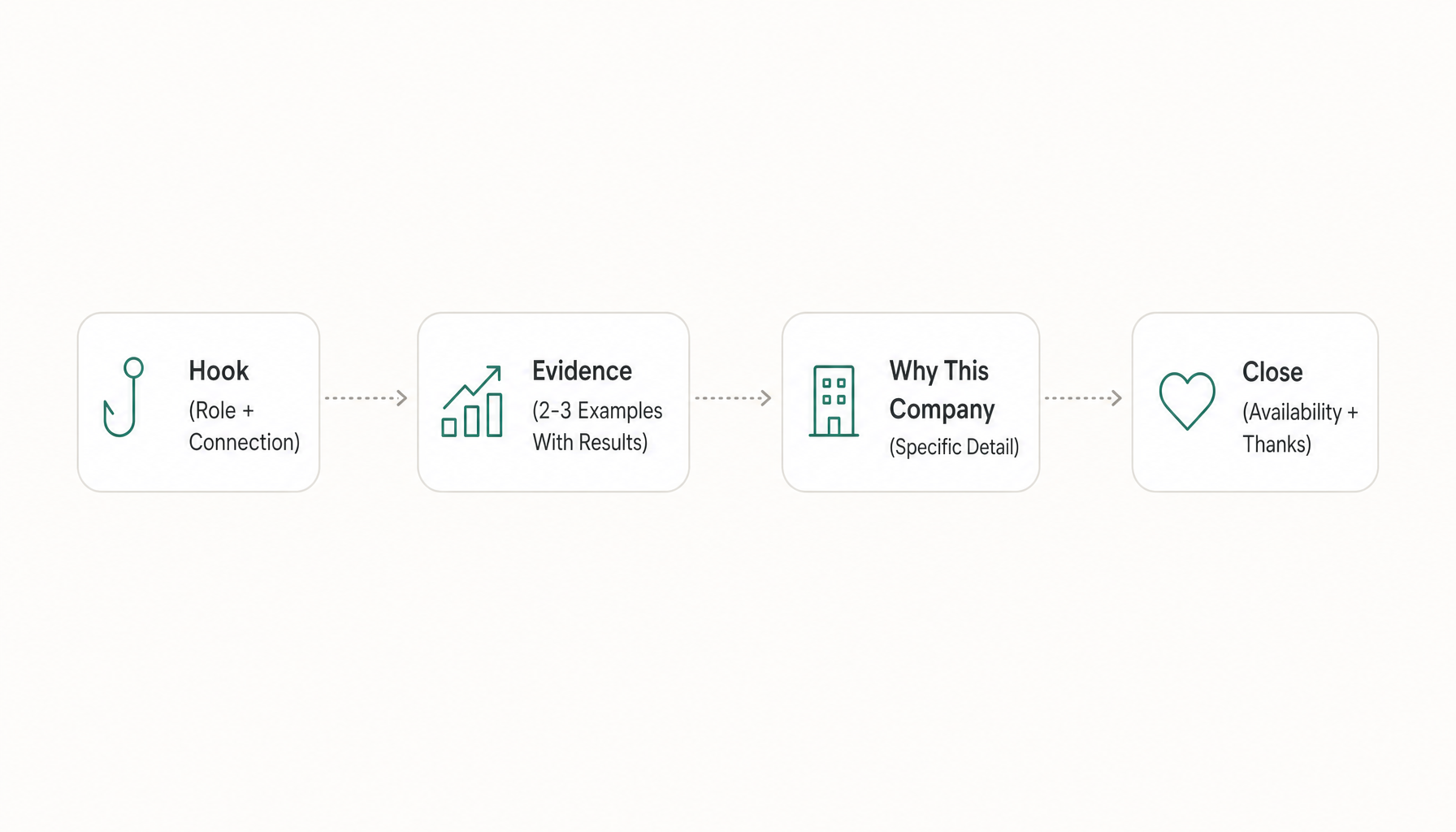
Here's the structure that works for entry-level applicants:
Paragraph 1 — The Hook (2-3 sentences) State the role you're applying for. Then immediately connect one specific thing about you to one specific thing about the role or company. No generic enthusiasm.
Paragraph 2 — Your Evidence (3-5 sentences) Pick 2-3 examples from your non-traditional experience that directly relate to what the job requires. Use the format: what you did → what happened → what skill it demonstrates.
Paragraph 3 — Why This Company (2-3 sentences) Reference something specific about the organization — a recent project, their mission, a product you've used. Explain why that drew you in.
Paragraph 4 — Close (1-2 sentences) Express availability, thank them, and state your interest in next steps.
Template:
Dear [Hiring Manager Name or "Hiring Team"],
I'm applying for the [Job Title] position at [Company]. Your requirement for [specific skill/quality from JD] aligns directly with my experience [brief connection to your background].
[Example 1 with result]. [Example 2 with result]. Through these experiences, I developed [2-3 transferable skills relevant to the role].
I'm drawn to [Company] specifically because [concrete, specific reason — not "you're a great company"]. [One sentence connecting their work to your goals or values].
I'd welcome the chance to discuss how I can contribute to your team. Thank you for your time.
Transferable Skills: Turning Coursework, Volunteering, and Side Projects Into Resume Gold
The phrase "transferable skills" sounds abstract until you see it in practice. Here's how to translate non-traditional experience into language hiring managers recognize:
| What You Did | The Transferable Skill | How to Phrase It |
|---|---|---|
| Led a group research project | Project management, collaboration | "Coordinated a four-person research team over 8 weeks, delivering our presentation on deadline" |
| Tutored classmates in statistics | Teaching, communication, patience | "Explained complex statistical concepts to 12 students, with 10 improving their grades by one letter" |
| Ran a personal blog or YouTube channel | Content creation, consistency, analytics | "Published 40+ articles over 6 months, using Google Analytics to increase organic traffic by 60%" |
| Organized a fundraising event | Event planning, budgeting, stakeholder management | "Planned and executed a charity event for 150 attendees, raising $3,200 against a $2,500 goal" |
Notice the pattern: verb + scope + measurable outcome. This is the same format experienced professionals use on their resumes. You just source it from different contexts.
For more on selecting the right verbs, see this guide to action verbs and power words for resumes.
Common Mistakes That Kill No-Experience Cover Letters
I've rejected hundreds of entry-level cover letters for these reasons:
"I'm a hard worker and a fast learner." Everyone says this. It means nothing without proof. Replace it with a specific example that shows you learn fast.
Apologizing for lack of experience. "I know I don't have much experience, but..." signals insecurity and wastes precious space. The hiring manager already knows your experience level from your resume. Use the cover letter to build your case, not undermine it.
Copying the job description back at them. "You're looking for someone detail-oriented and I am detail-oriented" tells them nothing. Show detail-orientation through a specific example.
Writing more than one page. For an entry-level cover letter, aim for 250-350 words. Anything longer suggests you can't prioritize information.
Using a generic template without customization. If your cover letter could work for 10 different companies, it won't work for any of them.
No-Experience Cover Letter Examples by Job Type
Retail/Customer Service:
"During my two years as a volunteer at the Eastside Community Center, I handled front desk reception three days per week — greeting visitors, answering phones, and resolving scheduling conflicts. This experience taught me to stay patient and solutions-oriented under pressure, which I'm excited to bring to the Customer Associate role at [Store]."
Internship (Marketing):
"For my Digital Marketing course capstone, I developed and executed a social media campaign for a local bakery. Over six weeks, I created 24 posts, A/B tested two content strategies, and increased their Instagram engagement rate from 2.1% to 5.8%. I'm eager to apply this hands-on experience at [Agency] as a Marketing Intern."
Administrative/Office:
"As treasurer of the Accounting Society, I managed a $4,500 annual budget, processed reimbursements for 30+ members, and prepared monthly financial summaries for our faculty advisor. This role required the organizational precision and attention to detail your Administrative Assistant listing describes."
How to Tailor Your Cover Letter to a Specific Job Description
Generic cover letters fail because ATS software and human readers are both scanning for alignment with the specific job posting. Here's the process:
- Read the job description three times. First for overall understanding. Second to highlight required skills and qualifications. Third to note exact phrasing and keywords.
- Mirror their language. If they say "cross-functional collaboration," don't paraphrase it as "working with different teams." Use their exact terminology where it naturally fits.
- Prioritize what they emphasize. Requirements listed first in the posting typically matter most. Address those in your evidence paragraph.
- Reference their specific tools or methods. If they mention Salesforce, Excel, or Agile methodology — and you have any exposure — name it explicitly.
Before you finalize your cover letter, run a quick sanity check: paste the job description into Resume Inspector — it's free, no signup required — and you'll instantly see which keywords from the posting you're missing in your application materials. Takes under a minute and catches gaps you'll miss reading it yourself.
For a deeper dive on matching your language to job postings, check out how to find and use resume keywords from job descriptions.
Try our free Job Keyword Scanner to see how your resume stacks up.
Try our free Job Description Analyzer to see how your resume stacks up.
Final Checklist Before You Hit Send
Run through this before every application:
- Does the first sentence reference the specific role and company?
- Have you included 2-3 concrete examples with measurable results?
- Is the letter under 400 words?
- Did you address the top 3 requirements from the job description?
- Is the company name spelled correctly (seriously — this eliminates more candidates than you'd think)?
- Did you use their exact terminology for key skills?
- Have you removed every instance of "I'm a hard worker" or "I'm a fast learner" without proof?
- Does your cover letter complement your resume rather than repeat it?
- Run your resume and cover letter against the job description to catch missing keywords — free, takes under a minute
- Did you save it as a PDF (unless they specifically request .docx)?
Writing a cover letter with no experience isn't about pretending you have qualifications you don't. It's about presenting the evidence you do have in the format hiring managers are already looking for. You've done more than you think. Now frame it properly, tailor it to each job, and stop apologizing for being new.