Job Hopping on a Resume: How to Frame It So Employers See a Story, Not a Red Flag
You've held four jobs in five years. Maybe six in seven. Every time you open your resume to apply somewhere new, you feel that knot in your stomach: Does this look bad?
Here's the truth most career advice won't tell you — the answer depends less on how many jobs you've held and more on how your resume tells the story of why. And increasingly, the first reader of that story isn't a human at all.
What Actually Counts as Job Hopping in 2026?
There's no universal definition, but here's the working rule most recruiters use: if more than two of your last five roles lasted under 18 months, you'll trigger a mental flag. One short stint? Nobody blinks. Two? They might glance at the context. Three or more in a row? That's where the narrative matters.
Contract roles, startup closures, and layoffs don't carry the same weight as voluntary departures — but only if your resume makes those distinctions clear. A hiring manager scanning quickly won't know you were laid off unless you tell them.
Why Job Hopping Looks Different Than It Did 10 Years Ago
In 2016, staying at a company for two years was considered short. In 2026, median tenure for workers aged 25-34 hovers around 2.8 years according to Bureau of Labor Statistics data. The tech layoff cycles of 2022-2024 normalized involuntary short stints across entire industries. Remote work made lateral moves easier. The gig economy blurred the line between "job" and "engagement."
Recruiters know this. The ones worth working for have recalibrated. But their recalibration still has limits — they need to see career progression, not just career motion.
The Real Reason Recruiters Pause on Short Tenures (It's Not What You Think)
It's not loyalty they're worried about. It's onboarding cost.
A hiring manager who's been burned by a quick departure calculates it this way: 3-6 months to get someone fully productive, another 2-3 months of peak output, then they're mentally checked out and interviewing. That math gives the team maybe 4 months of real contribution from a 12-month employee.
When you frame your short stints, you're really answering one question: Did you actually deliver value in the time you were there, or did the company just absorb the cost of training you?
How to Format a Job Hopper Resume to Lead With Strengths
The functional vs. chronological resume debate comes up constantly for job hoppers. Here's my take after reviewing thousands of resumes: pure functional resumes make recruiters suspicious. They know what you're hiding.
Instead, use a hybrid format:
- Lead with a strong summary that frames your career narrative in 3-4 lines (see resume summary examples)
- Group related short roles under a single heading when they share an industry or function (e.g., "Contract UX Roles, 2023-2025")
- Keep chronological order but let your bullet points do the heavy lifting on impact
- Use years only (not months) for roles where the short tenure isn't the story — though note that some ATS systems and recruiters will ask for months eventually
Which Resume Sections Can Minimize the Appearance of Job Hopping
Your skills section becomes your best friend. A consistent throughline of deepening technical or functional expertise counteracts the visual noise of multiple company names.
What works:
- A "Key Projects" or "Selected Achievements" section near the top that pulls your best results across multiple roles into one block
- A skills section that shows progressive mastery (e.g., you didn't just use Python at three companies — you went from scripting to building ML pipelines)
- Certifications or continuous learning that span multiple tenures, showing intentional development
What doesn't work:
- Hiding roles entirely (background checks catch this)
- Listing every two-month gig as a full position
- Using "Various Companies" as an employer name
How to Write Bullet Points That Justify Short Stints With Results
Every bullet point on a job hopper's resume needs to answer: What did you accomplish in the time you actually had?
Here's a real before/after:
Before: "Managed social media accounts and created content calendars."
After: "Grew Instagram engagement 34% in 4 months by restructuring content calendar around user-generated content — strategy still in use 18 months after departure."
The second version does three things: quantifies impact, acknowledges the short timeframe, and proves lasting value. Use strong action verbs to make these bullets punch above their weight.
For roles under a year, aim for 2-3 high-impact bullets max. Don't pad. Brevity signals confidence.
Job Hopping and ATS: What the Software Flags Before a Human Reads Your Resume
This is the layer most job hoppers never consider, and it might be the most important one.
ATS software doesn't "flag" job hopping the way a human does — it doesn't count your tenures and make a judgment call. But it creates a different problem for frequent job changers:
Keyword dilution. If you've worked across multiple industries or functions, your resume likely contains keywords from several different domains. When you apply to a marketing role but your last three jobs span marketing, product management, and sales enablement, your keyword density for marketing-specific terms drops. The ATS scores you lower because the matching algorithm sees a scattered profile.
Formatting inconsistencies. Multiple short roles mean more date ranges, more company names, more location lines. If your formatting breaks down, the parser misreads your employment history and creates phantom gaps.
Missing role-specific language. Each short stint may have used different terminology for similar work. If the job description says "stakeholder management" and your resume says "cross-functional collaboration" across five different entries, you might not clear the keyword threshold.
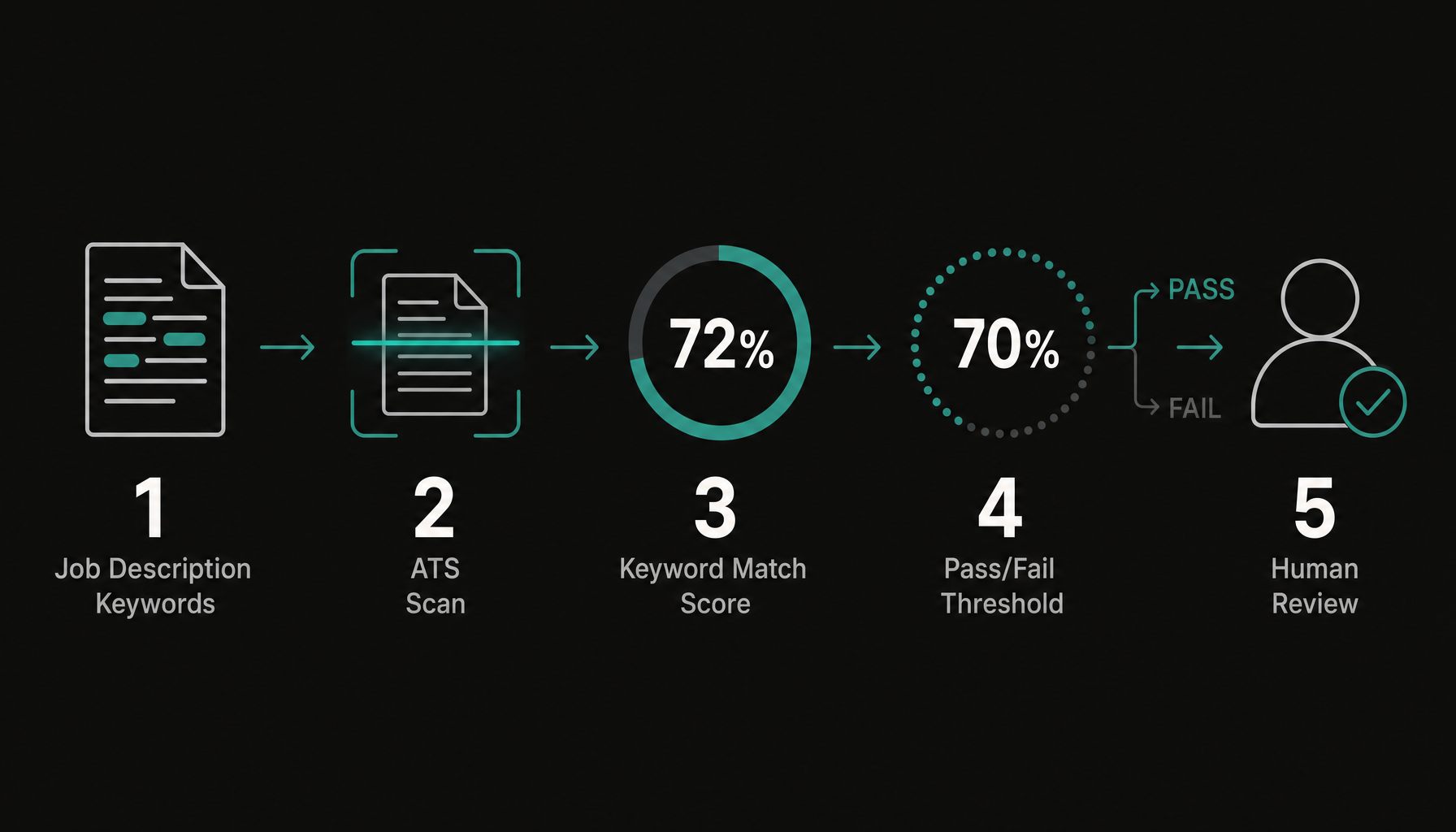
The fix: tailor your resume to each job description by identifying the exact keywords the posting uses and weaving them into your most relevant roles. For job hoppers, this often means emphasizing only 2-3 of your recent positions and minimizing the rest.
Want to see how your resume actually scores against a specific job? Paste any job description into Resume Inspector — it's free, no signup needed — and you'll see exactly which keywords you're missing in under a minute. For job hoppers especially, this is where you catch the keyword dilution problem before a recruiter does.
When to Address Job Hopping in a Cover Letter vs. Letting the Resume Speak
Not every situation requires a cover letter explanation. Here's when you need one:
Address it in a cover letter when:
- You have 3+ moves in under 3 years and you're applying to a role that explicitly mentions "long-term" or "growth"
- Your moves look lateral or downward (you need to explain the upward trajectory isn't visible on paper)
- You're switching industries and the short stints might look like indecision
Let the resume speak when:
- Your moves clearly show progression (title upgrades, bigger companies, larger scope)
- The industry norm is short tenures (startups, agencies, contract-heavy fields)
- Your bullet points already tell the story with quantified results
If you do write a cover letter addressing frequent moves, keep it to one sentence — not a paragraph of apology. Something like: "My path through three high-growth startups in four years gave me an unusual breadth of scaling experience that now makes me especially effective at [specific thing this job needs]." For more on this, see how to write a cover letter that actually gets read.
Red Flags You Can't Fix — and How to Be Honest Without Hurting Your Chances
Some patterns require honesty rather than spin:
- You were fired from multiple roles. Don't lie. Do frame what you learned and how you course-corrected. "The role wasn't the right cultural fit" is acceptable once. Twice requires more specifics about what changed.
- You left roles before completing any meaningful project. You can't fabricate results. Focus on skills applied and what you contributed to in-progress work.
- You have a pattern of quitting within 90 days. This is the hardest to spin. Address it directly in interviews, not on paper. On the resume, these ultra-short stints can sometimes be omitted if they won't surface in a background check.
The key principle: never lie on a resume, but you're allowed to choose what to emphasize. Omitting a 6-week role that ended badly isn't dishonest — it's editorial judgment.
Try our free Job Keyword Scanner to see how your resume stacks up.
Try our free ATS Resume Checker to see how your resume stacks up.
A Quick Checklist Before You Submit Your Job Hopper Resume
Before you hit send on your next application:
- Your summary tells a coherent career story in 3-4 lines — not a timeline, a narrative
- Each role under 18 months has 2-3 bullet points max, focused on measurable outcomes
- You've grouped contract or related short roles where appropriate
- Your skills section shows deepening expertise, not scattered abilities
- You've tailored keywords to this specific job description, not your generic career history
- You've decided whether a cover letter explanation adds value or draws attention to the problem
- You've checked that your formatting parses cleanly through ATS
That last point matters more than you think. Before you submit, run a quick ATS check with the free analysis tool to make sure your formatting and keywords clear the first filter — especially when your employment history formatting is more complex than the average candidate's.
Job hopping isn't the career death sentence it was a decade ago. But it does require you to treat your resume as narrative architecture — every structural choice either builds trust or erodes it. Make the choices intentional, back them with results, and let the story do the work.