What Does ATS Stand For? (And What It Actually Means for Your Job Search)
ATS stands for Applicant Tracking System. That's the short answer. The longer answer—the one that actually matters for your job search—is that this software sits between you and a human recruiter, deciding whether your resume ever gets read by a person.
Let me explain what that means in practice and what you can do about it.
What Does ATS Stand For?
ATS stands for Applicant Tracking System. It's hiring software that companies use to collect, organize, sort, and filter job applications. Think of it as the digital gatekeeper between "Submit Application" and an actual recruiter opening your resume.
Every major ATS—Workday, Greenhouse, Lever, iCIMS, Taleo—does roughly the same thing: it ingests your resume, parses the text into structured data fields, and ranks or filters you based on criteria the recruiter sets. Over 97% of Fortune 500 companies use an applicant tracking system, and adoption among mid-sized companies has surged through 2026 as hiring teams try to manage volume without adding headcount.
When people talk about "beating the ATS" or making an "ATS-friendly resume," they're talking about this layer of software.
How Does an Applicant Tracking System Actually Work?
Here's the actual workflow when you click "Apply":
- Parsing — The ATS extracts text from your uploaded file and maps it to database fields (name, email, job titles, companies, dates, skills, education).
- Storing — Your information lives in a searchable database. Recruiters can pull it up months later using keyword searches.
- Screening — The system applies filters or knockout questions. "Does this person have 3+ years of experience?" "Does this resume mention Python?" If you don't pass, a recruiter may never see your application.
- Ranking — Some systems score candidates by how closely their resume matches the job description's requirements, surfacing the "best matches" first.
- Workflow management — Recruiters move candidates through stages (phone screen, interview, offer) within the same platform.
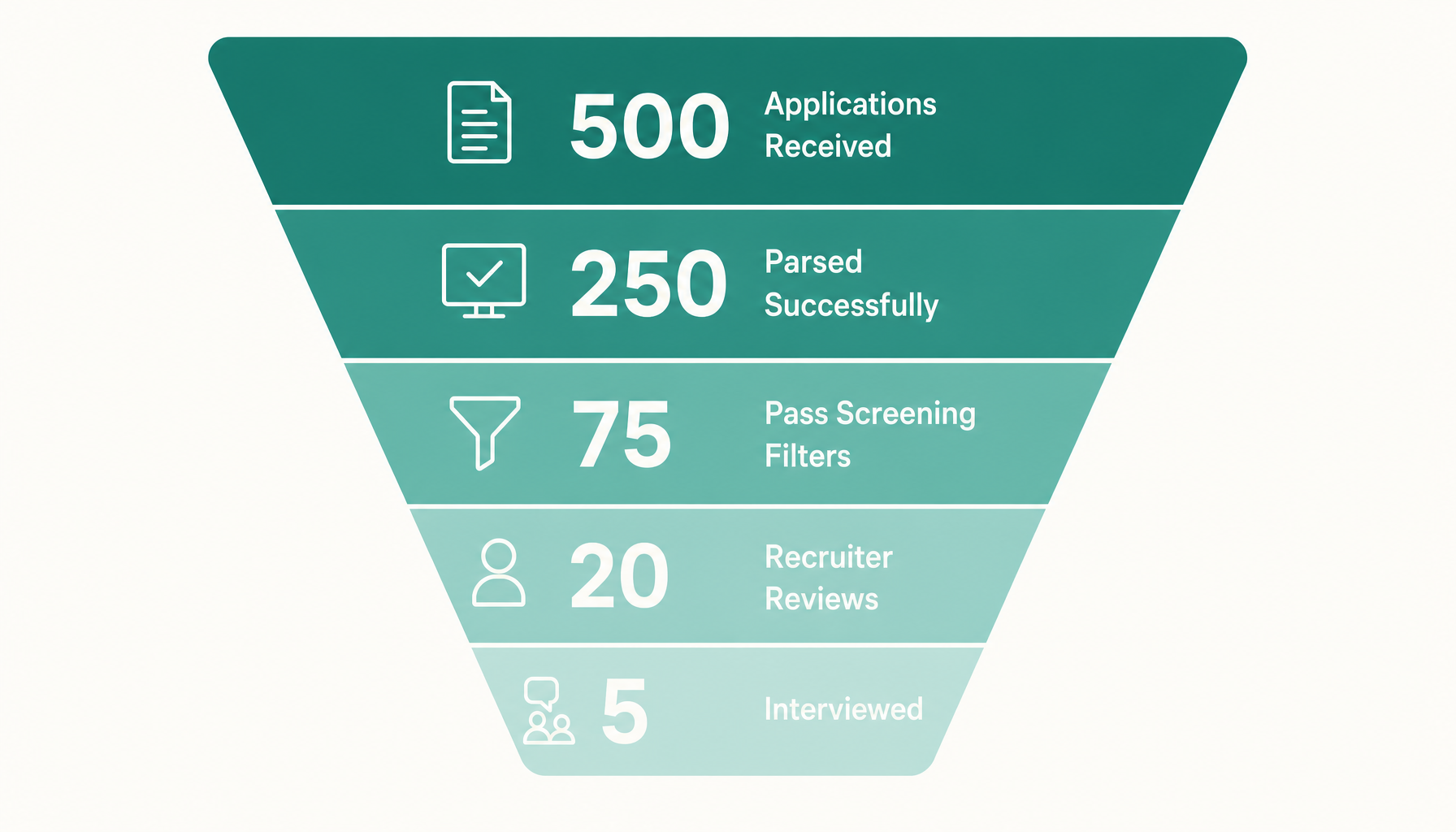
The critical point: steps 1–4 often happen before any human involvement. Your resume is being read by software first.
Why ATS Software Exists (The Recruiter's Perspective)
Recruiters aren't using applicant tracking systems to torture you. A single LinkedIn job post for a mid-level marketing role can generate 400–800 applications in 48 hours. A recruiter managing 25 open roles cannot manually review 15,000 resumes a month.
ATS software exists to:
- Reduce volume to something manageable. If 500 people apply and 300 don't meet minimum qualifications, the system removes them so the recruiter can focus on the 200 who might actually fit.
- Create a searchable talent database. That application you submitted in January? A recruiter can find it in August when a new role opens.
- Ensure compliance. Companies need audit trails for EEOC and OFCCP requirements. ATS software tracks every application and disposition reason.
Understanding this perspective matters because it tells you what the system is optimized for: matching your resume's content against the job description's requirements. It's not trying to be unfair. It's trying to be efficient.
What ATS Software Is Looking For in Your Resume
Resume screening in an ATS typically evaluates:
- Hard skills keywords — Specific tools, technologies, certifications, and methodologies mentioned in the job posting (e.g., "Salesforce," "CPA," "Agile," "SQL")
- Job title alignment — Whether your previous titles suggest relevant experience
- Years of experience — Either parsed from date ranges or inferred from knockout questions
- Education requirements — Degree type, field of study, institution
- Location — Whether you're in the target geography (less relevant for remote roles, still filtered for many others)
The system is doing keyword matching and requirement checking, not evaluating the quality of your writing or the impressiveness of your achievements. That's what the human does after you pass.
This is why resume keywords from the job description matter so much. If the posting says "project management" and you only wrote "managed projects," some systems won't make the connection.
Common Ways Job Seekers Fail ATS Screening Without Knowing It
These are real failure modes I saw repeatedly as a recruiter:
Using graphics, tables, or columns. A two-column resume looks sharp in PDF but many ATS parsers read it as scrambled text. Your "Marketing Manager at Acme Corp" becomes "Marketing Acme Manager Corp" in the database.
Submitting creative file formats. Pages files, Canva exports with embedded images as text, or password-protected PDFs. Stick to .docx or standard PDF.
Stuffing skills in a header or footer. Many parsers skip headers and footers entirely. Your email address and key skills disappear.
Using acronyms without the full term (or vice versa). Write "Search Engine Optimization (SEO)" the first time. The system might only search for one version.
Applying with a generic resume. If the job description mentions "stakeholder management" twelve times and your resume mentions it zero times, the math doesn't work regardless of how qualified you are.
Fancy section headers. "Where I've Made an Impact" instead of "Experience." "My Toolkit" instead of "Skills." The ATS doesn't know what those mean.
For a deeper dive on formatting that won't break parsers, see our guide on ATS resume tips that actually work.
How to Tell If Your Resume Is ATS-Friendly
Here's the fastest test: open your resume in a plain text editor (Notepad on Windows, TextEdit in plain text mode on Mac). If the content reads in logical order—name, contact info, summary, experience, education, skills—and nothing is garbled, scrambled, or missing, you're in reasonable shape.
But that only tells you about formatting. It doesn't tell you whether your resume actually matches a specific job's keywords and requirements.
This is where most job seekers get stuck. You think your resume is a good match because you read the posting and said "yeah, I can do all that." But you never wrote those exact terms on your resume.
Want to know exactly where the gaps are? Paste any job description into Resume Inspector—it's free, no signup needed—and you'll see which keywords you're missing and how well your resume actually scores against that specific role. Takes about 60 seconds.
ATS vs. Human Review: What Happens After You Pass the Filter
Passing the ATS isn't the finish line. It gets you to the starting line.
Once your application clears the screening filters, here's what typically happens:
- Recruiter skim (6–8 seconds). They're scanning for: relevant title, recognizable company, quantified results, career trajectory. This is where your resume summary and strong action verbs earn their keep.
- Deeper read (30–60 seconds). If the skim passes, they read your most recent 2–3 roles looking for specific evidence you can do this job.
- Decision. Phone screen, reject, or "maybe later" pile.
The implication: your resume needs to satisfy two audiences with different priorities. The ATS wants keywords and structure. The human wants clarity, results, and a coherent narrative. You need both.
Quick Answers: ATS FAQs Job Seekers Actually Ask
Is ATS the same as AI screening? Not exactly. Traditional ATS systems use keyword matching and Boolean filters—they're databases, not intelligence. However, in 2026, many platforms (like HireVue and Eightfold) layer AI on top of the ATS for predictive scoring. The practical advice remains the same: match the job description's language.
Do small companies use ATS software? Increasingly, yes. Free or low-cost options like Breezy HR and JazzHR mean even 20-person companies may use resume parsing. Assume every online application goes through some form of tracking software.
Can I trick the ATS by hiding keywords in white text? Don't. Modern systems detect this, and even if they didn't, a recruiter will eventually see your resume. Hidden keyword stuffing is an instant rejection when caught.
Does the ATS reject me, or does the recruiter? Both can. The system filters you out automatically if you fail knockout criteria. But even candidates who pass the ATS may never get reviewed if the recruiter finds enough qualified people in the first batch they see.
Should I use a .docx or PDF? In 2026, most major systems parse both formats well. However, if you're applying through older platforms (Taleo, older versions of iCIMS), .docx remains the safer choice. When in doubt, submit .docx.
Does tailoring my resume for each job really matter? Yes, and the data is unambiguous. A resume tailored to the specific job description scores dramatically higher in ATS screening than a generic one. One resume for fifty applications is the most common reason qualified candidates hear nothing back.
Try our free Job Keyword Scanner to see how your resume stacks up.
Try our free Job Description Analyzer to see how your resume stacks up.
Before your next application, take 60 seconds to see how your resume actually stacks up. Paste the job description into Resume Inspector and get a free fit analysis showing exactly what's missing—no signup, no commitment, just clarity on whether you'll make it past the filter.