Resume vs CV Difference: A Plain-English Guide (With Real Examples)
You've found a job posting that says "submit your CV/resume" and you're staring at the screen wondering if these are the same thing. They're not. Here's the clear answer.
Resume vs CV: The One-Sentence Answer
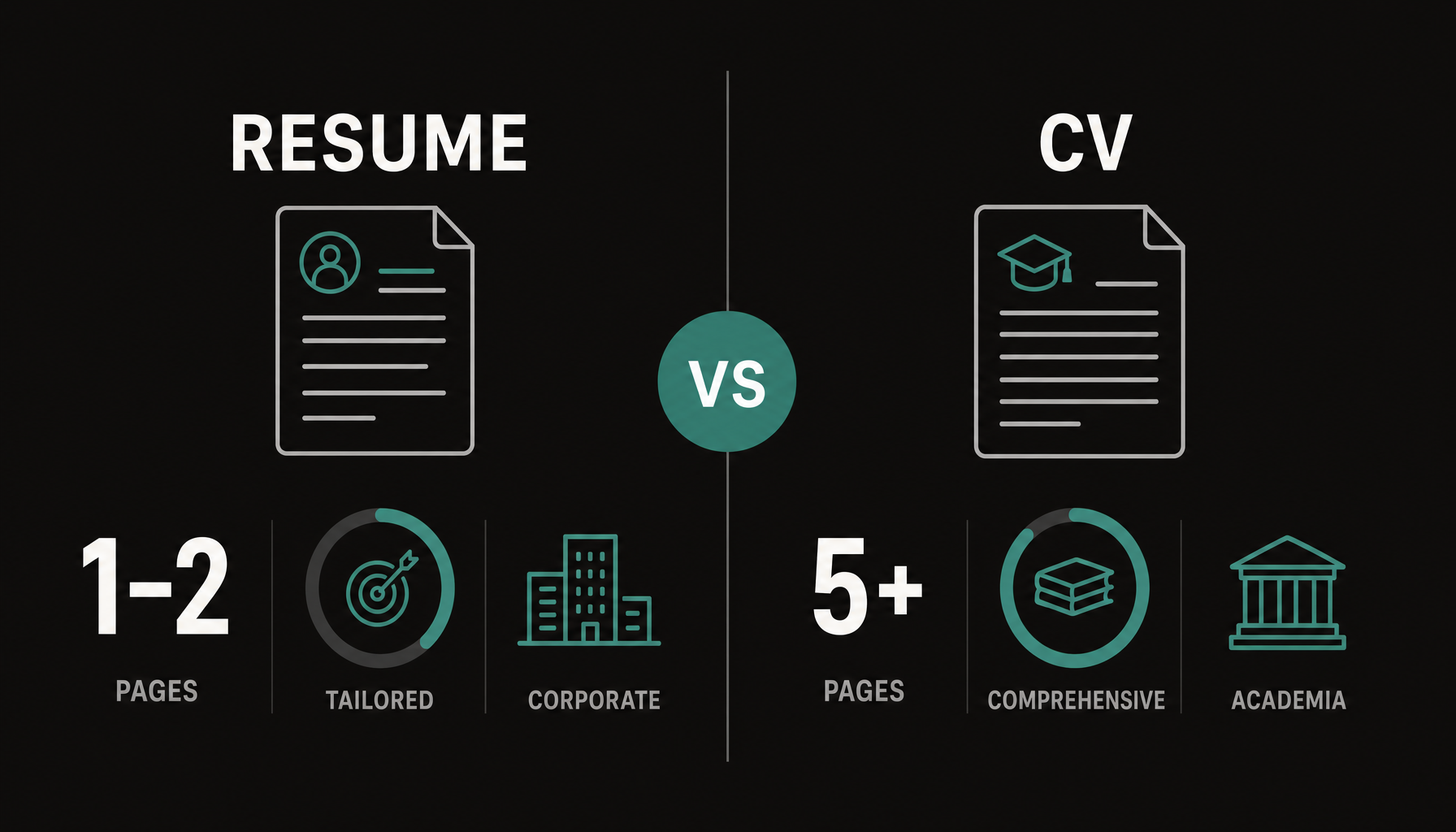
A resume is a 1–2 page marketing document tailored to a specific job, while a CV (curriculum vitae) is a comprehensive record of your entire academic and professional history with no page limit.
That's it. Everything else — formatting, content, when to use which — flows from that single distinction.
What Is a Resume? (Definition, Length, Purpose)
A resume is a targeted summary of your qualifications designed to get you an interview for a specific role. It's curated, not comprehensive.
Key characteristics:
- Length: 1 page for early-career professionals, 2 pages for 10+ years of experience
- Purpose: Convince a hiring manager you're the right fit for this job
- Content: Only includes experience, skills, and achievements relevant to the target role
- Customization: Changes for every application (or at least every type of role)
A marketing manager applying to a SaaS company would cut their retail management experience from six years ago. A resume is selective by design.
What Is a CV? (Definition, Length, Purpose)
A CV — short for curriculum vitae, Latin for "course of life" — is an exhaustive document covering your full academic career, research, publications, presentations, grants, and teaching history.
Key characteristics:
- Length: 3–10+ pages (a tenured professor's CV might run 30 pages)
- Purpose: Document every professional contribution in your field
- Content: Publications, conference presentations, grants awarded, courses taught, committee service, research projects
- Customization: Rarely changes beyond adding new entries; you don't delete old publications
A postdoctoral researcher applying for a faculty position at a university would submit a CV listing every paper, every conference talk, every grant. Nothing gets cut.
Resume vs CV: Side-by-Side Comparison Table
| Feature | Resume | CV |
|---|---|---|
| Length | 1–2 pages | No limit (3–30+ pages) |
| Content scope | Tailored to target job | Complete career record |
| Customization | High — rewritten per application | Low — add new items chronologically |
| Used for | Industry/corporate jobs | Academia, research, medicine, grants |
| Format | Flexible (chronological, functional, hybrid) | Strict chronological within sections |
| Publications section | Rarely included | Required |
| ATS screening | Almost always | Sometimes (academic job portals vary) |
| Photo | Never (in the U.S.) | Depends on country |
When to Use a Resume vs a CV
Use a resume when:
- Applying to any private-sector job in the U.S. or Canada
- Submitting through an online applicant tracking system
- The posting says "resume" (obviously)
- You're applying to startups, agencies, or corporate roles regardless of seniority
Use a CV when:
- Applying for academic faculty positions
- Applying for research grants (NSF, NIH, ERC)
- Applying for postdoctoral fellowships
- Applying for medical residency programs
- The posting explicitly says "CV" and it's in academia or research
- Applying for roles outside North America (see next section)
Real example: A PhD in biochemistry applying for a Research Scientist role at Pfizer submits a 2-page resume. That same person applying for an Assistant Professor position at Johns Hopkins submits a 7-page CV. Same person, same qualifications, different documents.
Does the Difference Change by Country?
Yes, dramatically. This is where most people get confused.
United States & Canada: Resume for industry, CV for academia. Clear split.
United Kingdom, Ireland, & New Zealand: "CV" means what Americans call a "resume." It's 2 pages, tailored to the job, and submitted for all roles. Nobody says "resume" in everyday usage.
Australia: Same as the UK — "CV" is their word for a standard job application document, typically 2–3 pages.
Continental Europe (Germany, France, Netherlands): "CV" refers to a 1–2 page document similar to an American resume. Many EU countries also expect a photo, date of birth, and nationality — things that would be illegal to require in the U.S.
India: Both terms are used interchangeably for a 2–3 page document.
The practical rule: If a UK-based company asks for your "CV," send a 2-page targeted document — not a 15-page academic history. Context is everything.
What Goes in Each: Content Breakdown
Resume sections (typical order):
- Contact information
- Professional summary or headline
- Work experience (most relevant only)
- Skills section
- Education
- Certifications (if relevant)
For guidance on structuring these sections effectively, see how to tailor your resume to any job description.
CV sections (typical order):
- Contact information
- Research interests
- Education (including dissertation title)
- Academic appointments
- Publications (peer-reviewed, book chapters, etc.)
- Presentations & conferences
- Grants & fellowships
- Teaching experience
- Service & committee work
- Professional memberships
- References
Notice the CV has no "skills section" with bullet points. Your skills are demonstrated through your body of work.
Common Mistakes People Make Mixing Them Up
Mistake 1: Submitting a 5-page CV to a corporate recruiter. A hiring manager at Deloitte receiving a document that lists every conference presentation from 2017 will assume you don't understand the business world. They'll likely pass.
Mistake 2: Submitting a 1-page resume for a faculty position. A search committee needs to see your full publication record, teaching philosophy evidence, and grant history. A summary won't cut it.
Mistake 3: Calling a 2-page targeted document a "CV" in the U.S. Some people think "CV" sounds more professional. In the American context, calling your resume a CV signals that you might not know the difference — which isn't the impression you want.
Mistake 4: Using a resume template for a CV. Two-column designs, infographic layouts, and heavy formatting that work on a resume will break academic CV conventions. CVs use plain formatting: single column, clear headings, no graphics.
How to Know Which One a Job Posting Is Actually Asking For
When the posting is ambiguous — "please submit your CV/resume" — use these three signals:
1. Look at the employer type. University, research institute, teaching hospital, government research lab → CV. Everything else → resume.
2. Check what they're asking for alongside it. If they want a "research statement," "teaching philosophy," or "publication list," they want a CV. If they want a "cover letter" and ask about "years of experience," they want a resume. Here's a guide on how to write a cover letter if that's what you need.
3. Look at the submission system. If it's Workday, Greenhouse, Lever, or iCIMS — it's a resume. These are ATS platforms built for corporate hiring. If it's Interfolio or a university HR portal with fields for "publications," it's a CV.
When genuinely unsure: Default to a resume if the role is in the private sector. You can always provide additional materials if asked.
Regardless of which format you choose, keyword alignment with the job description still matters. A quick way to check: paste the job description into Resume Inspector and see which terms you're missing. It's free and takes under a minute.
Quick Checklist Before You Submit Either One
If submitting a resume:
- Is it 1–2 pages maximum?
- Is every bullet point relevant to this specific job?
- Does it include keywords from the job description?
- Is the format ATS-compatible (no tables, no headers/footers, standard fonts)?
- Did you write a tailored summary at the top?
If submitting a CV:
- Are all publications listed in proper citation format?
- Is every section in reverse chronological order?
- Did you include your dissertation/thesis title under education?
- Are grants listed with funding amounts and agency names?
- Is the formatting plain and consistent (no fancy templates)?
For both:
- Contact info is current and professional
- No typos (read it backwards, paragraph by paragraph)
- File is saved as PDF unless the posting specifies .docx
- Filename includes your name (not "Resume_final_v3.pdf")
Try our free Job Keyword Scanner to see how your resume stacks up.
Try our free Job Description Analyzer to see how your resume stacks up.
Now that you've picked the right format, make sure the content actually matches what the employer is looking for. Paste the job description into Resume Inspector — no signup required — and you'll see your keyword fit score in under a minute. Whether you're submitting a one-page resume or a ten-page CV, the words still need to align with what the hiring committee or ATS is scanning for.