How to Write a Resume for a Career Change (That Actually Gets Interviews)
Switching careers feels like trying to get hired for a job you haven't done yet — because that's exactly what it is. The resume that landed your current role won't get you into the next one. I've seen thousands of career changers make the same mistake: they dust off their old resume, slap a new objective at the top, and wonder why they never hear back.
A resume for a career change requires a fundamentally different strategy. Here's how to build one that actually works.
Why a Standard Resume Won't Cut It for a Career Change
A chronological resume — the kind most people default to — tells a linear story. For someone climbing a ladder within one industry, that's perfect. For someone switching industries, it's a liability.
When a hiring manager for a marketing role sees five years of nursing experience listed chronologically, their brain immediately files you as "wrong fit." They don't have the time or motivation to decode how your patient education work translates to content strategy.
The problem compounds at the ATS level. If you're pivoting from teaching to instructional design, your old resume is packed with keywords like "classroom management" and "lesson planning" — terms that won't match a single requirement in an L&D job description. The system rejects you before a human ever sees your name.
A career change resume needs to do three things your old one doesn't:
- Lead with relevance, not chronology
- Translate your experience into the new industry's language
- Match the specific keywords an ATS is scanning for
Choose the Right Resume Format for Switching Careers
The "right format" depends on how far you're jumping. Here's the decision logic:
Adjacent pivot (e.g., sales rep → account manager, journalist → content marketer): Use a hybrid resume format. Keep your work history prominent but lead each role with bullets that emphasize transferable accomplishments. Your timeline still tells a coherent story — you just need to reframe it.
Full industry switch (e.g., accountant → UX designer, teacher → software developer): Use a skills-based resume structure. Place a robust skills section and project portfolio above your work history. Your job titles will initially confuse readers, so you need to establish credibility through demonstrated capabilities first.
Recent grad or early career (under 3 years of experience): Use a hybrid format with heavy emphasis on education, certifications, and side projects. You don't have enough work history to worry about — lean into what you've been building toward.
One format I'd avoid entirely: the pure functional resume that eliminates dates and company names. Recruiters know that trick, and it triggers suspicion rather than curiosity.
How to Identify and Frame Your Transferable Skills
Transferable skills aren't soft platitudes like "hard worker" or "team player." They're specific, demonstrable capabilities that apply across contexts.
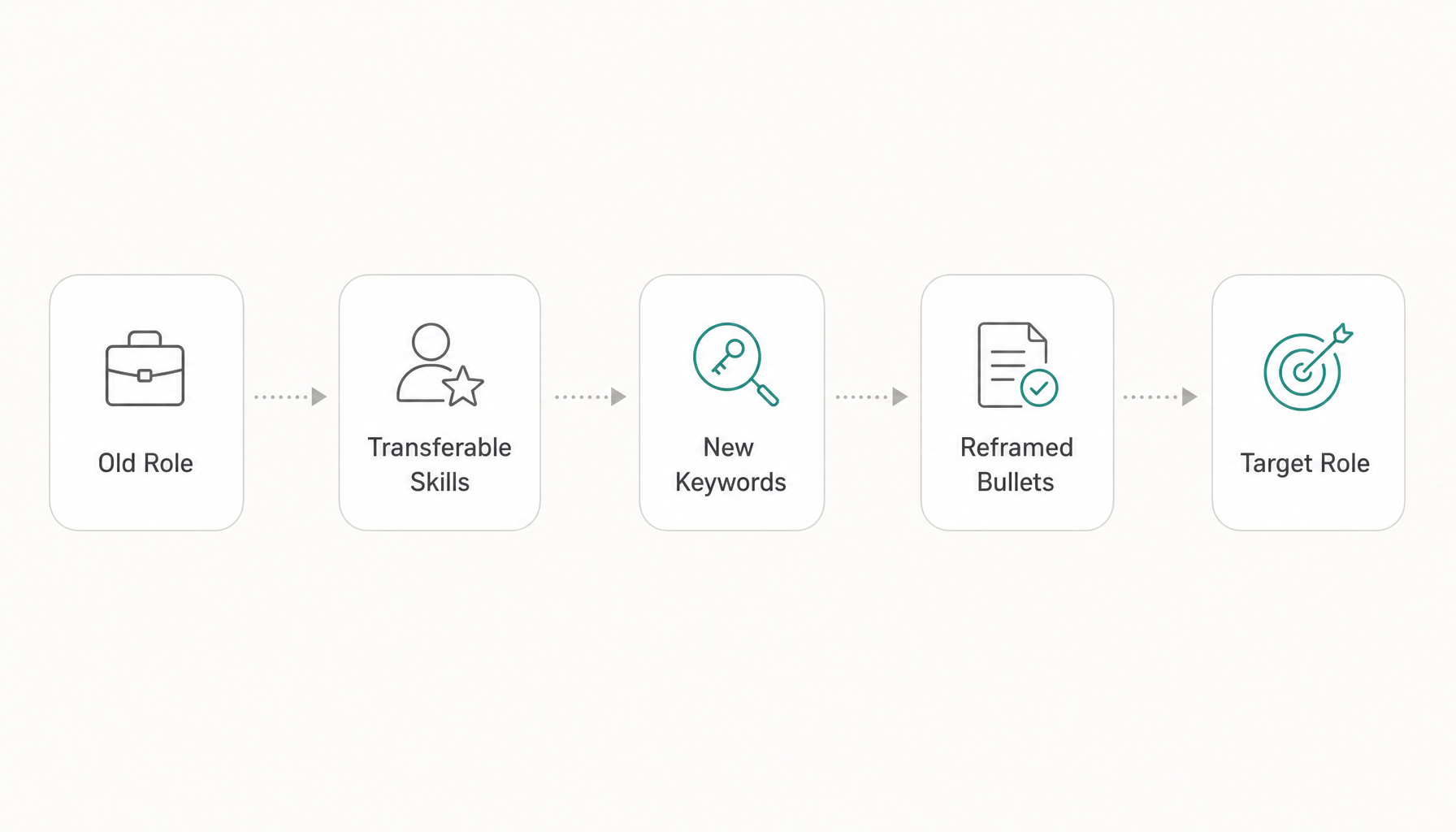
Here's my process for finding yours:
Step 1: Pull up three job descriptions for your target role. Highlight every skill, tool, or competency mentioned more than once.
Step 2: For each highlighted item, ask: "Have I done something equivalent, even in a different context?" A project manager who coordinated 15 cross-functional stakeholders has the same skill as a wedding planner who managed 12 vendors for 200-person events.
Step 3: Rewrite your experience using the target industry's language. Don't say "managed patient intake workflow." Say "designed and optimized a client onboarding process handling 40+ cases daily" — if you're targeting operations roles.
Real example: A teacher pivoting to corporate training shouldn't write "Taught 9th grade biology." They should write "Designed and delivered curriculum for groups of 30+, achieving 92% knowledge retention measured through quarterly assessments."
Not sure if you're framing the right skills? Paste any job description into Resume Inspector and get a free fit score in under a minute — it'll show you precisely what the employer's ATS is looking for.
Writing a Career Change Resume Summary That Hooks Hiring Managers
Forget the resume objective statement ("Seeking a position in marketing where I can leverage my skills..."). That tells the employer what you want. They care about what you bring.
A career change resume summary should accomplish three things in 2-3 sentences:
- Establish your identity in the new field (not the old one)
- Quantify a relevant accomplishment
- Name a specific skill that bridges both worlds
Weak: "Experienced teacher looking to transition into corporate training and development."
Strong: "Instructional designer with 6 years of curriculum development experience. Built assessment frameworks that improved learner outcomes by 34% across 500+ students annually. Certified in Articulate 360 and adult learning methodology."
Notice: the strong version never mentions "teacher" or "classroom." It positions the candidate as an instructional designer by leading with the relevant identity and proof.
For your resume summary, borrow the exact language from your target job descriptions. If they say "stakeholder management," don't write "worked with different departments." Mirror their terminology.
How to Tailor Your Work Experience for a New Industry
You don't need to fabricate experience. You need to edit ruthlessly and translate accurately.
Rule 1: Cut anything that doesn't serve the new role. That impressive accomplishment in your old field? If it doesn't connect to the target role, it's noise. A nurse pivoting to healthcare consulting doesn't need to list every clinical procedure — but should highlight process improvement, data analysis, and cross-team coordination.
Rule 2: Rewrite bullets using the target role's vocabulary. Pull keywords directly from job descriptions. If the posting says "data-driven decision making" and you used metrics to improve outcomes in your old role, use their exact phrasing.
Rule 3: Quantify everything. Numbers transcend industries. "Increased efficiency by 28%" means something whether you're in logistics or marketing.
Before (financial analyst → product manager pivot):
- "Created financial models and forecasts for quarterly reporting"
After:
- "Translated complex data sets into actionable product recommendations, influencing $2M in resource allocation decisions"
Same experience. Completely different framing. The second version speaks product management.
Education, Certifications, and Side Projects: Your Secret Weapons
When your job titles don't match your target role, these sections carry disproportionate weight:
Certifications signal intentionality. A Google Analytics certificate on a career changer's resume tells me they're serious about digital marketing — not just fantasizing about it. Relevant certifications to consider: Google Certificates, HubSpot Academy, AWS/Azure certs, PMP, specific bootcamp completions.
Side projects demonstrate capability without requiring employment history. Built a website? That's web development experience. Managed a nonprofit's social media? That's marketing experience. Freelanced on three data analysis projects? List them like jobs.
Education gets promoted above work experience when it's more relevant than your employment history. If you just completed a UX bootcamp but your work history is all retail management, lead with education.
Format these sections with the same rigor as your work experience — quantify outcomes, use strong action verbs, and mirror the job description's language.
Common Career Change Resume Mistakes to Avoid
Apologizing for the pivot. Phrases like "although my background is in..." or "despite not having direct experience..." signal weakness. State what you bring. Period.
Keeping irrelevant details for "completeness." Nobody switching to data science needs to list their barista experience from 2018 unless they can quantify inventory management or something directly relevant.
Using one generic resume for every application. This kills career changers faster than anyone. Each application needs tailored keywords from that specific job description. A resume for a "Product Manager" role at a fintech company needs different language than one for a "Product Manager" at an edtech startup.
Ignoring the cover letter. A career change resume raises questions. A strong cover letter answers them — specifically why you're making this move and what you uniquely bring from your previous world.
How to Check If Your Career Change Resume Will Pass ATS
You've done the hard work: chosen your format, identified transferable skills, rewritten every bullet in your target industry's language. Now you need to validate it.
Career changers face a unique ATS challenge. Because your background is in a different field, you're statistically more likely to miss critical keywords that someone already in the industry would include instinctively. A marketing resume from a marketer naturally contains "campaign performance," "conversion rate," and "A/B testing." Yours might not — even after careful tailoring.
Try our free Job Keyword Scanner to see how your resume stacks up.
Try our free ATS Resume Checker to see how your resume stacks up.
Before you send that first application, paste the job description into Resume Inspector — it's free, no credit card needed — and see exactly which keywords your resume is missing and how well it matches the role. You'll get a fit score showing gaps you'd never catch by eyeballing it. For career changers especially, that gap between "what you wrote" and "what the ATS expects" is where applications go to die. Close it before you hit submit.