What to Wear to a Job Interview in 2026: A Practical Guide for Every Industry
You've landed the interview. Now you're standing in front of your closet wondering if a blazer is too formal or if jeans will torpedo your chances. The answer depends entirely on where you're interviewing, how you're interviewing, and what signals you want to send before you say a single word.
Here's exactly how to figure it out.
Why Interview Dress Codes Have Shifted (and What That Means for You in 2026)
The pandemic-era dress code reset wasn't temporary — it compounded. Remote work normalized casual attire. Hybrid schedules blurred the line between "office" and "home." And company cultures that were already trending informal (tech, startups, creative agencies) pushed even further toward "wear what makes you productive."
But here's what actually changed for interviews specifically: hiring managers in 2026 evaluate fit more holistically. A McKinsey recruiter still expects tailored suiting. A Series B startup founder might distrust someone who shows up overdressed — it reads as "doesn't get our culture."
The rule isn't "dress up" or "dress down." It's dress accurately for the environment you're trying to enter.
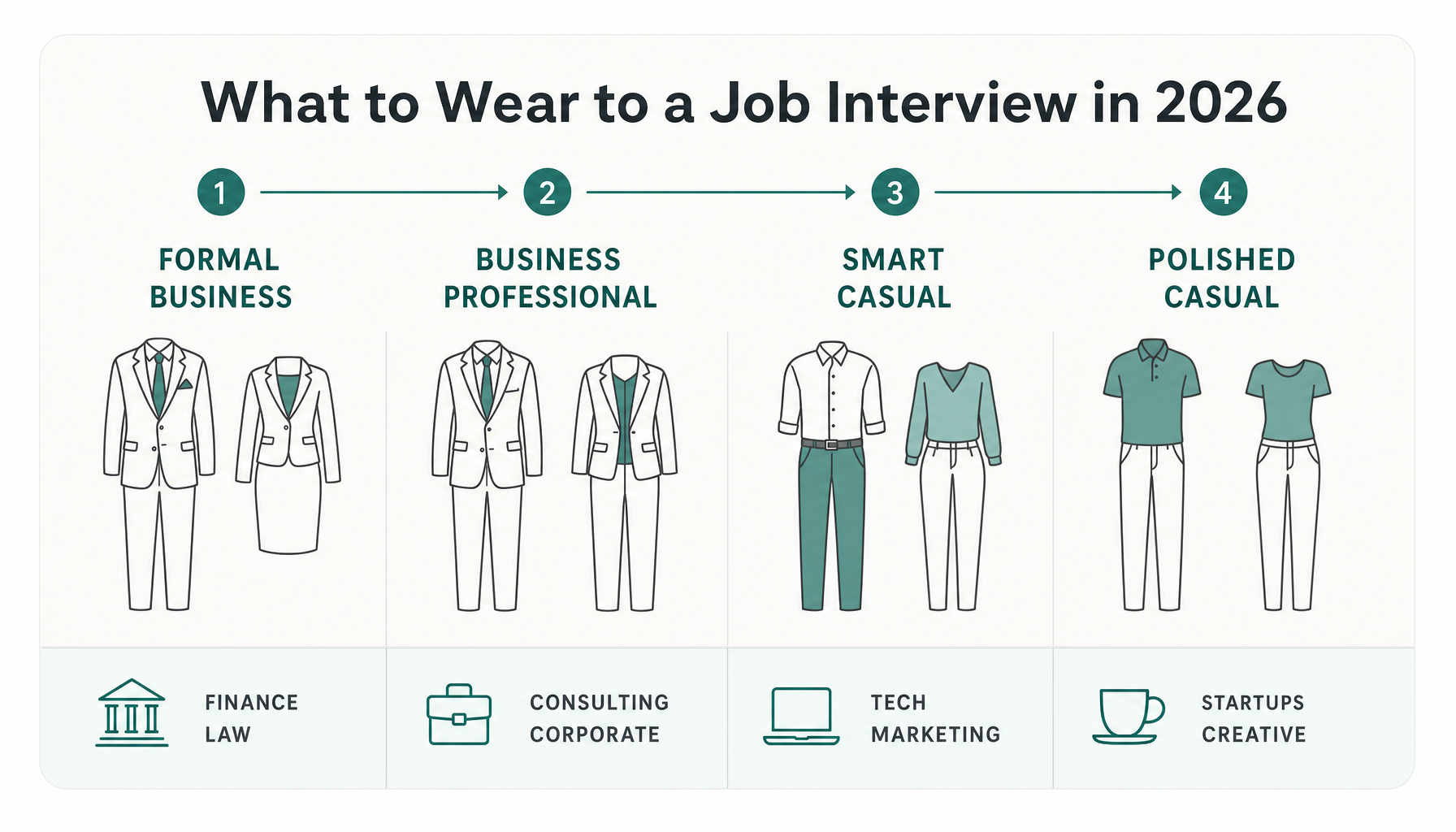
The 4 Levels of Interview Attire — and How to Know Which One Applies
Every interview dress code falls into one of these categories:
Level 1: Formal Business — Full suit, tie or equivalent, polished leather shoes. Finance, law, consulting, C-suite roles.
Level 2: Business Professional — Blazer with dress pants or a structured dress. No tie required. Corporate roles in healthcare, education administration, B2B sales.
Level 3: Smart Casual — Collared shirt or blouse, chinos or tailored pants, clean leather or suede shoes. Tech, marketing, mid-level startup roles.
Level 4: Polished Casual — Clean, intentional outfit without a blazer. Well-fitted jeans (dark wash), quality sneakers, structured tops. Early-stage startups, creative roles, trades (office-side interviews).
How to identify the right level: Check the company's recent team photos on LinkedIn, their About page, or Glassdoor interview reviews. When in doubt, dress one half-level above what employees wear daily — not a full level up.
What to Wear to an In-Person Interview by Industry (Tech, Finance, Healthcare, Creative, Trades)
Tech (FAANG, SaaS, startups): Smart casual dominates. A clean button-down or structured knit with dark chinos and minimalist sneakers. Skip the suit — at most companies it signals you didn't research the culture.
Finance & Consulting: Formal business, still. Navy or charcoal suit, conservative colors underneath, minimal accessories. Goldman Sachs relaxed its dress code for daily work in 2019, but interview expectations haven't budged.
Healthcare (administrative/corporate roles): Business professional. Blazer optional but appreciated. Closed-toe shoes. No heavy fragrances — this one matters in healthcare more than any other industry.
Creative (agencies, design firms, media): This is where personal style actually helps. Smart casual as a baseline, but show intentional taste. A well-chosen accessory, interesting textures, or a bold color can demonstrate creative sensibility without looking costumey.
Trades (interviewing for management or office roles): Polished casual to business professional depending on company size. For a regional contractor, clean dark jeans and a collared shirt work. For a national firm's project manager role, add a blazer.
What to Wear to a Virtual Interview in 2026 (It's Not the Same Rules)
Virtual interviews aren't just "waist-up dressing." They have their own visual language:
Solid colors over patterns. Thin stripes and small prints create visual static on camera. Navy, forest green, burgundy, and soft white all read well.
Structure matters more than fabric. A blazer with a T-shirt underneath looks polished on video. An unstructured cardigan can read as "rolled out of bed," even if it cost $200.
Avoid pure white and pure black tops. They blow out or absorb light depending on your setup. Off-white and dark charcoal are safer.
Jewelry and accessories: Keep earrings and necklaces simple — anything that catches light or swings creates distraction on video.
Yes, wear real pants. You will forget you're on camera at some point. Stand up to grab something, adjust your chair, or get asked to show something. It happens constantly.
Interview Outfit Tips for Men in 2026
The versatile foundation: A navy or charcoal blazer that fits through the shoulders without pulling. Pair it with dark chinos for smart casual or dress trousers for business professional. One blazer covers both levels.
Shoes that signal effort: Clean white leather sneakers work for tech and creative. Brown or black leather loafers bridge smart casual and business professional. Cap-toe oxfords for finance and law only.
Fit over price. A $60 shirt from Uniqlo that's been tailored ($15 at any alterations shop) looks better than a $200 shirt that bags at the waist. Sleeve length should hit mid-wrist. Collar should sit flat.
Grooming details that get noticed: Clean nails, trimmed facial hair (if applicable), and a subtle fragrance — one spray, not four. Interviewers at close range notice these immediately.
Interview Outfit Tips for Women in 2026
The power combination: A structured blazer with ankle-length trousers and pointed-toe flats or low block heels. This works from tech to finance with minor adjustments (swap fabrics, not silhouettes).
Dresses and skirts still work — with caveats. Knee-length or longer. A sheath dress with a blazer reads as business professional. A midi skirt with a tucked blouse reads as smart casual. Avoid anything that requires constant adjustment — pulling, tugging, or repositioning breaks your focus.
Bag choice matters. A structured tote or portfolio bag in a neutral color looks intentional. A crossbody or large handbag creates visual clutter and gives you something extra to manage when you're shaking hands.
Makeup philosophy: Enough to look polished, not enough to be the topic. Defined brows, even skin tone, and a lip color that doesn't transfer to coffee cups cover most industries.
Gender-Neutral and Non-Binary Interview Outfit Options
The good news: most modern interview attire already works across gender expression. The key principles:
Structured outerwear anchors any outfit. An unstructured blazer, a clean bomber jacket, or a tailored overshirt in wool or cotton creates the "I'm here on purpose" signal regardless of what's underneath.
Tailored fits in the shoulders and chest. Whether you're wearing a button-down or a crew-neck knit, fit through the upper body matters most for looking polished.
Monochromatic palettes simplify decisions. All-black, all-navy, or tonal grays look cohesive and put-together without requiring traditionally gendered pieces.
Footwear: Chelsea boots, loafers, and clean minimal sneakers are all gender-neutral options that read professional across industries.
If you're concerned about a company's reception: Research their DEI page and employee resource groups. Look for inclusive language in the job posting. Companies that signal inclusion in their hiring copy generally back it up in their interview culture.
What NOT to Wear: The Mistakes That Still Hurt Candidates in 2026
Visible logos or brand names. A Gucci belt or Balenciaga sneakers don't impress — they distract. Interviewers notice, and not positively.
Wrinkled anything. It doesn't matter if it's a $500 blazer. Wrinkles tell hiring managers you don't prepare. Steam or iron the night before.
Athletic wear presented as casual. There's a difference between clean minimal sneakers and running shoes. Joggers aren't chinos.
Overdressing for the environment. Showing up to a startup in a three-piece suit creates social distance. The interviewer in jeans now feels like they need to justify their outfit to you.
Strong fragrances. This eliminates candidates more often than people realize, particularly in small interview rooms or open-plan offices.
(A side note: showing up dressed perfectly but with an untailored resume creates the same mismatch as showing up underdressed. If you haven't checked whether your resume actually matches the job posting's language, a free ATS compatibility check takes sixty seconds and catches gaps you won't notice on your own.)
Budget-Friendly Ways to Build an Interview-Ready Wardrobe
You don't need five interview outfits. You need one versatile base and a few swaps:
The $150 interview capsule:
- One blazer (thrift stores consistently stock quality blazers — Goodwill, ThredUp, Poshmark)
- One pair of dark, well-fitted pants ($30-40 at Uniqlo or H&M, then tailored for $15)
- Two solid-color tops (one button-down, one knit)
- One pair of clean, neutral shoes
Alterations change everything. A $12 thrifted blazer with $20 of tailoring (shorten sleeves, take in the waist) looks better than most off-the-rack options at ten times the price.
Borrow or rent for one-off interviews. If you have a single finance interview but your wardrobe is entirely casual, borrowing a suit from a friend who wears your size is a better investment than buying one you'll wear once.
Your Outfit Is Only One Piece — Make Sure Your Resume Is Doing Its Job Too
You've figured out what to wear. You've steamed your blazer, chosen the right shoes, and researched the company culture. But here's what I've seen repeatedly as a recruiter: candidates who look the part but get screened out before anyone sees them because their resume doesn't speak the same language as the job description.
Your outfit gets you through the lobby. Your resume gets you into the room in the first place.
Try our free Job Keyword Scanner to see how your resume stacks up.
Try our free Job Description Analyzer to see how your resume stacks up.
Before your interview, paste the job description into Resume Inspector — it's free, no credit card needed — and you'll see exactly which keywords you're missing and how well your resume matches what that specific employer is looking for. It takes under a minute. If the fit score reveals gaps, you still have time to tailor your resume before that interview slot arrives. Think of it as the same logic as your wardrobe: match the environment, speak their language, show up prepared.