How to Write a Bio for LinkedIn That Actually Gets You Noticed (With Examples)
Your LinkedIn bio is the single most underused asset in your job search. Recruiters spend an average of 6 seconds scanning a profile before deciding whether to dig deeper. That "About" section — the 2,600-character space most people either leave blank or stuff with corporate buzzwords — is where you either earn those extra seconds or lose them forever.
Here's how to write one that actually works.
What Is a LinkedIn Bio (and Why It Matters More Than You Think)
Your LinkedIn bio is the "About" section on your profile. It sits directly below your headline and profile photo — prime real estate that appears in recruiter searches and shows up when someone clicks through from a job application or a mutual connection's recommendation.
Why it matters:
- It's searchable. LinkedIn's algorithm indexes the text in your About section. The keywords you use (or don't) determine whether you surface when a recruiter types "product manager fintech" or "RN pediatric care" into the search bar.
- It's your first impression in long-form. Your headline gets ~120 characters. Your bio gets 2,600. This is where you tell your professional story, not just list a title.
- It builds trust fast. A well-written LinkedIn summary signals competence before a recruiter even opens your resume. A blank one signals you're not serious about being found.
The Anatomy of a Strong LinkedIn Bio: What to Include
Every effective LinkedIn profile summary contains four elements:
- A hook — The first 2-3 lines (what shows before "see more") that compel someone to click.
- Your professional narrative — What you do, who you help, and how you got here.
- Proof — Specific results, credentials, or experience that backs up your claims.
- A call-to-action — What you want readers to do next (connect, message, check your portfolio).
That's it. No mission statements. No paragraphs about your childhood passion for solving problems. Four elements, executed cleanly.
How to Write Your LinkedIn Bio in 5 Actionable Steps
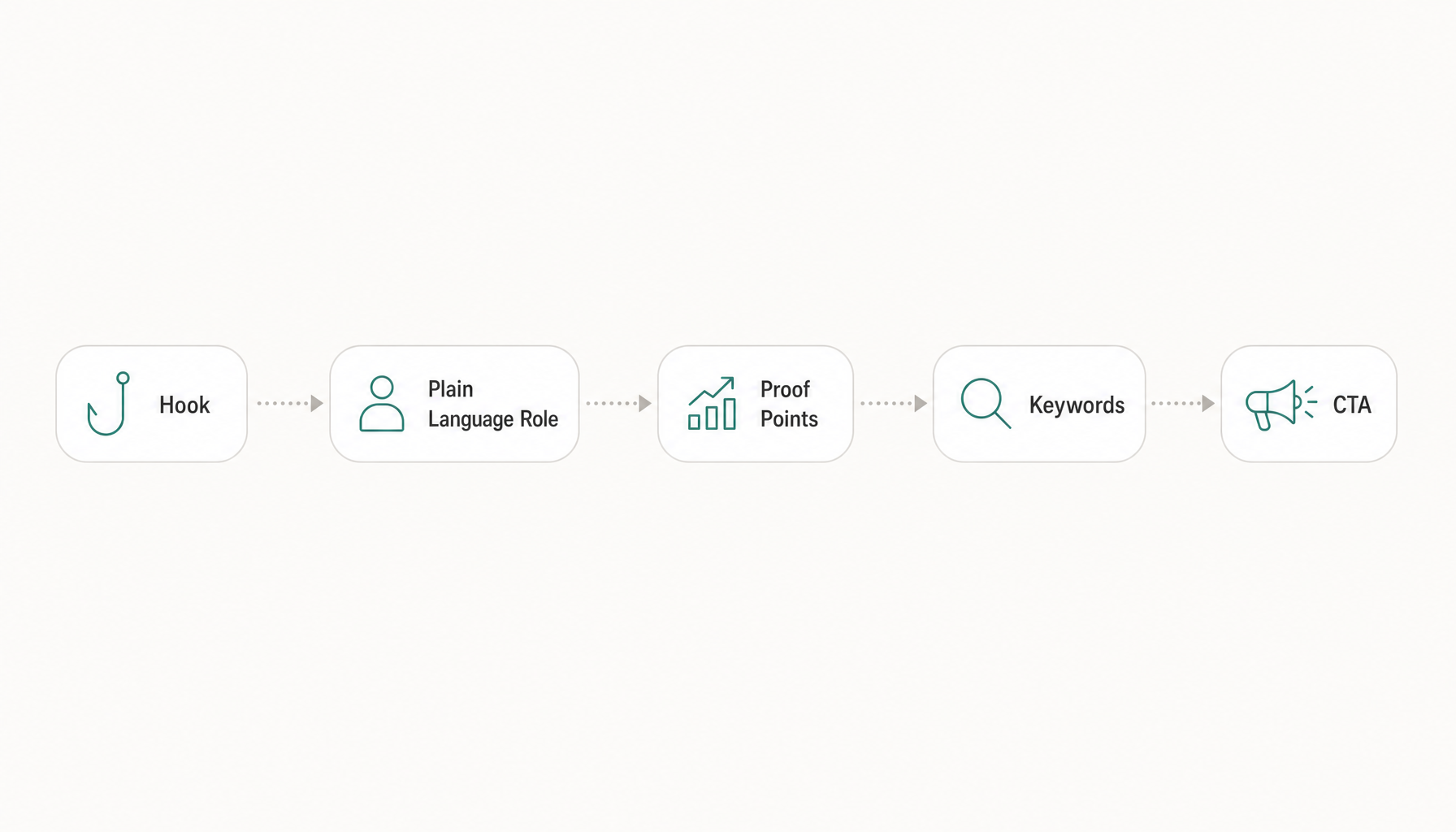
Step 1: Write the "see more" hook first
Only the first ~300 characters display before LinkedIn truncates. Start with your strongest identity statement or a specific result.
Weak: "I'm a passionate professional looking for new opportunities in marketing." Strong: "I've helped 3 SaaS companies grow from $2M to $10M+ ARR through paid acquisition strategies most CMOs won't touch until Series C."
Step 2: State what you do in plain language
Drop the jargon. Write as if you're explaining your job to a smart friend at a dinner party. "I help mid-market companies reduce employee turnover by redesigning their onboarding experience" beats "Dynamic HR professional leveraging synergies across the employee lifecycle."
Step 3: Add 2-3 proof points
These are specific numbers, projects, or credentials. Examples:
- "Reduced patient wait times by 34% across a 200-bed facility"
- "Managed a $4.2M annual ad budget for a direct-to-consumer brand"
- "Licensed CPA with 8 years in forensic accounting"
Step 4: Weave in keywords naturally
Look at 3-5 job postings for roles you want. Notice the recurring terms — those are your LinkedIn keywords. Work them into sentences rather than dumping a list at the bottom. A recruiter searching for "supply chain optimization" will find you if that phrase lives in a real sentence.
Step 5: End with a clear CTA
Tell people what to do: "Reach out if you need a freelance copywriter for Q1 launches" or "Open to senior PM roles in healthtech — let's connect." Don't end with a period and silence.
LinkedIn Bio Examples for Different Career Stages
Student / Entry-Level
I'm finishing my B.S. in Data Science at Georgia Tech (May 2026) with a focus on NLP and predictive modeling. Last summer, I built a churn prediction model at a Series B fintech that identified 23% of at-risk customers 30 days earlier than their existing system.
Skills: Python, SQL, TensorFlow, Tableau, A/B testing
I'm looking for full-time data analyst or junior data scientist roles starting July 2026. If you're building a data team that values curiosity over credentials, I'd love to talk.
Why it works: Specific project with a measurable result, clear timeline, honest about career stage without being apologetic.
Career Changer
After 8 years as a high school biology teacher, I pivoted into instructional design — and brought my classroom instincts with me. I now build e-learning programs for healthcare organizations that actually change behavior, not just check compliance boxes.
In my first year at MedLearn Inc., I redesigned their nurse onboarding curriculum, cutting time-to-competency from 12 weeks to 8 and reducing first-year turnover by 19%.
Certified in Articulate Storyline, Adobe Captivate, and ADDIE methodology. Looking for senior instructional design roles in health or edtech.
Why it works: Owns the career change as a strength, immediately proves the new skills with a hard result, and doesn't spend three paragraphs justifying the pivot.
Senior Professional
I've spent 15 years scaling operations at logistics companies from $50M to $500M+. Currently VP of Operations at FreightPulse, where I lead a team of 120 across 4 distribution centers.
Key results: • Cut last-mile delivery costs by 22% through route optimization and carrier renegotiation • Built the fulfillment infrastructure for our expansion into 3 new markets (Southeast, Midwest, Pacific NW) • Reduced warehouse injury rate from 4.1 to 1.3 per 200K hours
I'm not actively looking, but I'm always open to conversations about operational leadership in high-growth logistics or supply chain.
Why it works: Leads with scale and credibility, uses bullet points for scannability, sets boundaries on outreach without closing the door.
Common LinkedIn Bio Mistakes That Kill Your Chances
Writing in third person. "John is a results-driven professional..." — no one talks about themselves this way in conversation. First person builds connection.
Listing traits instead of evidence. "Hard-working, detail-oriented, team player" tells a recruiter nothing. Replace every adjective with a result that proves it.
Copying your resume summary verbatim. Your LinkedIn bio and your resume summary serve different purposes. The bio can be more conversational, longer, and narrative-driven. The resume summary is a tight 3-4 line pitch.
Ignoring the space entirely. A blank About section is worse than a mediocre one. Even three sentences outperform zero.
Keyword stuffing at the bottom. Some people add "Keywords: project management, agile, scrum master, PMP, leadership..." This reads as desperate and doesn't help. The algorithm weights keywords in natural sentences just as heavily.
How to Tailor Your LinkedIn Bio for the Jobs You Actually Want
Here's what most people miss: your LinkedIn bio shouldn't describe who you were. It should describe who you are for the roles you're targeting next.
That means reverse-engineering the language from real job descriptions. If every product manager posting you want mentions "cross-functional stakeholder alignment" and "data-informed roadmap prioritization," those exact phrases need to appear in your bio — naturally, inside real sentences about real work you've done.
The process:
- Pull 3-5 job descriptions for roles you'd apply to today.
- Highlight the repeated terms across all of them (usually 8-12 core phrases).
- Rewrite your proof points using that language wherever it honestly applies.
Not sure which keywords to prioritize? Paste any job description into Resume Inspector — it's free, no credit card needed — and you'll see exactly which terms are missing from your profile in under a minute. Use that list to punch up both your LinkedIn bio and your resume before you apply.
This isn't gaming the system. It's speaking the same language as the people who are trying to find you. Recruiters search for specific terms. If your bio uses "client management" but every job posting says "account management," you're invisible for the wrong reason.
For more on aligning your overall LinkedIn profile with what recruiters actually search for, start with the keyword layer — it's the foundation everything else builds on.
Quick LinkedIn Bio Template You Can Fill In Today
Use this structure and fill in the brackets:
Line 1-2 (Hook): I [specific action/result] for [who you serve/what industry]. [One supporting detail with a number.]
Paragraph 2 (Narrative): I got here by [brief career path in 1-2 sentences]. What drives my work today is [specific focus area or philosophy — keep it concrete, not abstract].
Paragraph 3 (Proof): Key results: • [Result 1 with number] • [Result 2 with number] • [Credential or recognition]
Line last (CTA): [What you're looking for or what you want people to do]. [How to reach you.]
Total length: 150-300 words. That's the sweet spot — long enough to be substantive, short enough to get read completely.
Your LinkedIn bio is a living document. Update it every time you land a new result, shift your job search focus, or notice new keywords appearing in the postings you care about. Write it once today using the steps above, then treat it like something you sharpen every few weeks — not something you set and forget.