How to List Multiple Positions at the Same Company (With Resume Examples)
Staying at one company through multiple roles is a career strength. But most resumes make it look like either a confusing mess or a missed opportunity. The formatting you choose determines whether a recruiter sees intentional career growth or just a wall of text they skip.
Here's exactly how to list multiple positions at the same company—with the right method for your specific situation.
Why Listing Multiple Positions at the Same Company Matters for ATS and Recruiters
Two audiences read your resume, and they interpret multiple roles differently.
ATS software scans for job titles, dates, and keywords. If your formatting confuses the parser—say, by nesting titles without clear date ranges—the system may only register one role, or worse, misattribute your experience. A 2026 analysis of major ATS platforms (Workday, Greenhouse, Lever) shows that inconsistent date formatting across stacked roles causes parsing errors in roughly 1 out of 5 submissions.
Human recruiters spend 6-8 seconds on initial scan. When they see multiple titles at one employer, they're looking for one thing: did this person earn progressively more responsibility, or did they just stick around? Your formatting answers that question before they read a single bullet point.
Getting this right also prevents a common misread: that you job-hopped between companies. Consolidating under one company header immediately signals stability plus growth—a combination hiring managers actively seek.
Method 1: Stacked Format (Best for Promotions and Linear Progression)
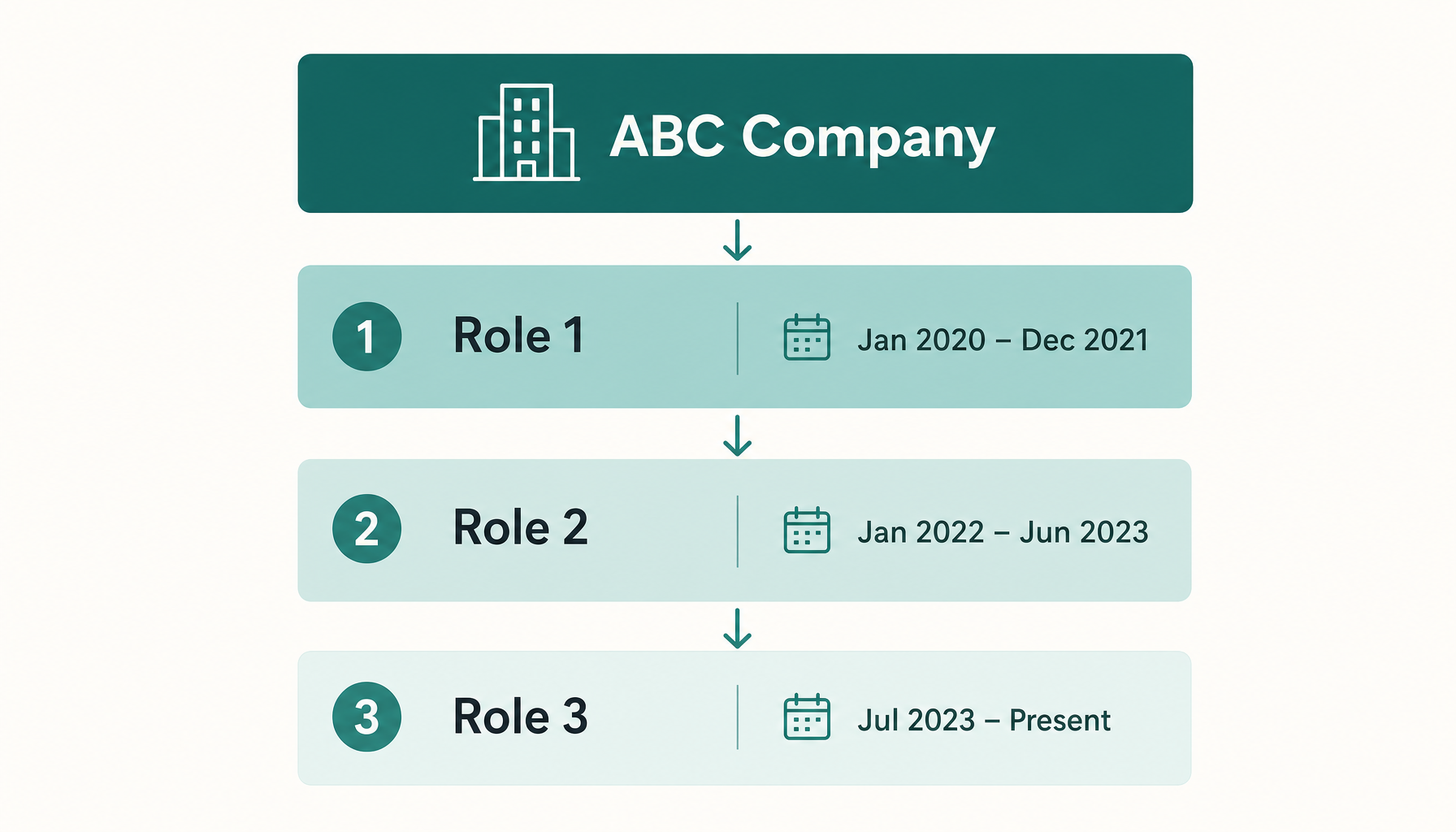
Use this when your roles built on each other sequentially. One company header, multiple titles underneath.
Example:
ACME CORPORATION, Chicago, IL                          March 2021 – Present

Senior Marketing Manager                               January 2024 – Present
• Led rebranding initiative that increased organic traffic 43% in 6 months
• Manage $2.1M annual budget across paid, organic, and event channels

Marketing Manager                                      June 2022 – December 2023
• Built and managed a team of 4 content specialists
• Launched email nurture program that generated 1,200 MQLs in Q3 2023

Marketing Coordinator                                  March 2021 – May 2022
• Coordinated 12 product launches across 3 regional markets
• Reduced vendor costs 18% by consolidating agency relationships
Why this works: One company name, one location, one overarching date range—then each role clearly nested with its own dates and achievements. ATS parses the company once. Recruiters instantly see the upward trajectory.
Use the stacked format when:
- Each role was a direct promotion
- The department or function remained similar
- You want to emphasize tenure and loyalty
Method 2: Separate Entries Format (Best for Distinct Roles or Lateral Moves)
Use this when your roles at the same company were fundamentally different—different departments, different skill sets, different reporting structures.
Example:
ACME CORPORATION – IT Department, Chicago, IL
Data Analyst                                           August 2023 – Present
• Built predictive churn model reducing customer attrition 22%
• Automated 6 weekly reports, saving 14 hours of manual work per sprint

ACME CORPORATION – Sales Department, Chicago, IL
Account Executive                                      January 2021 – July 2023
• Closed $1.8M in new business across mid-market SaaS accounts
• Maintained 112% quota attainment for 5 consecutive quarters
Why this works: A recruiter applying for a data analyst role needs to see your analytical experience front and center—not buried under a sales header. Separate entries let each role stand on its own merit and target different keyword clusters for ATS matching.
Use separate entries when:
- You changed departments or functions entirely
- The roles require different skill sets (and you're applying for one of them)
- A lateral move makes more sense presented as its own experience block
How to Handle Concurrent or Overlapping Roles at the Same Company
This happens more than people think: you held a primary role while also leading a cross-functional project, serving as interim manager in another department, or maintaining a part-time internal role.
Format it like this:
ACME CORPORATION, Chicago, IL                          June 2022 – Present

Product Manager (Primary Role)                         June 2022 – Present
• Shipped 3 major features generating $400K in incremental ARR
• Reduced sprint cycle time 30% by restructuring backlog prioritization

Interim Engineering Team Lead (Concurrent)             March 2024 – September 2024
• Managed 8-person engineering team during leadership transition
• Maintained 95% on-time delivery rate across 4 product sprints
The word "Concurrent" or the date overlap makes it immediately clear this wasn't a switch—it was additional responsibility. That distinction matters because it signals capacity, not instability.
What to Do When Job Titles Don't Reflect Your Growth
Internal titles can be meaningless externally. If you went from "Specialist I" to "Specialist II" to "Specialist III," that tells a recruiter nothing about what actually changed.
Solution: Add a brief parenthetical with a market-equivalent title or clarifying context.
Specialist III (equivalent to Senior Operations Manager)    Jan 2024 – Present
Specialist II (Team Lead, 6 direct reports)                Mar 2022 – Dec 2023
Specialist I                                               Aug 2020 – Feb 2022
Don't fabricate titles. But contextualizing them with scope—team size, budget, or market-equivalent role—bridges the gap between internal jargon and what recruiters search for. This also helps with ATS keyword matching since "Senior Operations Manager" appears in far more job descriptions than "Specialist III."
Bullet Point Strategy: Avoiding Repetition Across Multiple Roles
This is where most people get stuck. When your roles overlap in function, your bullets start sounding identical. Here's the framework:
For each role, answer a different question:
| Role Level | Question Your Bullets Answer |
|---|---|
| Most recent | What did I lead or own? |
| Middle role | What did I build or improve? |
| Earliest role | What did I learn or execute? |
Before (repetitive):
- Managed social media accounts (appears in all 3 roles)
- Created content for social channels (appears in 2 roles)
After (progressive):
- Senior role: Developed social strategy that grew audience 280% and generated $180K in attributed pipeline
- Mid role: Built content calendar system adopted by 3 regional teams, increasing posting consistency 4x
- Entry role: Managed daily posting across Instagram and LinkedIn, growing followers from 2K to 8K in 10 months
Same function. Completely different story. Each bullet escalates in scope, autonomy, and measurable impact.
For more on writing strong action-oriented bullet points, use verbs that signal increasing seniority: executed → built → led → directed → transformed.
Common Mistakes That Hurt Your Resume When Listing Multiple Jobs at One Company
1. Inconsistent date formats. "Jan 2022" in one place and "January 2022" in another confuses ATS parsers. Pick one format and commit.
2. Repeating the company description for each role. If you use the stacked format, describe the company once (or not at all). Repeating "ACME Corporation is a Fortune 500 technology company..." under each title wastes space.
3. Giving equal space to each role. Your most recent role deserves 3-5 bullets. The role from five years ago? Two bullets, maybe one. Recency signals relevance.
4. Omitting short-tenure roles to avoid "looking bad." If you were promoted after 8 months, that's impressive—don't hide it. A short stint that led to a promotion reads as acceleration, not instability.
5. Forgetting to tailor to the target job. If you held 3 roles at one company but only one is relevant to your target position, weight the formatting accordingly. Give the relevant role prime real estate and tailor your resume to the specific job description.
Quick Formatting Checklist Before You Submit
Run through this before hitting send:
- Company name appears once per block (stacked) or with clear department distinction (separate)
- Every role has its own date range—no gaps or overlaps that don't exist
- Most recent role has the most bullets; earliest role has the fewest
- No bullet point repeats the same achievement across roles
- Titles are clarified if internal naming is non-standard
- Format is consistent with how you list other employers on the resume
- The overall structure matches your chosen resume format
Try our free Job Keyword Scanner to see how your resume stacks up.
Now that your multi-role formatting is clean, the natural next question is: does the rest of your resume actually match what employers are searching for? Paste any job description into Resume Inspector — it's free, no credit card needed — and you'll see exactly which keywords you're missing and how well your resume scores against that specific role. Takes under a minute, and it catches gaps that clean formatting alone can't fix.