How to Address a Cover Letter: Every Scenario Covered (With Examples)
I've reviewed thousands of cover letters as a recruiter, and here's a pattern I noticed early: the ones addressed to a specific person got read more carefully. Not because the salutation itself was magic, but because it signaled something about the candidate — they did research, they cared enough to dig, they understood that job applications aren't form letters blasted into the void.
Let's fix your cover letter salutation for every scenario you'll actually encounter.
Why the Salutation Matters More Than You Think
The greeting line is the first thing a hiring manager reads. It sets the tone for everything that follows, and it takes roughly two seconds to form that initial impression.
Here's what different salutations actually communicate:
- "Dear [Specific Name]" → This person researched our company. They're intentional.
- "Dear Hiring Manager" → Fine, professional, but they didn't dig deeper.
- "To Whom It May Concern" → This is a form letter. They're blasting applications.
- "Hey there!" → Wrong read on our company culture (unless you're applying to a surf shop).
A recruiter at a mid-size tech company told me she triages applications partly by salutation when volume is high. "If someone found my name on LinkedIn, I know they'll do research on our clients too." That's the signal you're sending.
How to Address a Cover Letter When You Know the Hiring Manager's Name
This is the straightforward case. Use it exactly like this:
Standard format:
Dear [First Name] [Last Name],
Real examples:
- Dear Sarah Chen,
- Dear Marcus Williams,
- Dear Dr. Priya Patel,
Rules to follow:
- Use their full name unless you have an established relationship. "Dear Sarah," reads as presumptuous when you've never spoken.
- Include professional titles when applicable. If they have a PhD, MD, or similar credential and use it professionally, address them as Dr. rather than Mr./Ms.
- Skip gendered honorifics when uncertain. "Dear Taylor Morgan," is always safer than guessing Mr. or Ms. for a name you can't confirm.
- Double-check spelling. Nothing undermines "I researched you" like misspelling their name. It's "Kathryn," not "Katherine." It's "Nguyen," not "Ngyuen."
How to Address a Cover Letter When You Don't Know the Name
Sometimes the hiring manager's name is genuinely unavailable. The job posting doesn't list it, the company's LinkedIn is a black box, and calling the front desk got you nowhere. Here's your hierarchy from best to worst:
Tier 1 — Department-specific:
- Dear [Department] Hiring Manager, (e.g., "Dear Marketing Hiring Manager,")
- Dear [Job Title] Search Committee,
Tier 2 — General but professional:
- Dear Hiring Manager,
- Dear Hiring Team,
- Dear Recruitment Team,
Tier 3 — Acceptable but forgettable:
- Dear [Company Name] Team,
Never use:
- To Whom It May Concern (reads as 1987)
- Dear Sir or Madam (gendered and archaic)
- Dear Sir/Madam (same problem, now with a slash)
- Hi! / Hello! / Hey there! (too casual for 95% of applications)
"Dear Hiring Manager" remains perfectly acceptable in 2026. It won't cost you the interview. But if you can get one tier higher by finding a name, you gain an edge.
How to Find the Hiring Manager's Name (Before You Give Up)
Most candidates spend zero minutes trying to find the name. Spend five, and you'll beat 80% of the applicant pool.
LinkedIn method (works ~60% of the time):
- Go to the company's LinkedIn page
- Click "People"
- Filter by the department you're applying to
- Look for titles like "Director of [Department]," "VP of [Department]," "[Department] Manager," or "Head of [Department]"
- If the company has 50 people, the hiring manager is usually the direct manager of the role you'd fill
Company website method:
- Check the "About" or "Team" page
- Look for leadership bios that mention the relevant department
Job posting clues:
- Some posts say "You'll report to the Director of Engineering" — that's your person
- Check if the post was shared on LinkedIn by someone at the company; that person often has involvement in hiring
Direct outreach:
- Call the company's main line: "I'm applying for the [Role] position and would like to address my cover letter correctly. Could you share the hiring manager's name?"
- Email a general address with the same question (works at smaller companies)
When to stop: If you've spent more than 10 minutes, use "Dear Hiring Manager" and move on. Your time is better spent tailoring the content of your letter.
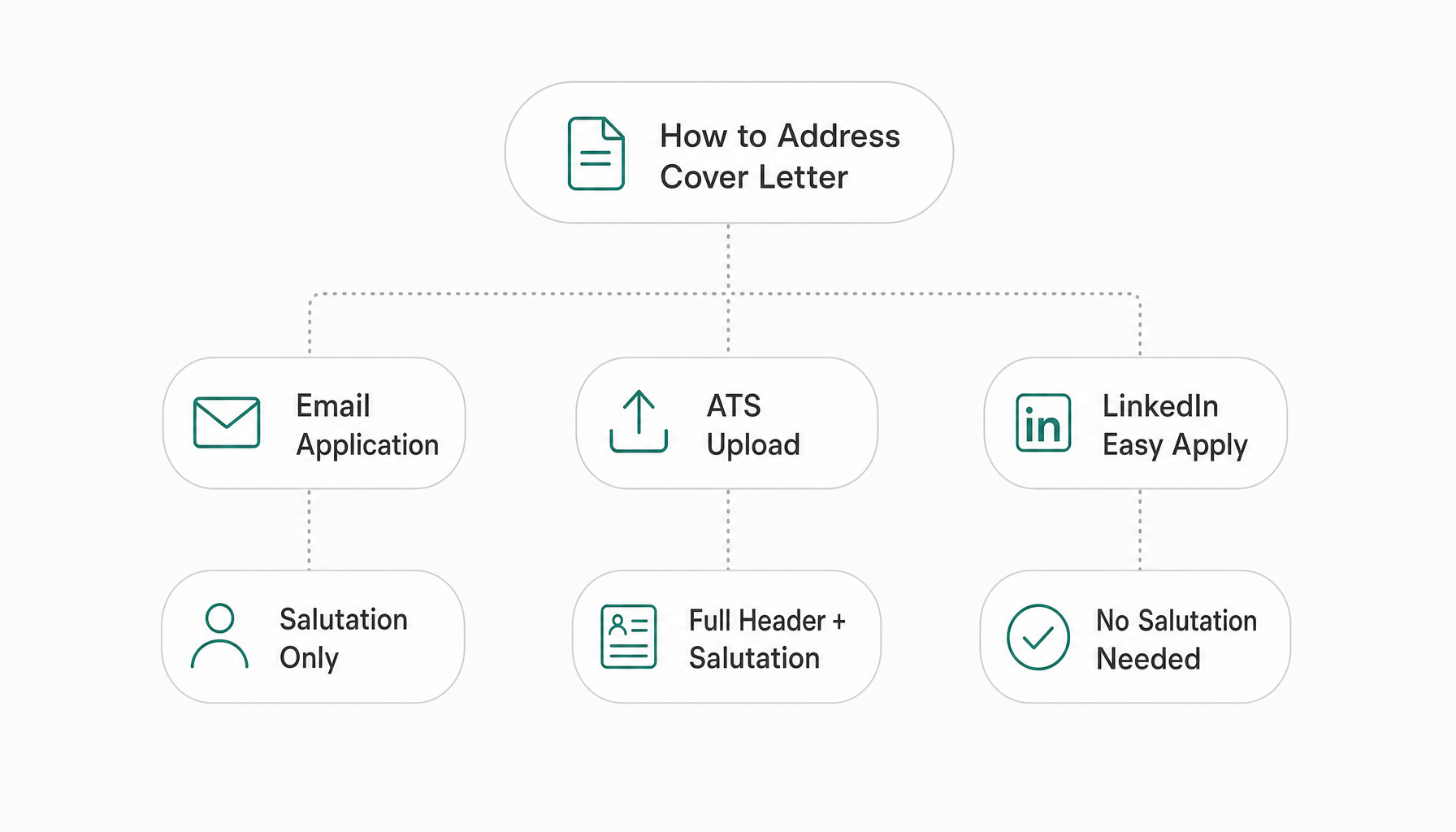
Addressing a Cover Letter for Email vs. Uploaded Applications
The format shifts depending on how you're submitting.
Email submissions: Skip the full formal header (your address, date, their address). The email metadata handles that. Go straight to the salutation:
Subject: Application for Senior Product Designer — [Your Name]

Dear Priya Patel,

I'm writing to apply for...
Uploaded documents (PDF/DOCX through an ATS portal): Use the full professional cover letter format with a header:
[Your Name]
[Your Contact Info]
[Date]

[Hiring Manager Name]
[Company Name]
[Company Address — optional in 2026]

Dear Priya Patel,
LinkedIn Easy Apply or "additional info" fields: These don't need a salutation at all. If the field says "Why are you interested in this role?" just answer the question directly. Cramming "Dear Hiring Manager" into a text box looks awkward.
Cover Letter Salutation Examples for Every Situation
| Scenario | Salutation |
|---|---|
| You know the hiring manager's name | Dear Rachel Torres, |
| They have a PhD/MD | Dear Dr. James Okafor, |
| Gender-neutral name, unsure of pronouns | Dear Jordan Lee, |
| Applying to a team/panel | Dear Product Design Hiring Team, |
| Name unknown, department known | Dear Engineering Hiring Manager, |
| Name unknown, department unknown | Dear Hiring Manager, |
| Startup with casual culture (confirmed) | Hello Sarah, |
| Addressing two people | Dear Rachel Torres and James Okafor, |
| Internal transfer | Dear Marcus, (first name OK for existing colleagues) |
| Government/academic application | Dear Selection Committee, |
| Recruiter-submitted (agency) | Dear Hiring Manager, (the recruiter forwards it) |
Common Addressing Mistakes That Kill First Impressions
Using the wrong name. I once received a cover letter addressed to "Dear Mr. Johnson" — my name was nowhere close. The candidate had copied and pasted from another application. Instant rejection? No. But it moved them to the bottom of the pile.
Guessing gender wrong. "Dear Mr. Kim" when Kim is a woman. "Dear Ms. Alex" when Alex is a man. Use the full name without a gendered title, and you sidestep this entirely.
Misspelling the name. If you're going to personalize, get it right. "Dear Micheal" when it's "Michael." "Dear Stephanie" when it's "Stefanie." Copy-paste from their LinkedIn profile.
Over-researching to the point of creepiness. "Dear Sarah (I saw your post about your daughter's soccer game — congratulations!)" — this happened. Don't do it.
Using outdated formality. "Dear Esteemed Members of the Hiring Committee" reads like a Victorian telegram. "Dear Hiring Team" does the same job without the costume.
Inconsistent formatting. If you address with "Dear Sarah Chen," end the salutation with a comma, not a colon. Colons (Dear Sarah Chen:) are traditional in business letters but read as stiff in 2026 cover letters. Pick one and be consistent.
What Comes After the Salutation: Making the Rest Count
The salutation gets you in the door. The first sentence after it determines whether they keep reading. Here's what works:
Strong openers (specific, relevant):
- "Your job description mentions scaling the data pipeline from 10M to 100M daily events — I did exactly that at Datastream last year."
- "I noticed you're expanding into the European market. I've launched three products across EU markets in the past four years."
Weak openers (generic, self-focused):
- "I am writing to express my interest in the position posted on your website."
- "I am a highly motivated professional with 7+ years of experience."
The pattern: strong openers reference something specific from the job description and immediately connect it to your experience. They prove you read the posting and thought about what you bring to this specific role. For more guidance on structuring the full letter, check out our complete cover letter guide.
The same principle applies to your resume's content — every bullet point should speak directly to what the job requires, using the language the employer actually uses.
Try our free Job Keyword Scanner to see how your resume stacks up.
Try our free Job Description Analyzer to see how your resume stacks up.
Now that your salutation is sorted, make sure what follows it actually matches the job. Paste any job description into Resume Inspector — it's free, no signup needed — and you'll see exactly which keywords are missing from your resume and cover letter in under a minute. Better to catch the gaps before you hit send than wonder why you never heard back.