What to Say in a Second Interview: A Practical Guide to Landing the Offer
You passed the first interview. They liked you enough to bring you back. But here's what catches most candidates off guard: the second interview isn't a repeat performance. It's a closing conversation. The people across the table already believe you might be the right hire. Now they need to hear you prove it—with specifics, with confidence, and with language that signals you're already thinking like an insider.
Here's your verbal playbook for walking in and walking out as the top candidate.
Why the Second Interview Is a Different Beast Entirely
In the first interview, you're auditioning. In the second, you're negotiating—even if salary hasn't come up yet. The dynamic shifts because:
- The audience changes. You're likely meeting senior leadership, cross-functional stakeholders, or future peers instead of a recruiter or hiring manager alone.
- The questions go deeper. Expect scenario-based, "how would you handle..." prompts rather than "tell me about yourself."
- The stakes are compressed. Most second-round shortlists include 2–4 people. Every sentence you say is being weighed against a real alternative candidate.
The biggest mistake? Treating it like Round 1 with better preparation. It's not. It's a different conversation with a different objective: convince them you're the hire, not just a qualified applicant.
What Interviewers Are Really Listening For the Second Time Around
First-round interviewers listen for baseline competence. Second-round interviewers listen for:
- Decision-making clarity. Can you articulate why you made choices, not just what you did?
- Self-awareness. Do you know your strengths relative to this specific role?
- Cultural signal matching. Do you speak in a way that sounds like someone who already works here?
- Commitment signals. Are you genuinely excited, or are you hedging?
They've already read your resume. They remember your first-round answers. What they want now is depth and conviction.
How to Open Strong: Setting the Right Tone From the First Minute
Your first 60 seconds set the frame. Don't waste them on generic pleasantries. Try this structure:
Acknowledge the process: "I really appreciated the conversation with [first interviewer's name]—it gave me a much clearer picture of how the team operates day to day."
Signal continued interest: "Honestly, what I learned made me more excited about this role, especially [specific detail from the first interview]."
Transition to value: "I've been thinking since our last conversation about how my experience with [specific skill] could contribute to [specific challenge they mentioned]."
This opening does three things simultaneously: it shows you listened, demonstrates genuine enthusiasm, and positions you as a problem-solver before the first question even lands.
Key Things to Say About Your Experience (Without Repeating Yourself)
The cardinal sin of second interviews is retelling the same stories. Instead, use what I call the depth-and-pivot approach:
- Go one layer deeper on a first-round story. "Last time I mentioned leading the product migration. What I didn't get to share was the political challenge—three VPs had competing priorities, and I had to build alignment before any technical work could start."
- Introduce new evidence. Bring a different accomplishment that maps to something specific from the job description. If the posting emphasizes cross-functional collaboration and you only talked about individual contributions in Round 1, now's the time to pivot.
- Connect dots they can't see. "You mentioned the team is scaling from 4 to 12 this year. I navigated a similar growth phase at [company]—here's what I learned about maintaining quality during rapid hiring."
One way to make sure your talking points actually align with what this role demands: cross-reference your resume bullets against the job posting. If you paste the job description into Resume Inspector, the free analysis shows you exactly which keywords and accomplishments match—and which gaps you need to address verbally in the interview.
How to Talk About Fit, Culture, and Long-Term Goals Confidently
When they ask "why this company?" or "where do you see yourself in three years?"—they're testing whether you've done your homework and whether your trajectory aligns with theirs.
Specific phrasing that works:
- "I read your CEO's recent interview about [topic]. That philosophy around [value] is exactly how I've operated in my last two roles."
- "In three years, I'd want to have built [specific outcome]—and from what I understand about this team's roadmap, that aligns with where you're headed."
- "I work best in environments where [specific cultural trait]. Based on my conversations so far, that seems baked into how your team operates."
What to avoid: vague flattery ("I love the company culture"), generic ambition ("I want to grow into leadership someday"), or anything that sounds rehearsed without substance.
What to Say When Asked About Salary or Start Date
Second interviews often include logistics questions. These aren't throwaway moments—they're commitment tests.
On salary:
- "Based on my research and the scope of this role, I'm targeting [range]. But I'm most focused on finding the right mutual fit—I'm confident we can work out the details if we're aligned on everything else."
- Never say "I'm flexible" without anchoring a number. Flexibility without a range sounds desperate.
On start date:
- "I'd want to give my current team a proper transition—two weeks minimum. If there's a specific date you're working toward, I'm happy to discuss what's realistic."
- This signals professionalism and reliability, two things they're evaluating right now.
For a deeper dive on handling the salary conversation via email later, check out this guide on how to negotiate salary offer via email.
Smart Questions to Ask in a Second Interview (and Why They Matter)
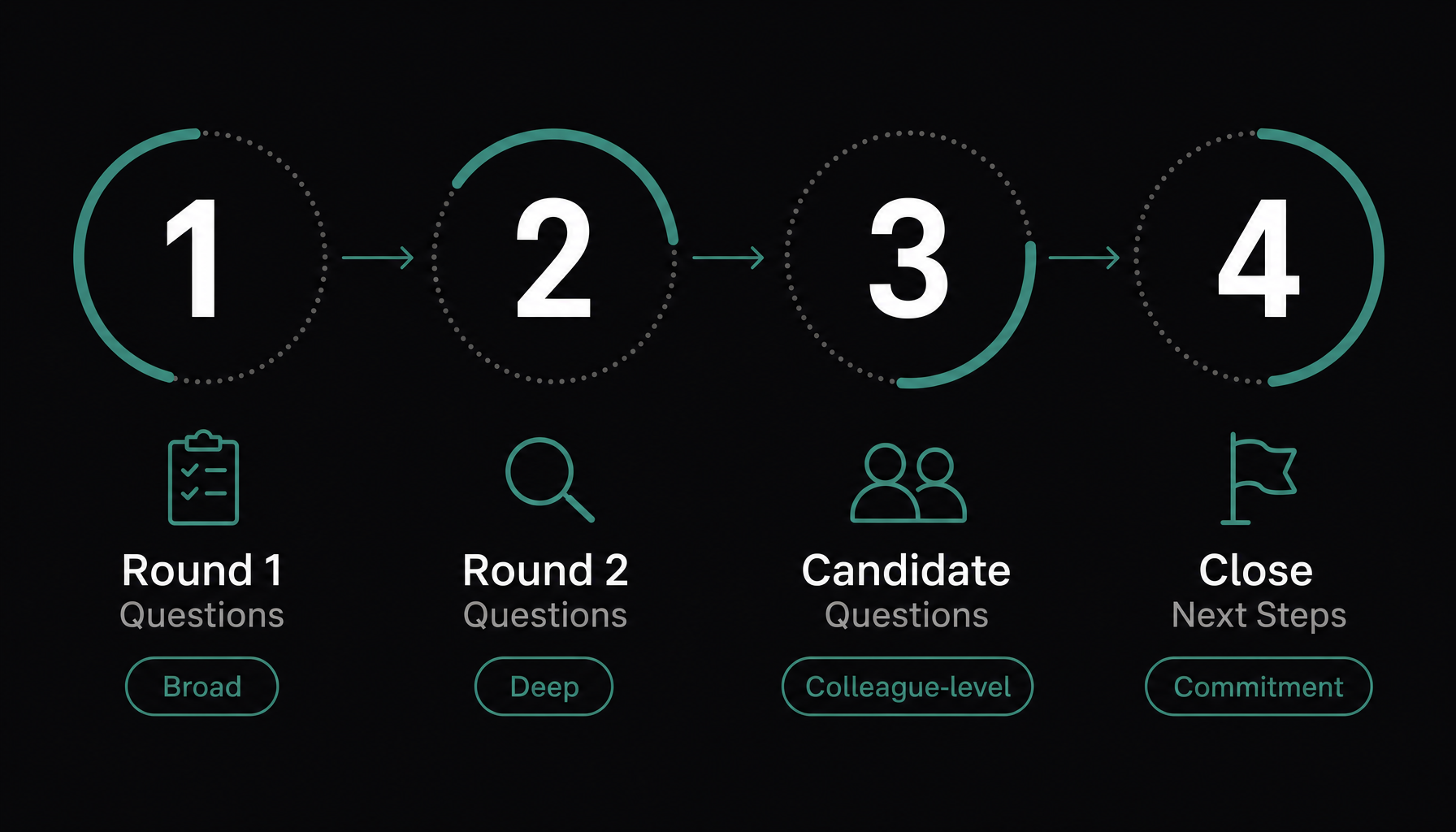
Your questions in Round 2 should sound like a colleague gathering information, not a candidate fishing for reassurance.
Questions that impress:
- "What does success look like in this role at the 90-day mark? At six months?"
- "What's the biggest challenge the team is facing right now that this hire would help solve?"
- "How does this role interact with [specific department you researched]?"
- "Is there anything about my background that gives you hesitation? I'd love the chance to address it directly."
That last one is bold—and extraordinarily effective. It gives you a chance to overcome objections in real time, which most candidates never get.
Questions that hurt you: Anything answered on the company website. Anything about perks or vacation before an offer exists. Anything that reveals you didn't listen in Round 1.
What Not to Say: Common Second Interview Mistakes to Avoid
- "As I mentioned last time..." — This frames you as repetitive. Instead: "Building on what we discussed..."
- Badmouthing a current employer. — Even subtle negativity reads as a red flag this late in the process.
- "I'm interviewing at a few other places." — Unless they ask directly, don't volunteer this. It doesn't create urgency; it signals split attention.
- Over-qualifying your answers. — "I'm not sure if this is what you're looking for, but..." undermines your authority. State your answer, then check in: "Does that address what you're asking?"
- Asking "How did I do?" — This shifts the dynamic from peer to supplicant. Never close on insecurity.
How to Close the Interview and Ask About Next Steps
The last two minutes matter more than most candidates realize. Use this three-part close:
- Restate your value proposition in one sentence. "I'm confident my experience in [X] and [Y] maps directly to what you need in this role."
- Express unambiguous interest. "I want to be transparent—this is my top choice. The team, the challenge, the direction you're heading—it all aligns."
- Ask for timeline clarity. "What are the next steps from here, and is there anything else I can provide to help you make a decision?"
This combination signals confidence, enthusiasm, and respect for their process—all in under 30 seconds.
Prep Checklist: What to Review Before You Walk In
Before your second interview, run through this list:
- ☐ Re-read the exact job description (not your memory of it—the actual posting)
- ☐ Review your first-round notes: what did they emphasize? What got the most follow-up questions?
- ☐ Research every person you're meeting (LinkedIn, company bios, recent talks or publications)
- ☐ Prepare 2–3 new stories that map to job description keywords you haven't addressed yet
- ☐ Rehearse your salary range and start date answer out loud
- ☐ Prepare 4–5 questions (expect to only get to 2–3)
- ☐ Run a quick fit check: paste the job description into Resume Inspector to see exactly which keywords you're matching and which ones you need to weave into your verbal answers. It's free, takes 60 seconds, and shows you the gaps before you walk into that room.
The second interview is where offers are won or lost. You already have the qualifications—they confirmed that by inviting you back. What separates you from the other finalist is how clearly, confidently, and specifically you communicate that you're the right person for this job, on this team, right now. Show up prepared, speak with intention, and close like someone who already belongs there.