How to Negotiate Salary Offer via Email: A Step-by-Step Guide That Actually Works
You got the offer. The relief lasted about thirty seconds before a new anxiety set in: the number is lower than you expected, and now you need to negotiate. Via email. Without the benefit of reading body language, building rapport in real-time, or course-correcting mid-conversation.
Here's the good news: email negotiation, done correctly, gives you an advantage most people overlook. You control the framing, the timing, and every word. This guide gives you the exact structure, templates, and strategy to negotiate your salary offer via email—and actually get a yes.
Should You Negotiate Salary via Email? (The Honest Answer)
Email isn't always the right channel. But it's the right channel more often than most career advice suggests.
Email works best when:
- The recruiter has been communicating primarily via email throughout the process
- You need time to articulate a complex counter (multiple components beyond base salary)
- You're negotiating with a large company where HR processes are documentation-heavy
- You want a written record of what's been offered and what you're requesting
- You tend to freeze or undervalue yourself in live conversations
A phone call is better when:
- The hiring manager specifically asks to discuss compensation by phone
- You're negotiating with a startup founder who values personal rapport over process
- You've already built strong chemistry in interviews and want to leverage that warmth
If you're unsure, default to email. You can always follow up with a call. You can't un-say something blurted on the phone.
Before You Write a Single Word: Do This Research First
The difference between a negotiation email that gets a raise and one that gets a polite "this is our best offer" isn't the phrasing—it's the preparation behind it.
Three data points you need before naming a number:
-
Market rate for this specific role, location, and company size. Use Levels.fyi for tech, Glassdoor for general roles, and H1B salary databases for public compensation data. A "Senior Marketing Manager" at a 50-person startup in Austin pays differently than the same title at Salesforce in San Francisco.
-
The company's compensation band. Many companies (especially post-2023 pay transparency laws) publish salary ranges in their job postings. If the range is $95K-$125K and they offered you $100K, you know there's room.
-
Your unique leverage points. What specific skills or experiences do you bring that other candidates didn't? A competing offer? A niche certification? Three years of experience with their exact tech stack?
Before you name a number, know where you stand. Paste the job description into Resume Inspector—free, no credit card needed—and you'll see exactly how your resume aligns with the role and which skills are giving you the most leverage. That gap analysis is your negotiation data. When you can say "I match 9 out of 10 requirements, including the three you marked as preferred," your counter offer stops being a request and starts being a logical conclusion.
The Anatomy of a Strong Salary Negotiation Email
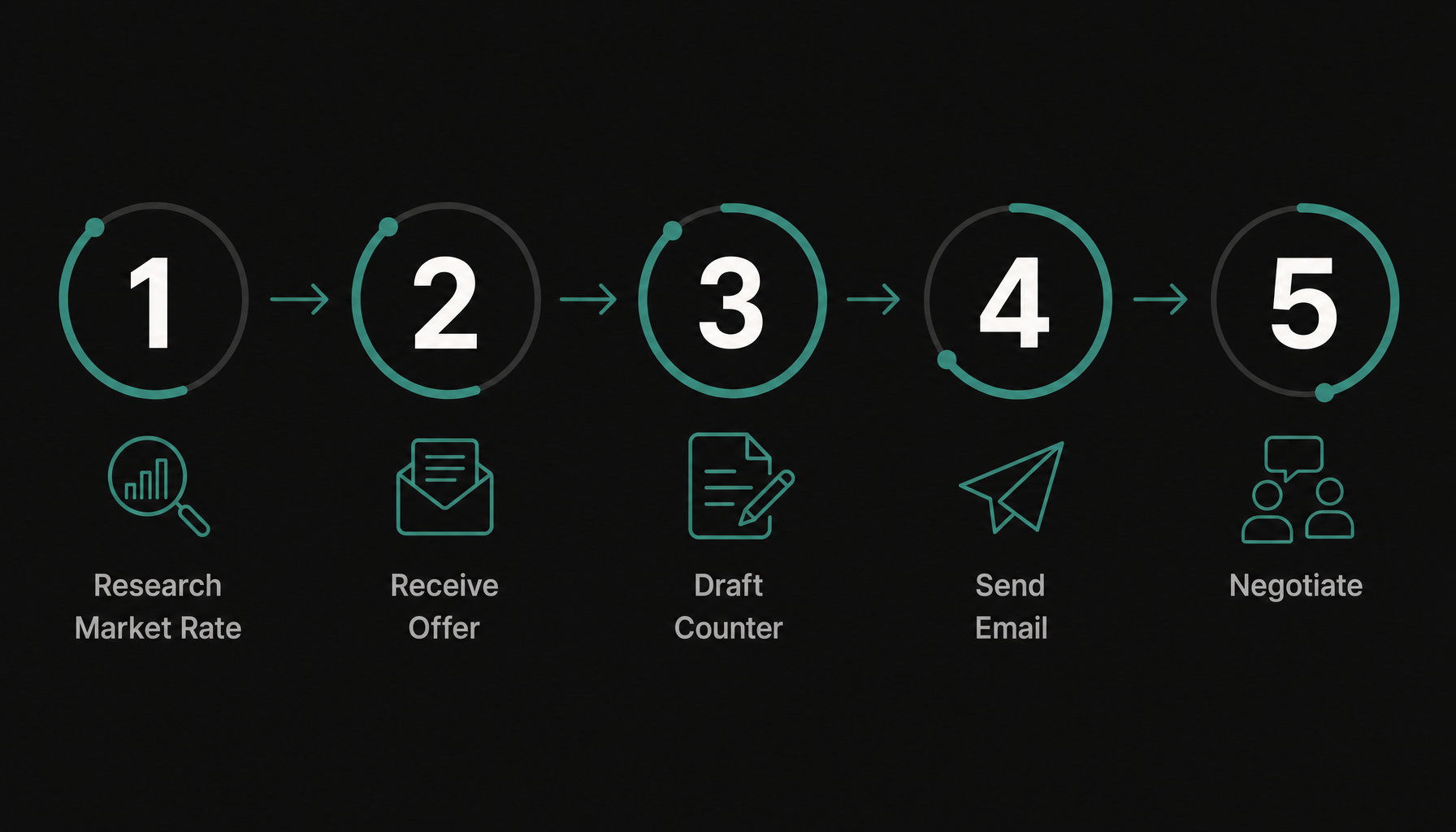
Every effective salary negotiation email has five components, in this order:
- Gratitude and enthusiasm (2 sentences max—don't grovel)
- Clear statement that you'd like to discuss compensation (no beating around the bush)
- Your counter number or range (specific, not vague)
- Brief justification (market data + your unique value, 2-3 sentences)
- Collaborative close (makes it easy for them to say yes)
What to leave out: Apologies, excessive hedging ("I don't know if this is appropriate..."), personal financial reasons ("my rent went up"), and ultimatums.
Salary Negotiation Email Templates for Every Scenario
Template 1: Standard Counter Offer (Base Salary)
Subject: Re: [Role] Offer — Excited to Discuss
Hi [Name],
Thank you for the offer to join [Company] as [Title]. I'm genuinely excited about the team and the work ahead on [specific project or initiative discussed in interviews].
I'd like to discuss the base salary. Based on my research into market compensation for this role in [city/remote] and the experience I bring in [specific skill], I'd like to propose a base of $[X]. This aligns with the [75th percentile/competitive range/data source] for similar roles, and I believe it reflects the [specific value you add—e.g., "three years of direct experience scaling B2B SaaS products from Series A to C"].
I'm flexible on how we get there—whether that's base, signing bonus, or another structure. I'd love to find something that works for both of us.
Looking forward to your thoughts.
[Your name]
Template 2: When You Have a Competing Offer
Subject: Re: [Role] Offer — Quick Discussion on Comp
Hi [Name],
I appreciate the offer and want to be transparent: I've received a competing offer at $[X] base. [Company] remains my first choice because of [genuine reason], but I want to make sure the compensation aligns.
Would you be able to match or come closer to $[X]? I'm ready to sign and start on [date] if we can close this gap.
Thanks for working with me on this.
Template 3: Entry-Level or First Negotiation
Subject: Re: [Role] Offer
Hi [Name],
Thank you so much for the offer—I'm thrilled about joining [Company]. Before I sign, I wanted to ask: is there flexibility on the base salary? My research shows the range for this role in [location] is $[X-Y], and given my [internship at Z / certification in A / relevant project experience], I'd like to propose $[specific number within range].
I'm very committed to this role and happy to discuss further.
How to Counter a Salary Offer Without Sounding Greedy
The fear of "sounding greedy" kills more negotiations than bad timing or weak data. Here's how to frame your counter so it lands as professional, not presumptuous:
Use collaborative language. "I'd like to explore," "Is there flexibility," and "I'd like to propose" all signal partnership. Avoid "I need" or "I require."
Anchor to external data, not personal needs. "Based on Glassdoor data for Senior Analysts in Denver" beats "I was hoping for more because of my student loans."
Name a specific number, not a range. When you say "$95K-$105K," the recruiter hears $95K. Say $105K and let them negotiate down if needed. Research from Columbia Business School confirms that specific numbers (like $103,500 rather than $100,000) signal that you've done homework and are perceived as more credible.
Express flexibility on structure. This gives the hiring manager room to say yes creatively. Maybe they can't move base salary but can add a $5K signing bonus or extra PTO.
Negotiating Beyond Base Salary: PTO, Bonuses, and Remote Work
If the company says "base salary is firm," you're not done. The total compensation package has multiple levers:
| Component | How to Ask |
|---|---|
| Signing bonus | "Would a one-time signing bonus of $[X] be possible to bridge the gap?" |
| Extra PTO | "Could we add 5 additional PTO days to the standard package?" |
| Remote flexibility | "Would a hybrid schedule of 3 days remote be feasible for this role?" |
| Early review | "Could we schedule a 6-month compensation review instead of the standard 12?" |
| Equity/RSUs | "Is there flexibility on the equity component?" |
| Professional development | "Would the company cover $[X] annually for professional development?" |
Pro tip: ask for the 6-month review in writing. Verbal promises from hiring managers evaporate when budgets shift or managers change.
Mistakes That Kill Salary Negotiations (And How to Avoid Them)
Waiting too long to respond. More than 48-72 hours without acknowledging the offer signals disinterest. If you need research time, reply immediately with: "Thank you—I'm reviewing the details and will follow up by [date]."
Negotiating before you have the written offer. Never counter a verbal number. Wait for the offer letter. Verbal numbers sometimes get "adjusted" before they hit paper.
Over-explaining your justification. Three sentences of reasoning is persuasive. Three paragraphs is defensive. The longer your justification, the less confident you appear.
Threatening to walk when you won't. Only mention a competing offer if it's real and you'd genuinely accept it. Recruiters talk. Bluffs get called.
Negotiating multiple times. One counter is expected. Two is acceptable if circumstances change. Three signals you'll be a difficult employee. Get it right the first time.
Try our free Job Keyword Scanner to see how your resume stacks up.
Try our free Job Description Analyzer to see how your resume stacks up.
What to Do After You Send the Email
The email is sent. Now what?
In the first 24 hours: Do nothing. Don't follow up, don't send a "just checking in" message, don't second-guess your number. The recruiter needs time to consult the hiring manager and possibly get budget approval.
If you haven't heard back in 3 business days: Send a brief, friendly follow-up. "Hi [Name], just wanted to check in on the compensation discussion. Happy to hop on a call if that's easier. Looking forward to resolving this!"
If they say yes: Respond within 24 hours confirming acceptance. Ask for the revised offer letter in writing before you resign from your current role.
If they say no or meet you partway: Decide in advance what your walk-away number is. If their "final" offer meets your minimum, take it. If it doesn't, you have a decision to make—but at least you made it from a position of information, not regret.
If they rescind the offer: This is extraordinarily rare (and legally questionable in some jurisdictions). In ten years of recruiting, I saw it happen twice—both times the candidate had been aggressive and rude, not merely firm. Professional negotiation does not cost you offers at reputable companies.
One final thought: salary negotiation gets easier when you know your value isn't just a feeling—it's backed by data. Before you send that counter offer email, run a free analysis by pasting the job description. You'll see exactly which qualifications and keywords put you in a strong position. That's not hope—it's leverage. No credit card needed, takes under a minute.