How to Write a Thank You Email After an Interview (Templates + Timing Tips)
You just walked out of an interview (or closed the Zoom window), and now you're staring at a blank email draft wondering what to say without sounding desperate, generic, or like you copied something off the internet. Here's everything you need to write a thank you email that actually moves your candidacy forward.
Why a Thank You Email After an Interview Still Matters in 2026
A 2022 survey from Robert Half found that 80% of hiring managers said thank you emails factor into their decision-making. That number hasn't changed. In 2026, with AI-generated applications flooding inboxes, a specific, well-timed follow-up email is one of the few signals that you're a real human who paid attention during the conversation.
Here's what a thank you email actually accomplishes:
- Reinforces your strongest talking point from the interview before the hiring manager's memory fades
- Addresses anything you flubbed — a question you answered poorly or a qualification you forgot to mention
- Demonstrates communication skills in a low-pressure format (especially important for roles involving writing, client management, or cross-functional collaboration)
- Keeps you top-of-mind when the hiring committee compares candidates the next morning
I've seen candidates win offers over equally-qualified competitors specifically because their follow-up email referenced a problem the team mentioned and proposed a concrete approach. That's not a myth — I watched it happen on three separate hiring committees.
How Soon Should You Send a Thank You Email After an Interview?
Send it within 2-4 hours of your interview ending. Not 24 hours. Not the next morning. The same business day.
Here's why: hiring managers often debrief with their team within hours of an interview. Your email landing in their inbox before that debrief means your name — and whatever you reinforced in the email — is fresh when they discuss candidates.
Timing decision framework:
| Scenario | Send within |
|---|---|
| Morning interview (before noon) | By 3 PM same day |
| Afternoon interview | By 7 PM same day |
| Friday interview | Same evening (don't wait until Monday) |
| Panel interview | Within 3 hours, individual emails to each panelist |
If your interview ended at 4:30 PM and you're worried about sending at 6 PM looking too eager — don't be. No hiring manager has ever thought "this candidate is too responsive and professional."
What to Include in Your Post-Interview Thank You Email
Every effective post-interview email has five components:
- A specific subject line — "Thank you — [Role Title] conversation" or "Following up on our [Day] discussion"
- A genuine opening — Not "Thank you for your time" (everyone writes this). Instead, reference something specific: "I left our conversation genuinely energized about the migration project you described."
- One reinforcement point — The single strongest thing you want them to remember about you, tied to something they said they need
- One addition — Something you didn't get to say, or a brief expansion on a question you could have answered better
- A clean close — Express continued interest, reference next steps if discussed, and sign off
Total length: 4-7 sentences in the body. That's it. Anything longer gets skimmed.
Thank You Email After Interview: Templates for Every Situation
One-on-one interview with a hiring manager
Subject: Thank you — Marketing Manager discussion
Hi [Name],
I really enjoyed our conversation about rebuilding the demand gen function, particularly the challenge around attribution across your current channel mix. It clarified that this role is exactly the kind of strategic-plus-execution work I thrive in.
I wanted to add one thing I didn't get to mention: at [Previous Company], I built a multi-touch attribution model that reduced wasted spend by 22% in Q3 — I'd be excited to bring that approach to your team's reporting gaps.
Looking forward to the next steps you mentioned. Please don't hesitate to reach out if you need anything else from me.
Best, [Your name]
Panel interview (send individually, not as a group email)
Subject: Great speaking with you today — [Role Title]
Hi [Panelist Name],
Thank you for the thoughtful questions during today's panel — especially your question about [specific question they asked]. It pushed me to think about [topic] from an angle I hadn't considered, and I've been reflecting on it since.
What stood out to me was [something unique this person said about the team/role/challenge]. That aligns closely with my experience [brief one-sentence example].
I'm very enthusiastic about this opportunity and happy to provide anything additional that would be helpful.
Best, [Your name]
Virtual/Zoom interview
Same structure as above, but you can add: "Even over video, I could tell the team's energy around [project/initiative] is genuine — that's rare and it matters to me."
When you're unsure about the role
Subject: Thank you for the conversation today
Hi [Name],
I appreciated the candid discussion about the role and where the team is headed. You gave me a much clearer picture of the day-to-day responsibilities, particularly around [specific area].
I'm reflecting on our conversation and would welcome the chance to continue the discussion if it makes sense for both sides. Would it be possible to connect briefly with [person/team member they mentioned] to learn more about [specific aspect]?
Thank you again for your time.
Best, [Your name]
This version keeps you in the running without faking enthusiasm.
How to Personalize Your Thank You Email (So It Doesn't Sound Generic)
The difference between a forgettable thank you email and one that strengthens your candidacy comes down to specificity. Generic: "I'm excited about the opportunity." Specific: "The way you described the compliance backlog — and your plan to fix it by Q3 — is exactly the kind of problem I've solved twice before."
Three personalization tactics that work:
-
Reference their exact words. If the interviewer said "we're drowning in manual reporting," use that phrase back. "You mentioned the team is drowning in manual reporting — I wanted to share that my Tableau automation at [Company] cut weekly reporting time from 6 hours to 45 minutes."
-
Name the specific project, challenge, or initiative they described. Not "your team's goals" — the actual thing. "The Series B expansion into APAC" or "migrating from Salesforce Classic."
-
Connect their stated need to a keyword or skill from the job description that you demonstrated in the interview. This is where most candidates leave impact on the table. If the job posting emphasizes "cross-functional stakeholder management" and you told a story about exactly that — name it explicitly in your follow-up.
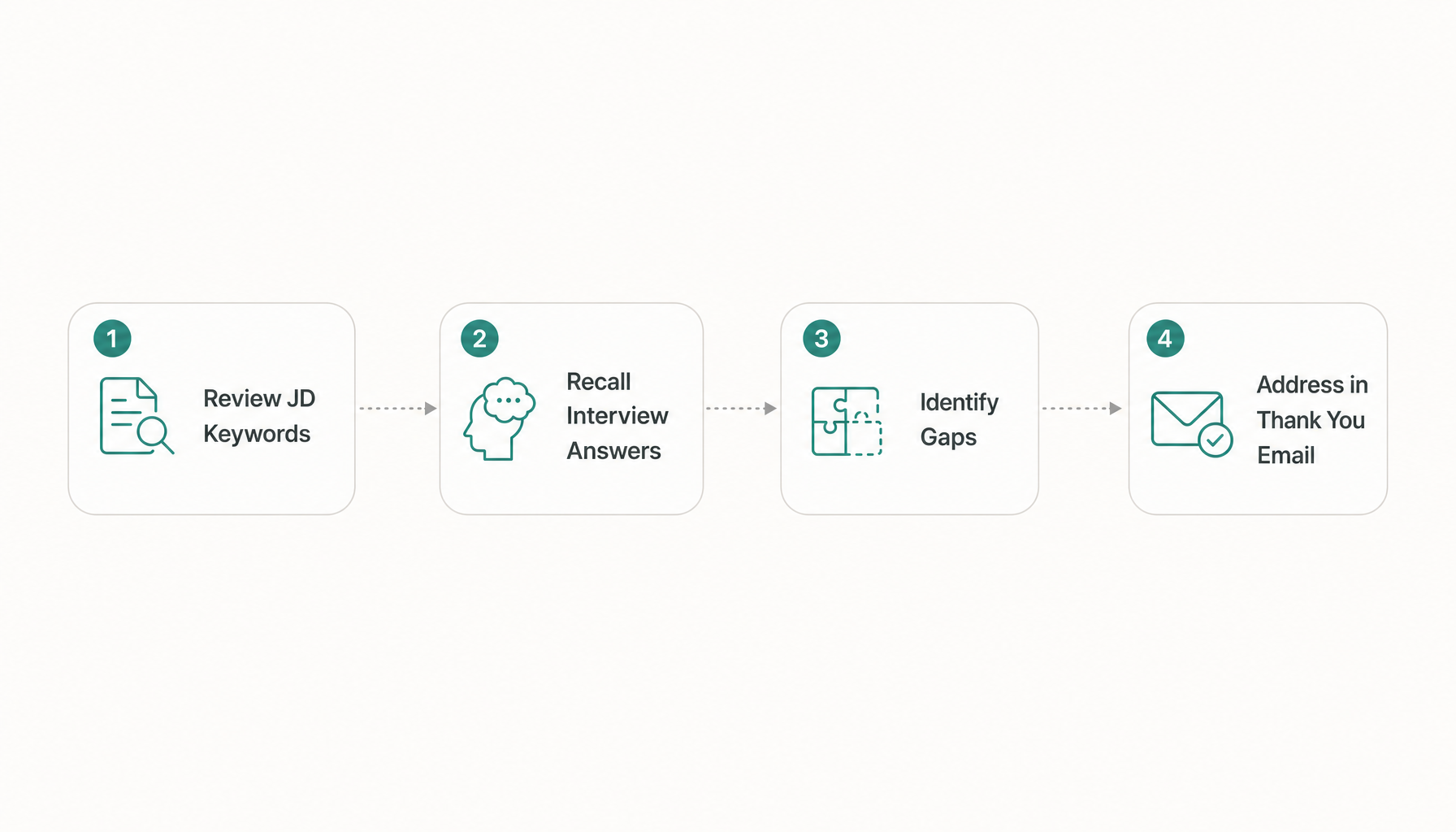
Here's a practical step that helps with #3: before you write the email, go back to the job description and identify which keywords and responsibilities you actually addressed during the interview. You might realize you nailed "data analysis" but completely forgot to mention "client-facing presentations" — and now your email becomes the place to add that.
Want a faster way to see which keywords from the job description you're covering (and which you're missing)? Paste the job description into Resume Inspector — it's free, no credit card needed — and you'll instantly see which terms and skills you may be underselling. That same awareness makes your thank you email sharper because you know exactly which gaps to fill.
Thank You Email Mistakes That Can Cost You the Job Offer
Sending a generic "thanks for your time" email. If your email could apply to any interview at any company, it's doing nothing. Worse, it signals you don't pay attention to details.
Writing a novel. Anything beyond 150 words in the body gets scanned, not read. Hiring managers are reviewing 8-15 candidates. Respect their time.
Apologizing for your performance. "I'm sorry I was nervous" or "I know I rambled on question 3" — never write these. You're planting negative memories that may not even exist.
Using a different tone than the interview. If the conversation was casual and first-name-basis, don't suddenly write like a Victorian letter. Match the energy.
CC'ing multiple interviewers on one email. Always send individual, distinct emails to each person you met. Same template with different names is painfully obvious when they compare notes (and they will).
Attaching your resume again unprompted. They have it. Attaching it again looks like you're not sure they received it — or worse, like a mass-send.
What to Do If You Forgot to Send a Thank You Email
It's been three days. You got overwhelmed, or anxious, or just forgot. Here's the good news: a late thank you email is still better than none, but you need to reframe it.
Don't open with "I'm sorry for the delayed follow-up." That draws attention to the gap.
Do lead with substance. Share an article relevant to something you discussed, mention a thought you had about their challenge, or reference something that happened in the industry since your interview.
Subject: Thought of your team when I saw this
Hi [Name],
I've been thinking about our conversation regarding [specific challenge], and came across [article/news/development] that felt relevant to the approach you described. [One sentence about why it connects.]
I remain very interested in the [Role Title] opportunity and would be glad to discuss further.
Best, [Your name]
This works up to about 5-6 days post-interview. Beyond a week, the window has likely closed for the thank you itself — but you can still send a follow-up email checking on the timeline.
Frequently Asked Questions About Post-Interview Thank You Emails
Should I send a thank you email to a recruiter or just the hiring manager? Both. The recruiter gets a shorter version: thank them for coordinating, express continued enthusiasm, ask about timeline. The hiring manager gets the substantive, personalized version.
What subject line should I use? Keep it simple and scannable. "Thank you — [Role Title] interview" or "Following up on today's conversation" both work. Avoid clever or vague subjects like "Great meeting!" — they read as spam.
Should I send a handwritten note instead? In addition to the email, sure — for executive-level roles or companies with traditional cultures. But never instead of the email. A physical note arrives days later; by then, decisions may already be made.
Is it okay to send a thank you email on LinkedIn instead? Only if all previous communication happened on LinkedIn. Otherwise, use email. LinkedIn messages feel informal and can get buried in a feed full of notifications.
What if I interviewed with five people? Send five separate emails. Each one should reference something unique that person said or asked. Yes, this takes more time. That's the point — it shows you were engaged with each individual, not just going through the motions.
Try our free Job Keyword Scanner to see how your resume stacks up.
Try our free Job Description Analyzer to see how your resume stacks up.
Before your next interview, make sure the resume that got you in the door actually reflects what the role requires. Paste any job description into Resume Inspector — it's free, no credit card needed — and see exactly which keywords you're missing in under a minute. That clarity helps you prepare better answers and write sharper follow-up emails after.