How to Write a Follow Up Email After an Interview (With Templates for Every Situation)
You walked out of the interview feeling good. Maybe great. Then silence. Days pass. You wonder if you said something wrong, if they forgot about you, if you should reach out or just wait.
Here's the reality: the follow up email after an interview isn't optional etiquette. It's a strategic move that most candidates either skip entirely or execute so generically it does nothing. I'm going to give you exact templates for six specific situations — not the same recycled "thank you for your time" nonsense you've already seen.
Why Sending a Follow Up Email After an Interview Actually Matters
When I was recruiting, roughly 40% of candidates never sent a thank you email after an interview. Of those who did, maybe half sent something worth reading. The rest? Copy-pasted templates that felt like form letters.
Here's what a strong follow up email actually accomplishes:
- Reinforces specific qualifications — You get one more chance to connect your experience to their needs.
- Addresses anything you fumbled — Blanked on a question? This is your recovery window.
- Demonstrates genuine interest — Hiring managers are choosing between candidates who seem equally qualified. Enthusiasm becomes the tiebreaker.
- Keeps your name visible — Recruiters review 15–30 candidates for a single role. Your email puts your name back on top of the pile during decision-making.
A 2024 study from Robert Half found that 80% of hiring managers said thank you notes were helpful when evaluating candidates. Not decisive alone — but helpful in a process where margins are thin.
When to Send Your Follow Up Email (Timing Breakdown by Interview Type)
Interview follow up timing matters more than most people realize. Too fast looks desperate. Too slow and the decision's already made.
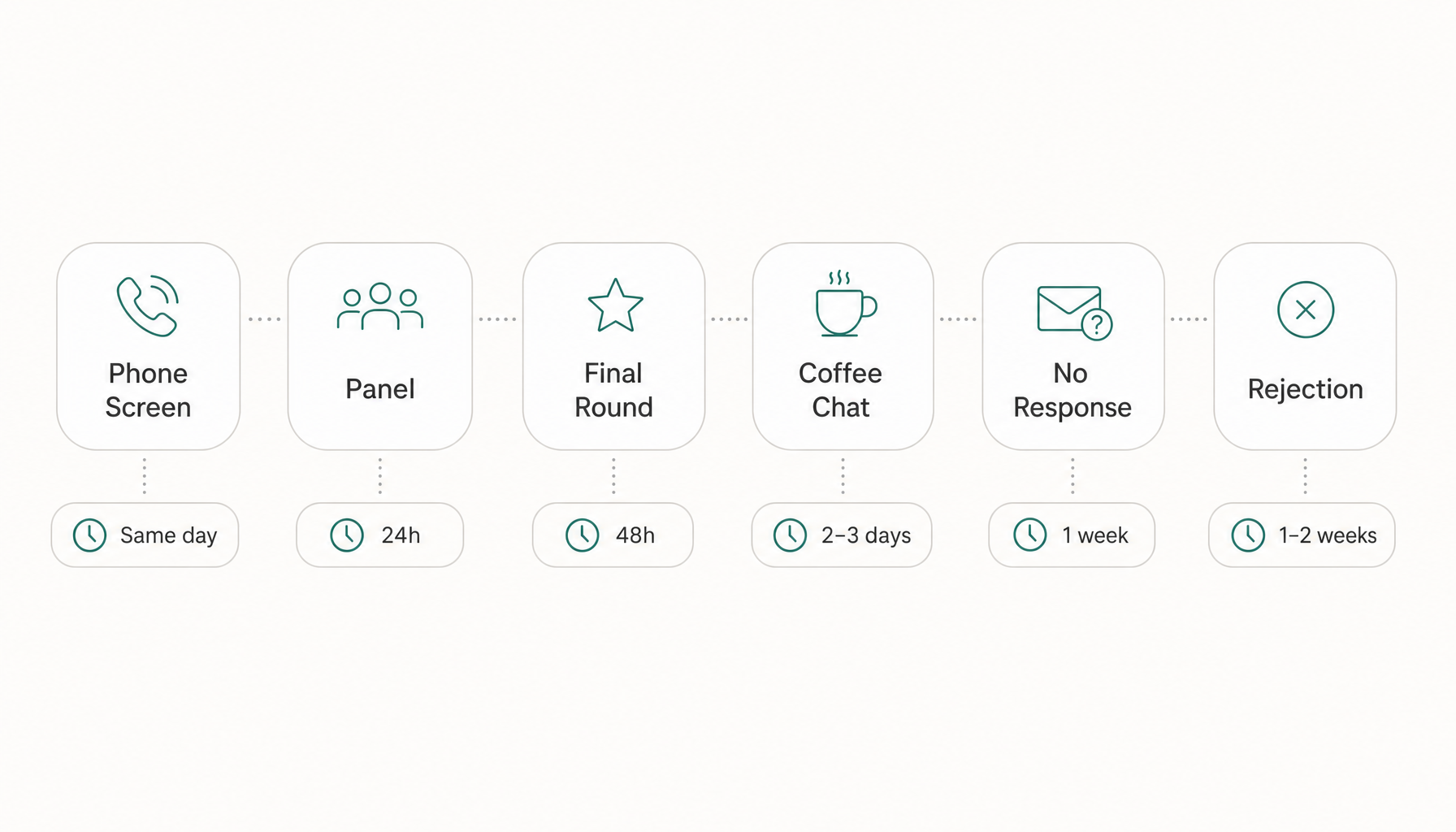
| Interview Type | Send Within | Why |
|---|---|---|
| Phone screen | 12–24 hours | Quick touchpoints need quick follow ups |
| First-round in-person | Same day or next morning | Shows you're organized and engaged |
| Panel interview | Within 24 hours (email each panelist separately) | Personalizing to each person signals effort |
| Second/final round | Same day, ideally within 4 hours | Decisions happen fast at this stage |
| Casual coffee chat / informational | 24–48 hours | Less urgency, but still matters |
| After rejection | 24–48 hours | Keeps the door open for future roles |
The one rule: if you interviewed in the morning, send by end of business that day. If you interviewed in the afternoon, first thing the next morning is fine.
What to Include in Every Follow Up Email After an Interview
Every professional follow up message needs five elements:
- A specific subject line — "Thank you — [Role Title] conversation" works. Avoid vague subjects like "Following up."
- A concrete reference to something discussed — Not "I enjoyed our conversation." Instead: "Your point about migrating the CRM to HubSpot gave me ideas about how my Salesforce integration experience could accelerate that timeline."
- A brief reinforcement of fit — One sentence connecting your strongest qualification to their biggest need.
- Anything you forgot to mention — Keep it to one point. Don't write a second interview in email form.
- A clear closing — State next steps or express readiness for them. "I'm looking forward to hearing about next steps" beats "Please let me know if there's anything else."
What to leave out: salary discussion, questions about benefits, links to your portfolio (unless they asked), and anything longer than 150 words in the body.
Follow Up Email Templates for 6 Common Situations
1. After a Phone Screen
Subject: Thanks for the conversation — [Role Title]
Hi [Name],
Thanks for taking the time to walk me through the [Role Title] position today. The challenge you described around [specific thing they mentioned] resonates with me — I dealt with something similar at [Company] when [brief example, one sentence].
I'm excited about the possibility of moving forward. Please let me know if there's anything else I can provide.
Best, [Your name]
2. After a Panel Interview
Send separate emails to each interviewer. Reference something unique each person said.
Subject: Appreciated the conversation — [Role Title]
Hi [Panelist Name],
I particularly appreciated your question about [topic]. It made me think more about how my experience with [relevant skill] could address [their team's challenge]. I realize I could have elaborated on [specific example] — happy to discuss further if useful.
Looking forward to next steps.
[Your name]
3. After a Second or Final Round
Subject: Following up — [Role Title] final round
Hi [Name],
After today's conversation with [names of people you met], I'm more confident this role is the right fit. Specifically, [one concrete reason tied to what you learned today].
I wanted to reiterate my enthusiasm and mention one thing I didn't get to cover: [brief, relevant point — keep to two sentences max].
I'm ready to move forward whenever makes sense on your end.
[Your name]
4. After a Casual Coffee Chat / Informational Interview
Subject: Thanks for the coffee — really valuable
Hi [Name],
I appreciate you taking the time today. Your insight about [specific thing they shared] is going to change how I approach [relevant aspect of your job search or career].
If anything comes across your desk where my background in [skill/area] might be a fit, I'd love to be considered.
Thanks again, [Your name]
5. No Response After a Week (Second Follow Up)
Subject: Checking in — [Role Title]
Hi [Name],
I wanted to follow up on our conversation on [date]. I remain very interested in the [Role Title] position and the work your team is doing around [specific initiative].
I understand timelines shift — just wanted to confirm my continued interest and see if there's any additional information I can provide.
Best, [Your name]
6. After a Rejection
Subject: Thanks for letting me know
Hi [Name],
I appreciate you taking the time to let me know. While I'm disappointed, I genuinely enjoyed learning about [specific thing]. If similar roles open up in the future, I'd love to be considered.
Wishing you and the team the best with the hire.
[Your name]
How to Write a Second Follow Up Email When You've Heard Nothing
The "no response after interview" situation is the most anxiety-inducing. Here's the framework:
Wait at least 5–7 business days past whatever timeline they gave you. If they said "we'll be in touch next week" and it's been 8 business days, that's your window.
Keep it short. Three to four sentences maximum. Don't rehash your qualifications. Don't express frustration. Don't ask "did I get the job?"
Add value if possible. Did you find an article relevant to something they discussed? Did the company announce something you can reference? This shows you're paying attention without being needy.
Know when to stop. Two follow ups total. If you've sent a thank you email and one check-in with no response, move on. A third email crosses from persistence into pressure.
Follow Up Email Mistakes That Kill Your Chances
These aren't hypothetical. I've seen every one of these end candidacies:
- Sending a group email to all interviewers — It signals laziness. Always personalize individually.
- Writing more than 200 words — Your follow up isn't a cover letter. Hiring managers skim.
- Typos in the hiring manager's name — I once eliminated a candidate who spelled my name wrong twice. It's the one thing you can control.
- Being vague — "I really enjoyed learning more about the company" tells them nothing. Reference specifics.
- Following up on LinkedIn AND email simultaneously — Pick one channel. Using both at once feels aggressive.
- Attaching your resume again — Unless they asked for an updated version, don't. They have it.
How to Customize Your Follow Up Email to the Specific Role
The biggest mistake in post-interview emails? Generic language that could apply to any job at any company. Your follow up should echo the exact language and priorities from the job description.
Here's how to do this concretely:
- Pull up the original job description before writing your follow up.
- Identify the top 2–3 requirements they emphasized during the interview.
- Mirror their terminology in your email. If they called it "cross-functional stakeholder management," don't paraphrase it as "working with different teams."
Not sure which parts of the job description matter most? Paste it into Resume Inspector — free, no signup needed — and you'll instantly see which keywords from the posting your resume hit and which it missed. Those gaps are exactly what to reinforce in your follow up. If the tool shows you're missing "data-driven decision making" and the interviewer asked about your analytical approach, that's your opening to add a concrete example in the email.
This technique works especially well after second-round interviews where multiple interviewers have different priorities. The job description reveals what the organization values; the conversation reveals what each individual cares about. Your follow up bridges both.
Try our free Job Keyword Scanner to see how your resume stacks up.
Quick Checklist Before You Hit Send
Run through this every time:
- Subject line includes the role title
- You've spelled every name correctly (double-check LinkedIn)
- Body is under 150 words
- You reference something specific from the conversation
- You've connected at least one qualification to their stated need
- No typos (read it aloud once)
- You haven't asked about salary, benefits, or timeline pressure
- Sent from a professional email address
- If panel interview: each person gets a unique email
- Sent within the appropriate time window for your interview type
The follow up email after an interview won't rescue a terrible interview. But it absolutely tips the scale when you're in a close race with another candidate — which, in 2026's market, you almost always are. Write it with specifics, send it on time, and move on to your next application while you wait.