How to Write a Resignation Letter That Leaves a Good Impression (With Examples)
Your resignation letter is the last document your employer will associate with you — and it directly shapes the reference they'll give your next employer. I've seen candidates lose offers because a hiring manager called a former boss who said, "Yeah, they left on bad terms." I've also seen mediocre performers get glowing references simply because they handled their departure with grace.
This isn't about etiquette for etiquette's sake. It's about protecting your professional future while you step into whatever comes next.
What Is a Resignation Letter and Why Does It Matter?
A resignation letter is a formal written notice that you're voluntarily ending your employment. It serves three practical purposes:
- Legal documentation — It establishes your last day of work, which affects final paychecks, benefits, and any non-compete timelines.
- Professional record — HR files it permanently. If a future employer calls to verify employment, this letter anchors the narrative.
- Relationship preservation — Your manager reads tone. A bitter, vague, or overly casual resignation letter can sour a relationship you spent years building.
Here's what most people miss: the resignation letter isn't really for you. It's for the person reading it six months from now when someone calls asking, "Would you hire them again?"
What to Include in a Resignation Letter (The 5 Core Elements)
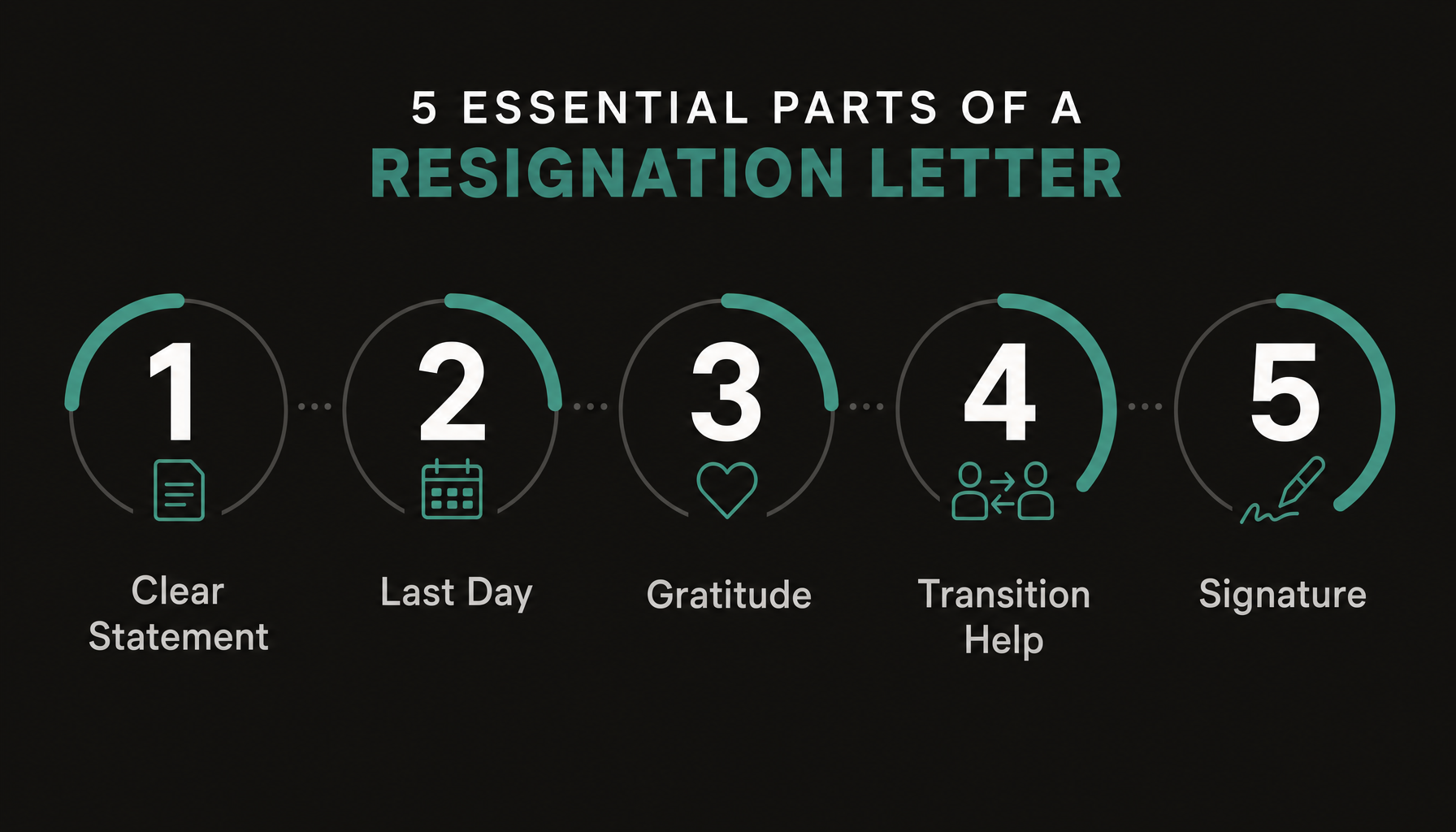
Every professional resignation letter needs these five components, regardless of your industry or reason for leaving:
1. A clear statement of resignation No ambiguity. "I am resigning from my position as [title]" — not "I'm thinking about moving on" or "I wanted to discuss my future here."
2. Your last day of work Specify the exact date. A standard notice period is two weeks, but check your contract — some roles require 30 days or more.
3. A brief expression of gratitude One or two sentences. You don't need to gush. Even if the job was terrible, find something: "I appreciate the opportunity to develop my project management skills here."
4. An offer to help with the transition This is where you earn goodwill. Offer to train your replacement, document your processes, or complete specific projects before you leave.
5. Your signature and date Formal? Yes. Necessary? Absolutely. This is a legal document.
How to Write a Resignation Letter: Step-by-Step
Step 1: Decide your last day before you write anything. Count backwards from your target departure date. If your contract requires two weeks and you want to leave by January 31, 2026, you need to submit by January 17, 2026. Don't write the letter until this date is firm.
Step 2: Open with the resignation statement and date in the first sentence. Your manager is busy. Don't bury the news in paragraph three. Example: "I'm writing to formally resign from my position as Marketing Coordinator, effective February 14, 2026."
Step 3: Add your gratitude line — keep it specific. Generic: "Thank you for everything." Specific: "Working on the Q3 product launch taught me more about cross-functional leadership than any role I've had." Specific wins because it feels genuine and gives your manager something to reference later.
Step 4: Offer transition support with concrete suggestions. Weak: "Let me know if I can help." Strong: "I'd like to spend my final two weeks documenting the vendor relationships I manage and walking Priya through the monthly reporting process."
Step 5: Close warmly but briefly. "I wish you and the team continued success" is fine. Then sign it.
Step 6: Proofread it like a resume. Typos in a resignation letter signal carelessness. Read it aloud once.
Resignation Letter Examples for Common Situations
Standard Two Weeks Notice Letter
Dear Sarah,
I'm writing to formally resign from my position as Account Manager at Brightly Inc., effective March 7, 2026.
I'm grateful for the mentorship you've provided over the past three years, particularly during the Greenfield account expansion. That experience shaped how I approach client strategy.
During my remaining two weeks, I'd like to transition my active accounts to Jake and complete the Q1 pipeline report. I'm happy to adjust this plan based on the team's priorities.
Thank you again for the opportunity. I wish you and the team all the best.
Sincerely, Marcus Chen
Resignation Email (Remote or Distributed Teams)
Subject: Resignation — [Your Name], Effective [Date]
Hi David,
I want to let you know that I'm resigning from my role as Senior Developer, with my last day being April 4, 2026.
I've genuinely enjoyed building the notification system with this team, and I'm proud of what we shipped together. I'd like to spend my remaining time ensuring clean handoff documentation for the microservices I own.
I'm available to discuss timing and transition over a call whenever works for you.
Best, Aisha Patel
Short Tenure (Under One Year)
Dear Michael,
I'm resigning from my position as Operations Analyst, effective February 21, 2026.
While my time here has been brief, I've valued the exposure to supply chain optimization and appreciate the team's support during onboarding. I'll ensure all active projects are documented and handed off cleanly before my departure.
Thank you for the opportunity.
Regards, Tomás Rivera
What NOT to Include in Your Resignation Letter
Don't explain why you're leaving in detail. "I got a better offer" or "I disagree with leadership's direction" — neither belongs here. If asked, share verbally and diplomatically. The letter is permanent.
Don't criticize anyone. Not your manager, not the CEO, not the company culture. I've reviewed resignation letters that read like Glassdoor reviews. Those writers did not get good references.
Don't apologize excessively. "I'm so sorry" repeated three times makes you sound unsure. You're making a professional decision, not asking for forgiveness.
Don't negotiate in the letter. If you're open to a counteroffer, have that conversation in person first. The letter should only exist once your decision is final.
Don't include your new employer's name. It's unnecessary, and in competitive industries, it can create tension or trigger non-compete enforcement.
How to Submit Your Resignation Letter (Timing and Delivery)
Tell your manager verbally first. Always. Schedule a private meeting or video call. Say, "I wanted to let you know that I've decided to move on, and my last day will be [date]. I have a formal letter for you." Then hand over or email the letter immediately after.
Never blindside your boss with a letter dropped on their desk or an email sent at 5pm on Friday. The conversation comes first. The letter is confirmation.
Time it strategically:
- Mid-week (Tuesday through Thursday) gives your manager time to process and plan before the weekend.
- Avoid submitting during major deadlines, company crises, or the day before your manager's vacation — not because you owe them your timeline, but because a calm recipient writes a better reference.
Cc HR when you send the formal letter so there's an official record. Keep a personal copy.
If you're leaving a toxic situation: You still follow this formula. The letter protects your reputation, not theirs. Write it clean. Vent to your friends.
Now that you know how to leave professionally, the next step is making sure your resume is ready for what comes next. If you're already eyeing new roles, paste any job description into Resume Inspector — it's free, no signup needed — and you'll see exactly which keywords your resume is missing before you hit apply. Getting that fit score takes under a minute and tells you whether you need to tailor your resume to each role or if you're already in good shape.
Try our free Job Keyword Scanner to see how your resume stacks up.
Frequently Asked Questions About Resignation Letters
How long should a resignation letter be? Three to five short paragraphs. Under 200 words is ideal. This is not a personal essay.
Can I resign via email? Yes, especially for remote roles or distributed teams. A resignation email has the same legal weight as a printed letter. Use a clear subject line: "Resignation — [Your Name], Effective [Date]."
What if I don't want to give two weeks notice? Check your employment contract and local labor laws. In most at-will employment situations in the US, two weeks is customary but not legally required. However, leaving without adequate notice burns bridges and can result in a "not eligible for rehire" flag on your file.
Should I mention where I'm going? No. It's irrelevant to the letter's purpose and can create complications. If your manager asks in person, you can share at your discretion.
What if my boss reacts badly? That's their problem, not yours. A professional, gracious letter limits their ability to paint you as the difficult one. You've created a paper trail of maturity. That matters.