How to Write a LinkedIn Summary With No Experience (That Actually Gets Noticed)
You have no job titles, no corporate achievements, no "10+ years in…" anything. And LinkedIn's About section is staring back at you like a blank exam you didn't study for.
Here's what most people in your position do: they either leave it empty (which signals "I don't care") or write something painfully generic ("Hardworking student seeking opportunities to grow"). Both are invisible to recruiters.
The good news: you don't need work experience to write a LinkedIn summary that gets noticed. You need a framework. Here's the one I used to coach hundreds of new grads into profiles that actually generated inbound messages.
Why Your LinkedIn Summary Matters Even Without Work Experience
Your LinkedIn summary isn't a resume rehash. It's a pitch — a 2,600-character window where you tell someone why they should care about you before you have credentials doing the talking.
For students and recent graduates, this section carries disproportionate weight. Why? Because your experience section is thin. Recruiters scanning entry-level candidates spend more time in the About section precisely because they need context your bullet points can't provide. They're looking for signal: direction, self-awareness, relevant interests, and communication ability.
A blank summary says "I haven't thought about what I want." A thoughtful one says "I know where I'm headed, and here's why I'll get there."
What Recruiters Actually Look for in an Entry-Level LinkedIn Summary
I spent years reviewing profiles as a recruiter. When I opened a student or new grad profile, I wasn't looking for impressive job titles — I knew those didn't exist yet. I was scanning for three things:
- Direction — Does this person know what kind of role they want, or are they spraying applications everywhere?
- Relevant signal — Projects, coursework, volunteer work, certifications, or self-directed learning that maps to the role.
- Communication quality — Can they write clearly? Do they sound like a real person or a template?
That's it. You don't need to be impressive. You need to be specific and clear.
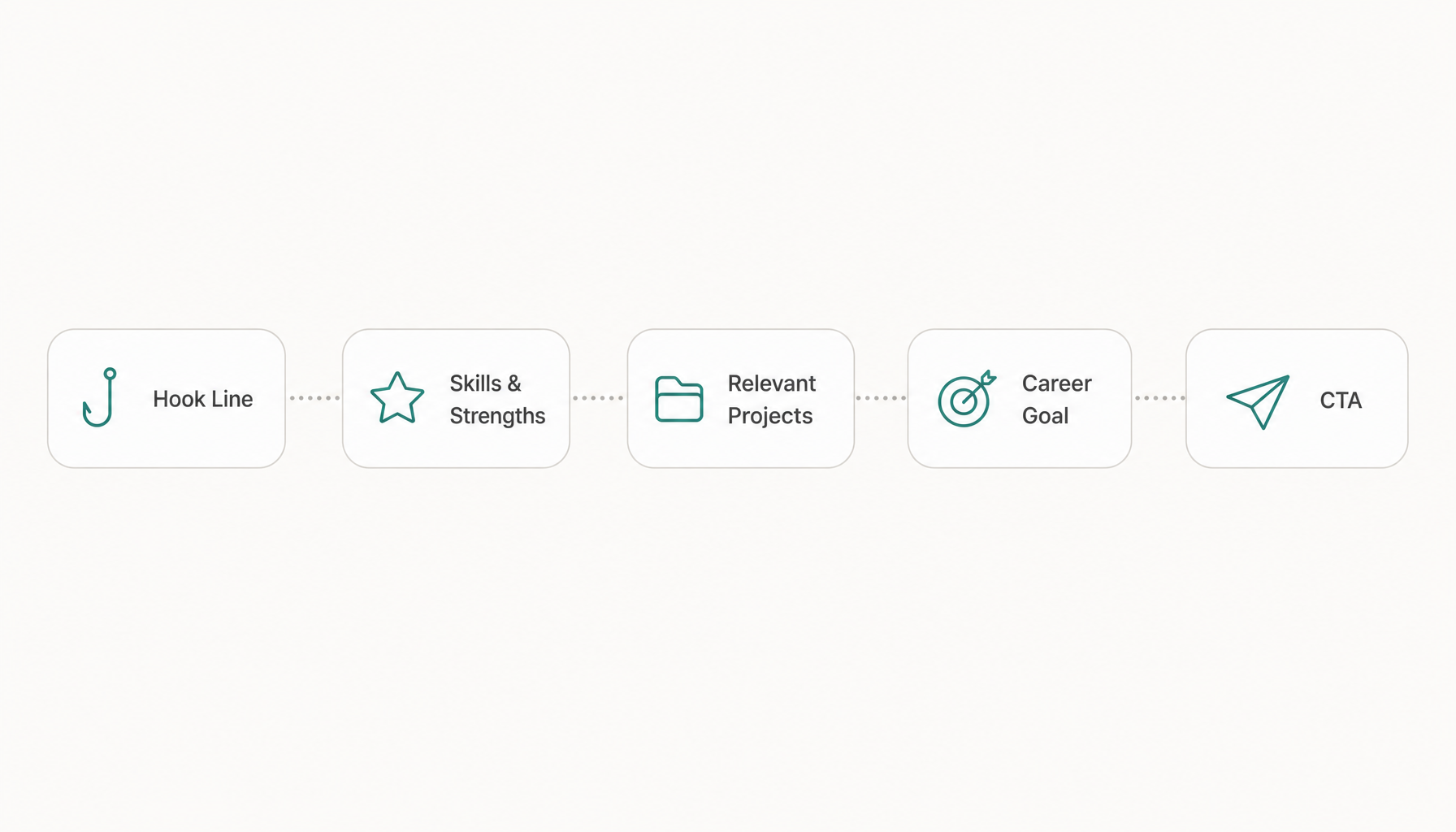
The 5-Part Framework for Writing a LinkedIn Summary With No Experience
This framework works whether you're a college sophomore, a recent graduate, or someone pivoting into a new field with no formal background.
Part 1: The Hook (1-2 sentences) Open with what you're pursuing and why it matters to you. Not "I'm a passionate individual." Instead: state the problem you want to solve or the type of work that energizes you.
Example: "I got hooked on data analysis after using Python to map food desert patterns in my city for a sociology research project."
Part 2: The Evidence (2-3 sentences) Back up your hook with what you've actually done — even if it's academic or informal. Coursework, a class project, a personal side project, volunteer work, a certification.
Part 3: The Skills Bridge (1-2 sentences) Name the specific skills you've built that are relevant to your target role. Use the same language job postings use.
Part 4: The Direction (1 sentence) State clearly what you're looking for. "Seeking a junior data analyst role in healthcare" is 10x more useful than "open to opportunities."
Part 5: The Invitation (1 sentence) End with a low-friction way for someone to connect. "Always happy to talk about [topic]" or "Reach out if you're working on [X] — I'd love to learn more."
What to Include When You Have No Work History (and What to Use Instead)
Stop thinking "experience = employment." Here's what counts:
- Academic projects — Especially capstones, research, or anything with measurable output. "Built a financial model projecting revenue for a local nonprofit" is legitimate experience.
- Volunteer and leadership roles — Organized a fundraiser that raised $4,000? Led a student org with 30 members? That's project management.
- Self-directed learning — Completed Google's Data Analytics Certificate. Built a portfolio website. Contributed to an open-source project.
- Freelance or informal work — Managed social media for a friend's small business. Tutored students in statistics. Designed flyers for campus events.
- Relevant coursework — Only if specific. "Advanced Econometrics" tells me something. "General Education Requirements" does not.
The key: connect each item to a transferable skill using language from real job descriptions in your target field.
LinkedIn Summary Examples for Students and Recent Graduates
Example 1: Marketing student
I became obsessed with understanding why people click after running A/B tests on email subject lines for my university's alumni association — and watching open rates jump 34% with one word change.
Through coursework in consumer behavior and digital marketing, plus managing Instagram content for two student organizations (growing one account from 200 to 1,400 followers), I've built hands-on skills in content strategy, copywriting, social media analytics, and email marketing.
I'm looking for an entry-level digital marketing or social media coordinator role where I can bring a data-informed approach to content creation. If you're building something interesting in B2C marketing, I'd love to connect.
Example 2: CS recent graduate
I built my first full-stack app during a 48-hour hackathon junior year — a campus ride-sharing tool that matched 200+ students in its first week. That experience taught me I want to build products that solve real, immediate problems.
My toolkit: JavaScript, React, Node.js, PostgreSQL, and Python. I've completed three team-based software projects using Agile methodologies, contributed to two open-source repositories, and hold AWS Cloud Practitioner certification.
Seeking a junior software engineering role at a product-focused company. Happy to talk about web development, hackathon war stories, or anything full-stack.
Notice: no apologies for being new. No "despite my limited experience." They lead with evidence and direction.
Common Mistakes That Make Entry-Level Summaries Easy to Ignore
- Starting with "I am a…" — Boring opener. Lead with a story, a result, or a specific interest.
- Being vague about goals — "Open to various opportunities in business" tells a recruiter nothing. Pick a direction, even if it's not permanent.
- Listing soft skills without proof — "Strong communicator and team player" is meaningless. Show it: "Presented research findings to a panel of 40 faculty members."
- Writing in third person — "John is a motivated student who…" feels bizarre on LinkedIn. First person is standard.
- Copying templates word-for-word — Recruiters see thousands of profiles. Template language ("results-driven professional seeking to leverage...") is immediately recognizable and immediately skipped.
How to Tailor Your LinkedIn Summary for a Specific Industry or Role
Your summary should mirror the language of the roles you're targeting. Here's how:
- Pull up 5 job descriptions for your ideal entry-level role.
- Highlight recurring keywords — tools, methodologies, responsibilities that appear in 3+ postings.
- Weave those terms naturally into your summary. If every junior data analyst posting mentions "SQL," "data visualization," and "stakeholder communication," those phrases belong in your About section.
- Adjust your hook to match industry values. Finance values precision and analytical thinking. Creative fields value curiosity and portfolio work. Tech values building things.
This isn't gaming the system. It's speaking the same language as the people you want to hire you.
Once your LinkedIn summary is dialed in, your resume needs to tell the same story. Want to check if it actually aligns with the jobs you're targeting? Paste any job description into Resume Inspector — it's free, no credit card needed — and you'll see exactly which keywords are missing and where your resume falls short. Takes about 60 seconds.
Try our free Job Keyword Scanner to see how your resume stacks up.
Try our free Job Description Analyzer to see how your resume stacks up.
Quick Checklist Before You Hit Save
Run through this before publishing:
- Opens with a specific hook (not "I am a student at...")
- Mentions at least 2 concrete projects, experiences, or results
- Includes 3-5 keywords from target job descriptions
- States a clear direction (role type, industry, or both)
- Written in first person
- Ends with a low-friction invitation to connect
- Under 2,600 characters (LinkedIn's limit)
- No apologies or disclaimers about being "new" or "inexperienced"
- Read aloud — sounds like a real person talking, not a template
Your lack of traditional experience isn't the problem. The problem is letting that fact make you invisible. A specific, well-structured LinkedIn summary signals exactly what recruiters need from entry-level candidates: clarity, direction, and evidence that you've already started doing the work — even before someone paid you for it.
For more on building a profile that supports your applications, check out our LinkedIn profile tips guide.