How to Write a LinkedIn Recommendation That Actually Gets Read (With Examples)
Most LinkedIn recommendations are forgettable. They read like this: "John is a great team player and hard worker. I highly recommend him." That tells a hiring manager nothing. It occupies space on a profile without earning a single second of attention.
A strong LinkedIn recommendation does three things: it names a specific skill, illustrates it with a real moment, and makes the reader think "I want to work with this person." Here's how to write one that actually accomplishes that — for any relationship type.
What Makes a LinkedIn Recommendation Worth Reading
I've read thousands of LinkedIn profiles as a recruiter. The recommendations I actually paused on shared these qualities:
- Specificity over adjectives. "Sarah rebuilt our onboarding flow and cut new-hire ramp time from 6 weeks to 3" beats "Sarah is very organized."
- A concrete story or result. One real moment proves more than five generic traits.
- Credibility signals. The reader needs to understand your relationship — how long you worked together, in what capacity, on what projects.
- Brevity. Three to five sentences. Anything longer gets skimmed.
The difference between a recommendation that strengthens someone's LinkedIn profile and one that clutters it is almost always detail.
Before You Start Writing: What to Ask the Person You're Recommending
This step gets skipped constantly, and it's the single biggest quality lever you have. Before writing a word, send them this message:
"I'd love to write you a recommendation. To make it as useful as possible, can you tell me: (1) what roles or opportunities you're targeting, (2) which skills or projects you'd most want highlighted, and (3) anything specific you'd like me to mention?"
Why this matters: A product manager pivoting to consulting needs different language than one pursuing a VP role. A recommendation that highlights "stakeholder management across 4 cross-functional teams" serves one goal. "Built and scaled a team from 3 to 15" serves another. You can't hit the target if you don't know where it is.
The 4-Part Structure Every Strong LinkedIn Recommendation Follows
Use this framework regardless of relationship type:
- Context — How you know them, how long, in what capacity.
- Specific skill or trait — One or two things they excel at, named clearly.
- Evidence — A real example, result, or story that proves the skill.
- Forward-looking statement — Who would benefit from working with them, or what they're uniquely suited for.
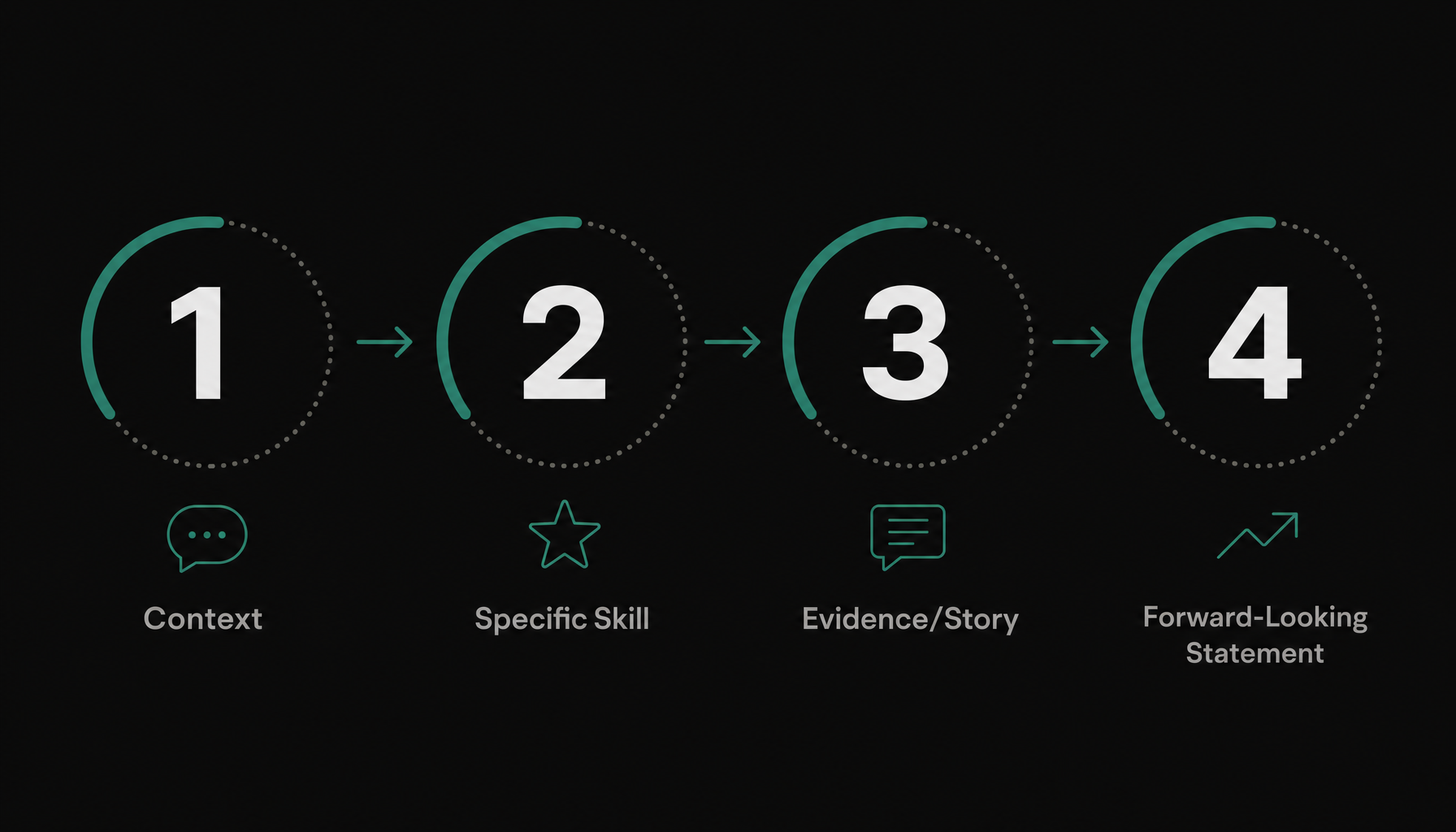
This structure works because it mirrors how we evaluate professional reference letters: relationship credibility, then proof, then endorsement. Each piece supports the next.
How to Write a LinkedIn Recommendation for a Colleague
When recommending a peer, your credibility comes from proximity — you worked alongside them daily and saw things managers missed.
Example:
"I worked alongside Marcus for two years on the growth marketing team at Finley. He's the person I'd go to whenever a campaign wasn't converting — he has an instinct for diagnosing funnel problems that I've never seen in another marketer. During our Q3 2025 product launch, he identified that our landing page copy was misaligned with the ad creative, rebuilt the page in 48 hours, and conversion jumped 34%. Any team doing performance marketing would be lucky to have him."
Notice: no filler words, one clear story, a measurable result, and a forward-looking close.
How to Write a LinkedIn Recommendation for a Manager or Boss
Writing up is tricky because flattery reads as political. Focus on what they did that made your work better, not how great they are.
Example:
"I reported to Priya for 18 months at Cortland Health. She's the rare manager who gives direct feedback in real time — not vague suggestions in quarterly reviews. When I was struggling to prioritize across three concurrent projects, she sat down with me for 20 minutes, helped me build a decision matrix, and then got out of my way. I shipped all three on time. Leaders who actually develop their people (rather than just managing tasks) are rare, and she's one of them."
How to Write a LinkedIn Recommendation for a Direct Report
Recommending someone you managed carries weight because you evaluated their performance. Avoid sounding like a performance review — sound like a champion.
Example:
"I managed Dani during her first year as a data analyst at BrightPath. Within three months, she was producing insights the senior analysts weren't catching — specifically, she identified a customer churn pattern tied to our billing cycle that saved us an estimated $180K in annual revenue. She's analytically rigorous but also knows how to communicate findings to non-technical stakeholders without dumbing them down. She's ready for a senior role, and whoever hires her next is getting someone who operates above her title."
How to Write a LinkedIn Recommendation for a Friend or Peer
When you haven't worked together formally, credibility is thinner — so you need to be explicit about what you've observed and in what context.
Example:
"I've collaborated with Tomás on three freelance projects over the past year, and I've referred two of my own clients to him. He's a brand strategist who does something unusual: he pushes back on briefs that don't make strategic sense, even when it means more work for him. On our last project together, he convinced the client to reposition their entire launch messaging — and their pre-order numbers doubled their target. I'd work with him again without hesitation."
LinkedIn Recommendation Examples You Can Actually Use
Here's a fill-in-the-blank template based on the 4-part structure:
"I [worked with / reported to / managed] [Name] for [duration] at [Company], where we [context of collaboration]. They're exceptionally strong at [specific skill] — for example, [one concrete story or result]. [Forward-looking statement about who would benefit from working with them]."
Adapt the template above to any of the relationship types. The key constraint: keep it under 100 words. LinkedIn displays a truncated preview, and if the first two lines are generic, no one clicks "see more."
Common Mistakes That Weaken LinkedIn Recommendations
- Leading with "I highly recommend..." — This is the conclusion. Put it last (or skip it entirely — the recommendation's existence IS the endorsement).
- Listing traits without proof. "Creative, driven, detail-oriented" means nothing without a story.
- Writing too long. Over 150 words, engagement drops. You're not writing a professional reference letter — you're writing a proof point.
- Copying the same recommendation for multiple people. Recruiters check. It devalues both.
- Confusing endorsements with recommendations. A LinkedIn endorsement is a one-click skill validation. A recommendation is a written narrative. They serve completely different purposes.
How to Send a LinkedIn Recommendation Request (and Get One Back)
When requesting a recommendation, don't use LinkedIn's default generic message. Instead:
"Hi [Name], I'm updating my LinkedIn profile as I explore [type of role]. Would you be open to writing a short recommendation focused on [specific project or skill]? I'm happy to write one for you as well — just let me know what you'd want highlighted."
This works because you're (1) making it easy by specifying what to write about, (2) offering reciprocity, and (3) giving context for why now.
Timing matters: request recommendations when the work is fresh — within a few weeks of completing a project, wrapping up a contract, or transitioning roles. Don't wait six months and ask someone to recall specifics.
A strong LinkedIn recommendation is one piece of a larger professional presence. It builds trust before an interview even happens. While you're strengthening your LinkedIn profile, make sure your resume is keeping up — paste any job description into Resume Inspector free, no credit card needed, and see exactly which keywords you're missing in under a minute.