How to List Volunteer Work on a Resume (The Right Way, With Examples)
You coached youth basketball for three years, organized fundraisers that raised $40,000, or built a nonprofit's website from scratch — but you're staring at your resume wondering if any of that "counts." It counts. The problem isn't whether to include volunteer work. It's that most people list it like an afterthought, stripped of context, buried at the bottom, and written in a way that tells hiring managers nothing useful.
Here's how to list volunteer work on a resume so it actually moves the needle on your application.
Does Volunteer Work Belong on a Resume? (Short Answer: Usually Yes)
Volunteer experience belongs on your resume when it demonstrates skills relevant to the job you're targeting. That's the only filter that matters.
A 2024 Deloitte study found that 82% of hiring managers prefer candidates with volunteer experience, and 85% are willing to overlook other resume shortcomings when they see it. But those numbers only work in your favor when the volunteering connects to the role.
Include volunteer work when:
- It fills an employment gap with productive activity
- It demonstrates transferable skills the job requires (project management, budgeting, teaching, technical work)
- You're entry-level or changing careers and need to prove capability
- It shows industry-specific experience (volunteering at a clinic when applying to healthcare)
Skip it when:
- Your resume is already two pages and the volunteering adds nothing relevant
- The experience is decades old and unrelated to your current direction
- It involves politically or religiously divisive organizations and the employer isn't aligned
Where to Put Volunteer Work on a Resume
Placement signals importance. Where you put volunteer work tells the hiring manager how seriously to take it.
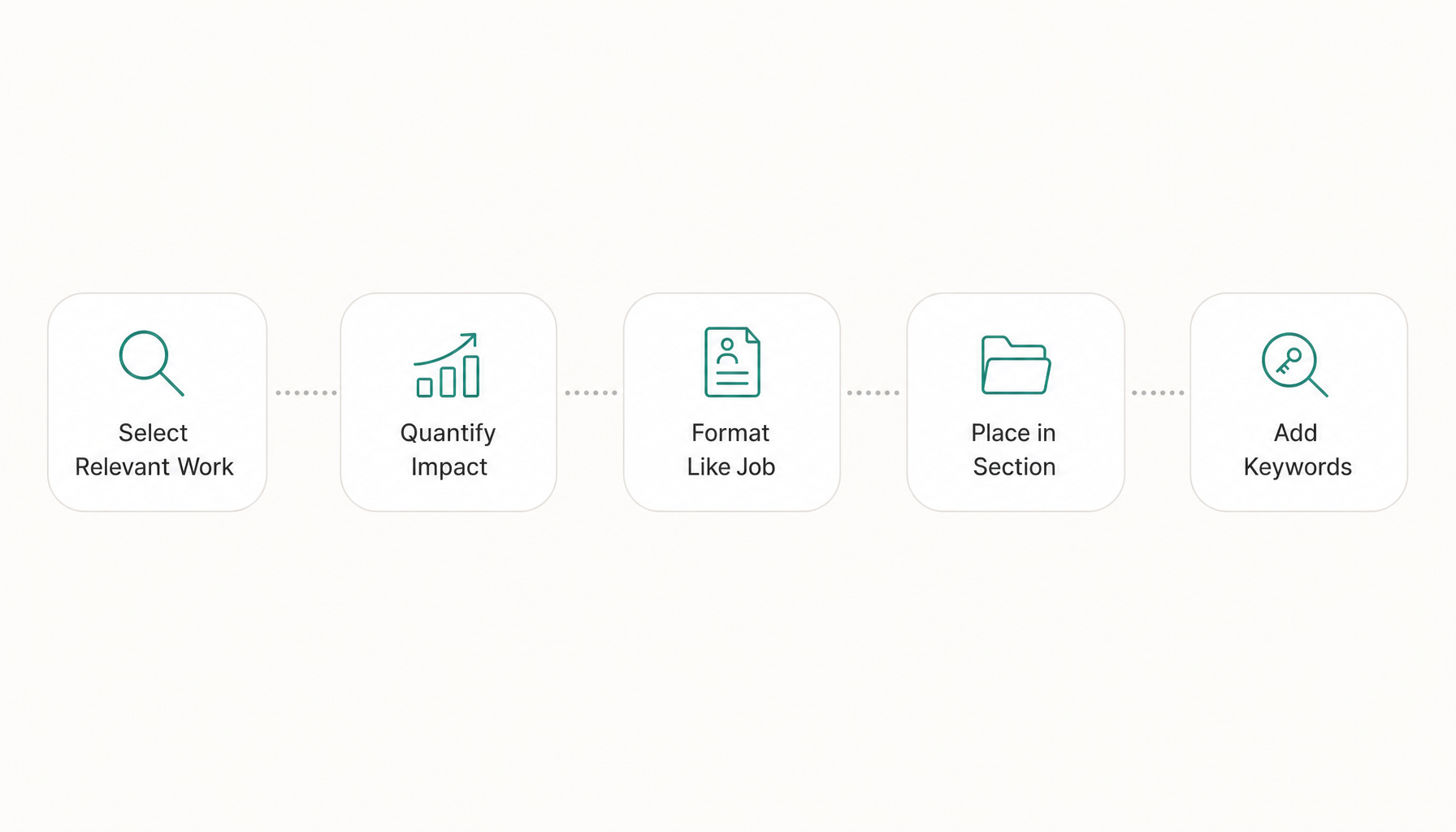
Option 1: Integrated into your main "Experience" section — Use this when the volunteer role is directly relevant to the job and demonstrates core competencies the employer needs. Don't label it "Volunteer Experience" separately; just include it chronologically with your paid roles.
Option 2: A dedicated "Volunteer Experience" or "Community Involvement" section — Use this when you have sufficient paid experience but want to round out your profile. Place it after your work experience and skills sections.
Option 3: Within your resume summary — Mention it in one line if a specific volunteer accomplishment is your strongest proof of fitness for the role.
For entry-level candidates or career changers with limited relevant paid work, Option 1 is almost always the right call. For experienced professionals, Option 2 keeps the resume organized without burying relevant skills.
How to Format a Volunteer Work Entry
Format volunteer entries identically to paid positions. This signals to both ATS software and human readers that the experience carries weight.
Volunteer Marketing Coordinator
Habitat for Humanity, Austin Chapter | March 2024 – Present
- [Bullet point with accomplishment]
- [Bullet point with accomplishment]
- [Bullet point with accomplishment]
Include these elements:
- Title (use the actual role title, or create a descriptive one if none existed)
- Organization name and location
- Date range (month/year format)
- 2–4 bullet points with measurable accomplishments
Don't write "(Volunteer)" after the title unless you're integrating it into your main experience section and want to be transparent. If it's in a dedicated volunteer section, the context is already clear.
How to Write Bullet Points for Volunteer Experience That Actually Impress Hiring Managers
The single biggest mistake: writing volunteer bullet points as task descriptions instead of accomplishment statements. "Helped organize events" tells a hiring manager nothing. Here's how to fix that.
Use this formula: Action verb + What you did + Measurable result
Bad: "Assisted with social media for the organization."
Good: "Grew Instagram following from 400 to 2,800 in 6 months by creating a content calendar and producing 3 Reels per week, increasing event attendance by 35%."
Bad: "Tutored students."
Good: "Tutored 12 high school students in algebra twice weekly, with 10 of 12 improving test scores by at least one letter grade within one semester."
The key is treating unpaid work with the same rigor you'd apply to paid roles. Quantify everything. Hours managed, people supervised, dollars raised, percentage improvements, deadlines met.
When to List Volunteer Work as Work Experience vs. a Separate Section
This decision depends on one question: Is the volunteer role doing the heavy lifting on your resume, or is it supporting an already-strong work history?
List as work experience when:
- You have fewer than 2 years of paid experience in your target field
- The volunteer role is the most relevant experience you have for the job
- You held significant responsibility (managed people, owned budgets, led projects)
- You're changing careers and the volunteer work bridges the gap
List in a separate section when:
- You have 5+ years of relevant paid experience
- The volunteer work supplements but doesn't replace your professional qualifications
- The role was periodic or part-time without major accomplishments
When integrating into your main experience section, you can add "(Volunteer)" after the title for clarity, but don't apologize for it. A hiring manager at a marketing agency doesn't care whether you were paid to run a campaign that generated 500 leads — they care that you can do it.
Volunteer Work Resume Examples (Entry-Level, Career Changer, and Experienced Professional)
Entry-Level (Recent Graduate, Limited Work Experience)
Program Coordinator (Volunteer)
Big Brothers Big Sisters, Denver, CO | Sept 2024 – Present
- Coordinate weekly mentorship sessions for 18 mentor-mentee pairs, managing scheduling
  conflicts and ensuring 92% attendance rate
- Developed onboarding guide for new volunteers, reducing training time from 3 weeks to 5 days
- Track program outcomes in Salesforce, generating monthly reports for the regional director
This entry works because it proves organizational skills, software proficiency, and process improvement — all transferable to entry-level operations or admin roles.
Career Changer (Moving from Retail to UX Design)
UX Design Volunteer
Code for America, Remote | Jan 2025 – Dec 2025
- Redesigned the intake form for a county benefits portal, reducing user drop-off by 40%
  across 3,000 monthly submissions
- Conducted 15 user interviews and synthesized findings into personas that guided
  the design team's sprint priorities
- Created wireframes and interactive prototypes in Figma, presenting iterations to
  stakeholders in bi-weekly reviews
This belongs in the main experience section because it demonstrates the exact skills a UX design role requires. Labeling it "volunteer" is fine — the work speaks for itself.
Experienced Professional (Adding Depth to a Strong Resume)
COMMUNITY INVOLVEMENT
Board Treasurer, Local Nonprofit Education Fund | 2023 – Present
- Oversee $1.2M annual budget and present quarterly financial reports to 9-member board
- Led audit preparation that resulted in zero findings for two consecutive years

Volunteer Tax Preparer, VITA Program | Jan – April 2026
- Prepared 85+ federal and state returns for low-income filers with 100% accuracy rate
For an experienced accountant or financial analyst, this section reinforces expertise without competing with paid experience for attention.
Common Mistakes to Avoid When Listing Volunteer Work
Listing every volunteer experience you've ever had. Relevance beats volume. Two targeted entries outperform six random ones.
Using vague language. "Helped with fundraising" is worthless. "Co-led annual gala that raised $62,000, exceeding goal by 24%" is a hiring argument.
Burying relevant volunteer work at the bottom. If your volunteer experience is your strongest evidence for the job, putting it last guarantees the recruiter never sees it. Most spend 6–8 seconds on initial scan.
Ignoring ATS keyword alignment. Your volunteer bullet points need to contain the same terminology the job description uses. If the posting says "stakeholder management" and you wrote "worked with people," you're invisible to the ATS. This is where most candidates lose — they format correctly but miss the keyword matching that actually gets them past automated screening.
Omitting dates. Dateless entries look like you're hiding something. Include them.
How to Know If Your Volunteer Work Is Helping or Hurting Your Resume
The real test isn't whether your resume "looks good" — it's whether the specific language in your volunteer entries matches what the ATS is scanning for. You might describe your experience perfectly from a storytelling perspective but use none of the keywords the employer's system is filtering on.
Here's a quick self-audit: pull up the job description you're targeting. Highlight every skill, tool, and qualification mentioned. Now check your volunteer bullet points. How many of those highlighted terms appear, either verbatim or as close synonyms?
If the overlap is thin, your volunteer section is taking up space without earning its keep. You need to rewrite those bullets using the employer's language — not generic descriptions of what you did.
Try our free Job Keyword Scanner to see how your resume stacks up.
Not sure if your volunteer bullet points are landing the right keywords? Paste any job description into Resume Inspector — free, no credit card needed — and you'll see in under a minute which skills are showing up and which ones aren't. It's the fastest way to know whether that carefully crafted volunteer section is actually registering with the systems employers use to filter candidates.