How to Explain an Employment Gap (Without Awkward Silence or Oversharing)
You have a gap on your resume. Maybe it's six months, maybe it's three years. And every time you think about applying for a job, that blank space feels like a flashing neon sign screaming "DON'T HIRE THIS PERSON."
Here's the truth: the gap itself almost never costs you the job. Your explanation of it—awkward, over-apologetic, or evasive—is what creates doubt. Let me show you exactly how to address employment gaps on your resume, in cover letters, and in interviews with scripts you can steal word-for-word.
Why Employment Gaps Are Less Disqualifying Than You Think in 2026
The stigma around gaps in work history has eroded dramatically. A 2023 LinkedIn study found that 62% of employees have taken a career break at some point. Post-pandemic hiring norms, widespread layoffs across tech and media in 2023–2025, and growing acceptance of non-linear careers mean recruiters have seen it all.
Here's what actually matters to hiring managers when they spot a gap:
- Can you still do the job today? (Are your skills current?)
- Are you reliable? (Will you show up and stay?)
- Are you hiding something problematic? (Fired for cause? Legal issues?)
That's it. They're not judging you for taking time off. They're assessing risk. Your job is to eliminate that perceived risk in under 30 seconds.
How to Explain an Employment Gap on Your Resume
You have two structural options, depending on gap length:
For gaps under 12 months: Use years only (not months) in your employment dates. "2022–2024" covers a lot of ground without lying.
For gaps over 12 months: Add a single line entry that accounts for the time:
Career Break | 2023–2025
Primary caregiver for family member. Maintained industry knowledge through
[specific course], [certification], or [freelance project].
The key is making the entry boring. Don't over-explain. Don't write a paragraph. One line that names it, one line that shows you stayed engaged. That's enough to satisfy ATS systems and human reviewers scanning in 6 seconds.
What NOT to do: Leave the gap completely unexplained and hope nobody notices. Recruiters always notice. A proactive one-liner beats an awkward discovery every time.
How to Explain an Employment Gap in a Cover Letter
Your cover letter is where you get to control the narrative with tone and context—something a resume can't do. But most people either ignore the gap entirely (leaving the reader to wonder) or spend three paragraphs apologizing for it (which signals low confidence).
The formula: one sentence acknowledging it, one sentence pivoting to readiness.
Example for a layoff gap: "After my team was eliminated during [Company]'s restructuring in early 2025, I used the transition period to complete my PMP certification and consult on two short-term projects in supply chain optimization. I'm now focused on a full-time role where I can apply both my decade of operations experience and this updated credential."
Example for a caregiving gap: "I stepped away from full-time work for two years to serve as primary caregiver for a family member—a chapter that's now closed. During that time, I kept current with [industry] trends through [specific action], and I'm energized to bring that perspective back into a [target role] capacity."
Notice what both examples do: name the gap without shame, demonstrate current-state readiness, and pivot immediately toward value. No oversharing. No apology.
Before sending that cover letter, make sure the rest of it is hitting the right keywords for the role. A mismatch between your language and the job description's language will hurt you more than any gap explanation. You can check keyword alignment with a free job description analysis to see what terms you might be missing.
How to Explain an Employment Gap in a Job Interview
Interviews are where gaps feel scariest—but they're also where you have the most control. You can use vocal tone, body language, and pacing to make your answer feel completely unremarkable.
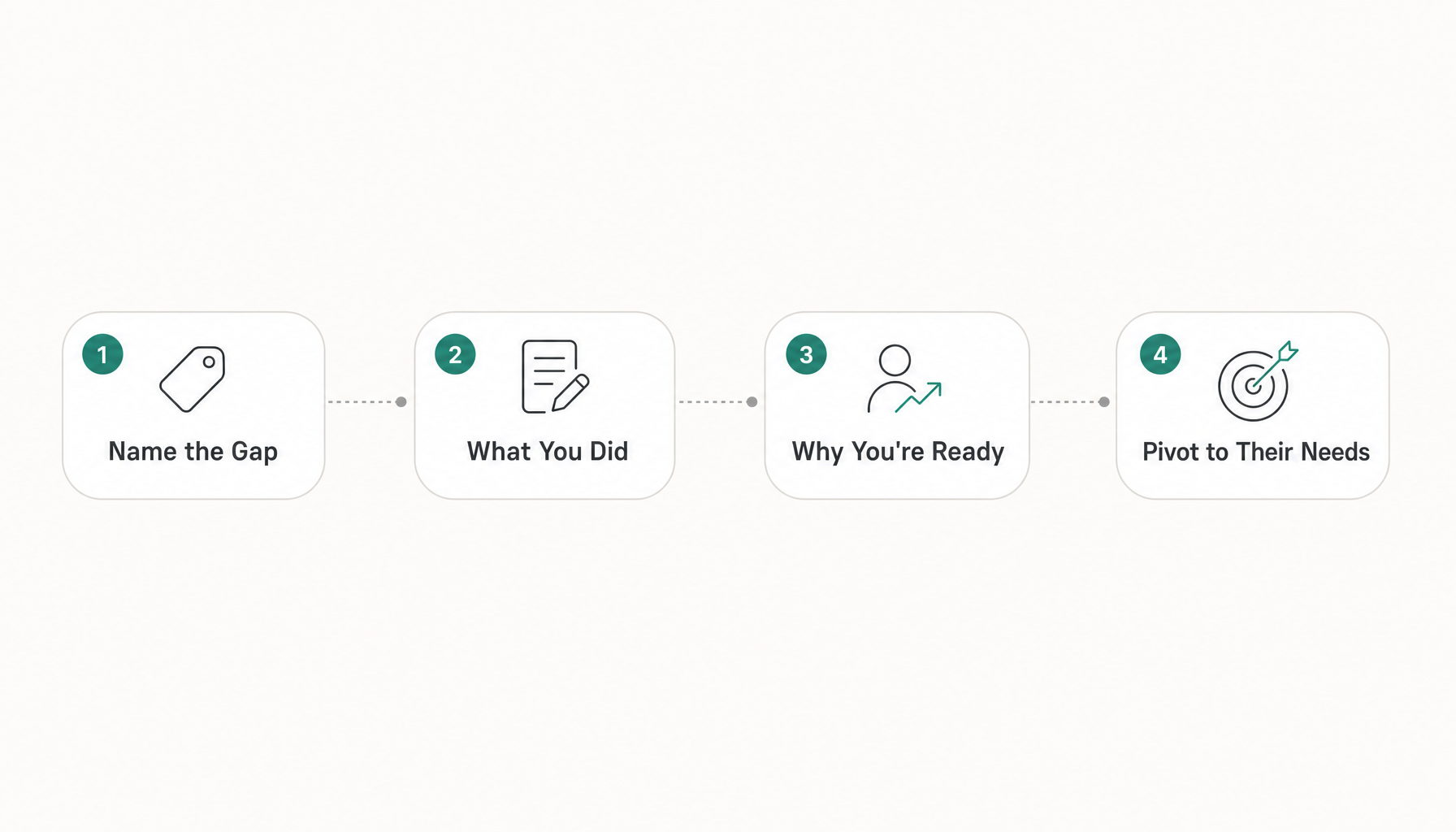
The 3-part formula (keep your answer under 30 seconds):
- Name it plainly (2 seconds)
- Explain what you did with the time (10 seconds)
- Bridge to why you're ready now (15 seconds)
Delivered with calm confidence, this structure makes the interviewer's brain file your gap as "resolved" and move on.
Scripts for the Most Common Types of Employment Gaps
Layoff
"My entire division was eliminated when [Company] restructured their [department] in [month/year]. Since then, I've completed [specific upskilling] and stayed active through [consulting/volunteering/projects]. I'm specifically excited about this role because [connection to their needs]."
Caregiving (child, parent, family member)
"I took time away to care for a family member—that responsibility has concluded. During that period I [stayed connected to industry through X]. I'm fully available and committed to returning in a full-time capacity, which is why this role caught my attention."
Health (yours)
"I dealt with a health matter that required my full attention for [timeframe]. It's fully resolved now, and I have no limitations moving forward. I used part of that recovery time to [relevant skill-building activity]."
You are never obligated to disclose diagnosis details. "Health matter" is enough. Any interviewer who pushes further is likely violating employment law.
Personal growth / travel / intentional break
"I made a deliberate decision to take a sabbatical after [X years in the industry]. I used that time to [travel/study/recharge], and I returned with [specific insight or renewed focus]. I'm now targeting roles in [specific area] because [reason]."
Extended job search
"The market has been unusually competitive in [your field] over the past [timeframe]. During my search I've been [freelancing/consulting/volunteering/upskilling], which has actually given me [specific relevant experience]. That's part of why this particular role is a strong match—[specific connection]."
What Hiring Managers Are Really Asking When They Ask About Gaps
When an interviewer says "I notice there's a gap here between 2024 and 2026—can you tell me about that?"—they're not asking for your life story. They're running a mental checklist:
- Flight risk? Will you leave again soon?
- Skill decay? Are you rusty or outdated?
- Pattern? Is this a one-time thing or chronic instability?
- Red flag? Were you fired for misconduct?
Your answer needs to quietly address ALL FOUR of these concerns, even though only one question was asked. That's why the "bridge to readiness" portion is non-negotiable—it signals stability, current skills, and forward momentum in one sentence.
Pro tip: After your 30-second answer, add one sentence that flips the question: "I'm curious—what does the ramp-up period typically look like for someone joining this team?" This moves the conversation forward and signals you're already thinking like an employee, not a candidate defending their past.
Red Flags to Avoid When Explaining Your Employment Gap
Over-apologizing. "I'm so sorry about the gap, I know it looks bad..." immediately frames you as damaged goods. State facts. Move forward.
Badmouthing a former employer. "They laid me off because the CEO was incompetent" makes you look unprofessional, even if it's true.
Being vague when directness would serve you better. "I was just...figuring things out" sounds evasive. "I took a deliberate career break to reassess my direction" sounds intentional.
Lying about dates or fabricating employment. Background checks exist. Getting caught in a lie is infinitely worse than having a gap.
Over-explaining health or personal situations. Three sentences maximum. Anything beyond that and you're performing vulnerability for an audience that just wants to know you can do the job.
How to Make Sure Your Resume Holds Up After Addressing the Gap
Here's the part most "how to explain your gap" articles skip entirely: even after you nail the explanation, your resume still needs to compete with candidates who have uninterrupted work histories. That means your resume keywords need to match the job description precisely—especially because ATS systems don't care about your gap story. They care about whether your document contains the right terms.
After a career break, your resume is particularly vulnerable to keyword drift. The industry may have adopted new terminology, new tools, or new frameworks while you were away. A job description from 2026 might use language that didn't exist when you last updated your resume in 2023.
Try our free Job Keyword Scanner to see how your resume stacks up.
This is where a quick sanity check saves you from silent rejections. Paste any job description into Resume Inspector—it's free, no signup needed—and you'll see exactly which keywords your resume is missing and how well you match overall. It takes under a minute, and it tells you whether your resume is speaking the same language as the role you're targeting. For someone returning after a gap, this is the difference between "qualified but invisible to ATS" and actually landing in the interview pile where your gap explanation can do its work.
Because here's the reality: the best gap explanation in the world doesn't matter if your resume never reaches a human. Fix the keyword alignment first, then let your confidence handle the rest.