How to Cold Email a Recruiter (And Actually Get a Response)
Cold emailing a recruiter feels like shouting into a void. You spend 20 minutes crafting a message, hit send, and hear nothing back. Then you wonder if anyone even read it.
Here's the reality: recruiters receive 50–100+ unsolicited emails per week. Most are terrible—generic, long-winded, or completely irrelevant to what they recruit for. But the ones that land? They open doors that job boards never will. I've seen candidates skip entire application queues because a single well-crafted cold email put them directly in front of the right person.
This guide gives you the exact framework, templates, and follow-up strategy to make your cold outreach actually work.
Why Cold Emailing Recruiters Works (When Done Right)
Most job seekers only apply through job boards, competing with 200–500 other applicants per listing. Cold emailing a recruiter flips the dynamic. You're reaching someone whose literal job is finding qualified candidates—and you're making their job easier by presenting yourself directly.
A few reasons this cold outreach job search strategy works:
- Recruiters get paid to fill roles. If you're a fit, you're not an interruption—you're a solution.
- Not all roles are posted. Roughly 70% of positions get filled before they ever hit a job board. Recruiters often know about openings weeks before they go public.
- You demonstrate initiative. The act of writing a cold email signals drive, communication skills, and professionalism—traits recruiters actively look for.
The catch: it only works when you email the right recruiter with the right message at the right time.
Before You Write a Single Word: Do This Research First
Sending a generic "I'm looking for opportunities" email to a random recruiter is a waste of everyone's time. Before writing anything, spend 10 minutes answering these questions:
- Does this recruiter actually fill roles in my field? A recruiter specializing in healthcare won't help you land a software engineering role. Check their LinkedIn activity, company page, or recent job postings.
- What company or companies do they recruit for? If they're an in-house recruiter at a company you want to work at, even better. If they're at an agency, identify which clients they serve.
- Are they currently hiring for roles that match my level? A recruiter posting senior director roles won't prioritize a mid-level candidate.
- Have they posted or shared anything recently you can reference? A specific mention of their content turns a cold email into a warm one.
This research takes 10 minutes but separates you from 90% of cold emailers who skip it entirely.
How to Find a Recruiter's Email Address
LinkedIn is the starting point, but don't stop there:
- LinkedIn: Search "[industry] recruiter" + company name. Check if they list their email in their profile's contact info section.
- Company websites: Look at the careers page or team page. Many companies list their talent acquisition team publicly.
- Hunter.io or Clearbit Connect: Input the company domain and these tools surface email patterns (e.g., firstname.lastname@company.com).
- Email pattern guessing: If you know the company format, construct it yourself. Test with a tool like NeverBounce to verify before sending.
- Twitter/X bios: Recruiters who are active on social media often list their email directly.
If you can't find an email, a LinkedIn message works as a backup—but email generally sees higher response rates because it doesn't get buried in LinkedIn's notification noise.
The Anatomy of a Cold Email That Gets Responses
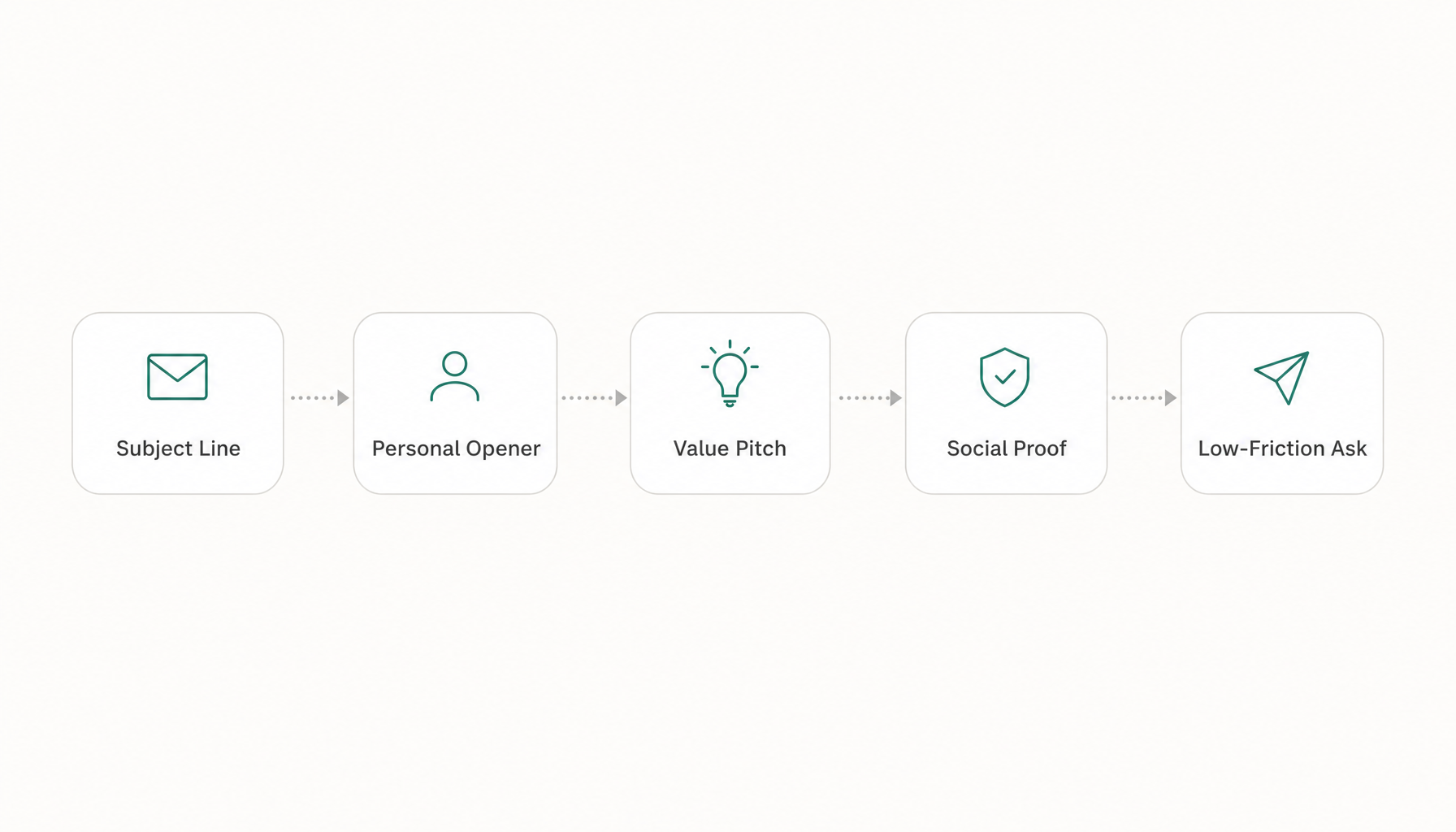
Every effective recruiter cold email has five elements:
- A relevant subject line (covered below)
- A one-sentence opener that establishes why you're emailing them specifically
- A two-sentence value pitch explaining what you bring and what you're looking for
- One piece of social proof (a metric, company name, or achievement)
- A low-friction ask (not "Can I send my resume?" but something they can answer in 10 seconds)
Total length: 4–6 sentences. That's it. Recruiters scan emails in under 8 seconds. If yours requires scrolling, it's too long.
Writing a Subject Line Recruiters Won't Ignore
Your subject line determines whether the email gets opened or ignored. Effective recruiter cold email subject lines are specific, concise, and signal relevance:
- "Senior PM with B2B SaaS experience — exploring opportunities"
- "Referred by [Name] — Frontend Engineer interested in [Company]"
- "Quick question about your [role title] opening"
- "[Specific skill] specialist — saw your post about hiring"
Avoid: "Job Inquiry," "Resume Attached," "Looking for Work," or anything that reads like spam.
Cold Email Templates You Can Steal and Customize
Template 1: The Targeted Approach (you know they have an open role)
Subject: Question about your [Role Title] opening
Hi [Name],
I saw you're hiring a [role title] at [Company]—the focus on [specific requirement from job description] caught my attention because I spent the last 3 years doing exactly that at [Current/Previous Company], where I [specific metric or achievement].
Would it make sense for me to send over my resume, or is there a better way to get into your pipeline?
Best, [Your Name]
Template 2: The Exploratory Approach (no specific role posted)
Subject: [Your Title] with [X years] in [Industry] — exploring next steps
Hi [Name],
I've been following [Company]'s growth in [specific area] and your team's work on [something specific]. I'm a [title] with [X years] experience in [specialty], most recently [one achievement with a number].
I'm not sure if you're hiring for anything in my wheelhouse right now, but would it be helpful if I sent my background for future reference?
Best, [Your Name]
Template 3: The Referral Leverage
Subject: [Mutual contact's name] suggested I reach out
Hi [Name],
[Mutual contact] mentioned you recruit for [type of roles] and suggested I get in touch. I'm a [title] with experience in [2-3 relevant skills], and I'm starting to explore my next role.
Would you be open to a quick 10-minute call this week or next?
Best, [Your Name]
Customize every template. If a recruiter senses a mass email, it goes straight to trash.
How to Follow Up Without Being Annoying
Most responses to cold emails come from the follow-up, not the initial send. Here's the cadence:
- Day 3–4: Send a brief follow-up. One sentence reminding them of your original email, one sentence adding something new (a recent achievement, a question about their hiring timeline).
- Day 10–12: Final follow-up. Keep it to two sentences. Something like: "Just bumping this to the top—happy to chat whenever timing works on your end."
- After that: Move on. If three emails get no response, this particular recruiter isn't the right door right now.
Example follow-up:
Hi [Name], just floating this back up—I know your inbox is probably wild. If the timing isn't right, no worries at all. Happy to reconnect down the road.
Never follow up more than twice. Never guilt-trip. Never send passive-aggressive "I guess you're too busy" messages.
Common Cold Email Mistakes That Kill Your Chances
- Attaching your resume unsolicited. Attachments from strangers trigger spam filters and feel presumptuous. Wait until they ask.
- Writing a novel. If your email is longer than 6 sentences, cut it in half.
- Making it about you instead of them. "I need a job" is not a value proposition. "I can help you fill your pipeline with a candidate who [specific value]" is.
- Emailing the wrong recruiter. A staffing agency recruiter focused on warehouse logistics won't help you get a data science role. Match matters.
- Using a clearly mass-produced template. If your email could be sent to any recruiter at any company without changing a word, it's too generic.
- No clear ask. End with something they can act on—"Would you be open to a brief call?" or "Should I send my resume your way?"
How to Make Sure Your Resume Is Ready Before You Hit Send
Here's where most cold email guides fail you: they help you write the email but ignore what happens after it works. When a recruiter replies and says "Send me your resume," you have maybe 24 hours before they move on. If your resume doesn't match what you promised in that email, you've wasted the connection.
Before hitting send on your cold outreach, do this:
- Check that your resume reflects the pitch in your email. If you mentioned "3 years of B2B SaaS product management," that exact language better appear on your resume.
- Verify your resume includes the right ATS keywords. Recruiters often run your resume through their applicant tracking system before forwarding it to a hiring manager.
- Make sure your format is clean and scannable. Recruiters review resumes in 6–10 seconds. Dense blocks of text kill your chances. If you're unsure about your format, review ATS formatting best practices.
- Run a gap analysis against the role you're targeting.
That last point is critical. Want to see how your resume actually stacks up against a specific role before a recruiter ever looks at it? Paste the job description into Resume Inspector — it's free, no credit card needed — and you'll see exactly which keywords you're missing in under a minute. If a recruiter replies and asks for your resume, you want it ready to back up everything your cold email promised.
Cold emailing recruiters isn't about volume—it's about precision. Research the right person, write a specific message, follow up once or twice, and make sure your resume can deliver on your pitch. Do those four things, and you'll hear back more than you expect.