How Long Should a Cover Letter Be? The Definitive Answer (With Examples)
You've spent 45 minutes crafting what feels like a compelling cover letter, and now you're staring at it wondering: is this too long? Too short? Will a hiring manager even read past the first paragraph?
Let's settle this once and for all — with specifics that actually match how hiring works in 2026.
The Short Answer: How Long Should a Cover Letter Be?
250–400 words. Three to four paragraphs. Never more than one page.
That's the answer. But the right length within that range depends on your experience level, submission format, and how much context the role requires. I'll break all of that down below.
Why Cover Letter Length Actually Matters to Hiring Managers
I reviewed cover letters for seven years as a recruiter. Here's what actually happens: a hiring manager spends 20–30 seconds scanning your cover letter before deciding whether to read your resume more carefully. That's not an estimate — it's what eye-tracking studies and recruiter surveys consistently confirm.
A cover letter that's too long signals poor communication skills. One that's too short signals low effort or disinterest. Neither gets you an interview.
The real function of a cover letter is to answer one question: Why does this specific person want this specific role, and why should we care? Anything beyond that answer is excess weight.
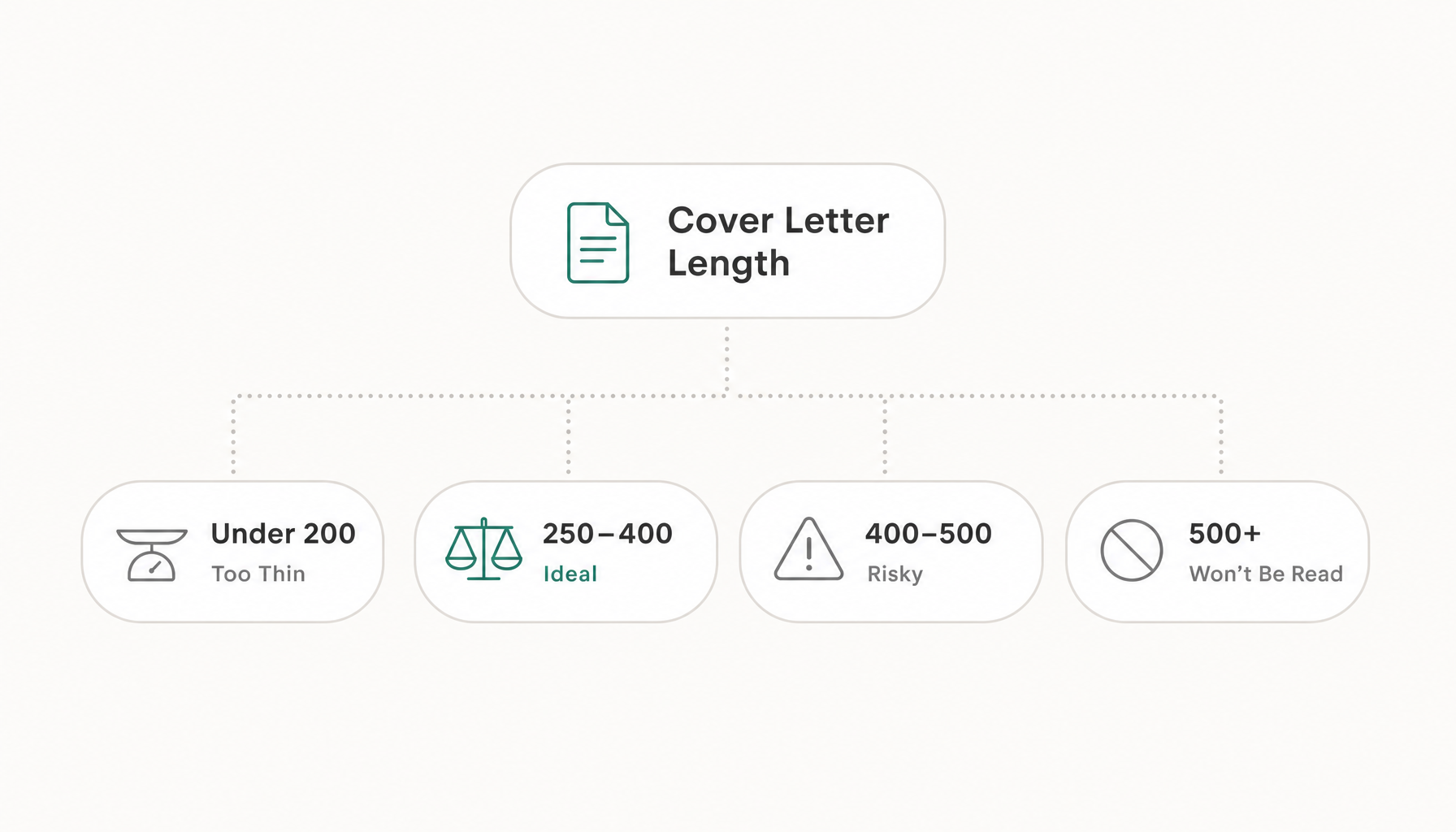
Ideal Word Count: The 250–400 Word Sweet Spot Explained
Here's why this range works:
- 250 words = the minimum needed to introduce yourself, connect your experience to the role, and close with a clear ask. Below this, you're likely just restating your resume.
- 400 words = the maximum a hiring manager will realistically read in that 20–30 second scan. Beyond this, you're burying your strongest points.
For context: 300 words takes roughly 40 seconds to read at average speed. That aligns perfectly with hiring manager behavior.
One Page Rule: What That Really Means in Practice
"One page" doesn't mean filling an entire page. It means:
- Standard margins (0.75"–1" on all sides)
- 11–12pt font (no shrinking to 9pt to cram more in)
- Visual whitespace between paragraphs
- The text ends between 50–75% down the page
A cover letter that fills the entire page with 10pt font is technically "one page" but functionally too long. If you have to adjust formatting to fit, you need to cut words instead.
How Length Should Change Based on Your Situation (Entry-Level vs. Senior)
Entry-level (0–3 years experience): 200–300 words
You don't have decades of results to reference. Lean short. A concise letter that demonstrates enthusiasm and one or two relevant experiences beats a padded letter stuffed with coursework descriptions. Example: a new marketing graduate applying for a coordinator role needs only to connect one internship project and one specific skill to the job description.
Mid-career (4–10 years): 300–400 words
This is where you have enough experience to draw meaningful connections. You might reference two or three specific achievements that map to the role's requirements. Don't exceed 400 — choose your strongest proof points, not all of them.
Senior/Executive (10+ years): 350–400 words
Counterintuitive, but senior letters shouldn't be longer. They should be denser. A VP of Engineering doesn't need to explain every role — they need to articulate strategic vision and one or two transformative results. Brevity signals confidence at this level.
Career changers: Up to 400 words
This is the one scenario where pushing toward the upper limit makes sense. You need space to bridge the gap between your background and the target role. But even here, discipline matters — explain the why and the transferable proof, not your entire career narrative.
What to Cut When Your Cover Letter Is Too Long
If your cover letter exceeds 400 words, start cutting in this order:
- Generic company praise ("I've always admired your innovative approach to...") — cut it entirely unless you're citing something hyper-specific
- Resume repetition — if a bullet point on your resume says the same thing, delete it from the letter
- Multiple examples for one skill — pick the strongest single example
- Hedge language ("I believe I would be a great fit because I think my experience might align...") — replace with direct statements
- The "thank you for your time" closer — one sentence max, not a full paragraph
Real example: "In my current role at Acme Corp, I manage a team of 12 engineers and have delivered 3 major platform migrations on time and under budget" beats a three-sentence version of the same information.
What to Add When Your Cover Letter Is Too Short
Below 200 words usually means you're missing one of these:
- A specific connection to THIS role — reference the actual job description's language or requirements
- A quantified achievement — numbers make thin letters immediately more substantive ("reduced churn by 18%" vs. "improved customer retention")
- Your motivation — one sentence explaining why this company or role, specifically, interests you
- A forward-looking statement — what you'd bring or accomplish in the first 90 days
Don't add filler. Add specificity. A short letter with generic content needs more detail about the match, not more words.
Cover Letter Length by Format: Email vs. Uploaded Document vs. Text Box
Email body cover letter: 150–250 words
When you're emailing a hiring manager directly, shorter wins. Email gets scanned even faster than documents. Three short paragraphs: who you are + why this role + ask for next steps. Skip formal headers and sign-off flourishes.
Uploaded PDF/document: 250–400 words
This is the standard format. Include a proper header with contact info, date, and recipient. The formatting itself takes space, so your actual body text can be slightly shorter while the document still feels substantial.
Application text box: 200–350 words
Many ATS platforms limit text box fields to 500–2000 characters (roughly 100–350 words). Check the character limit before writing. If it's tight, prioritize the single most relevant achievement and a clear statement of interest. No headers, no formatting — just clean paragraphs.
LinkedIn Easy Apply message (when available): 100–150 words
This isn't technically a cover letter, but many candidates treat it like one. Don't. Two to three sentences connecting your experience to the specific role is enough.
Common Length Mistakes That Get Cover Letters Rejected
Mistake 1: Writing a second resume. Your cover letter isn't a narrative version of your work history. It's an argument for why this role fits right now.
Mistake 2: One massive paragraph. Even if word count is perfect, a 300-word wall of text won't get read. Break it into three to four paragraphs with clear visual separation.
Mistake 3: Optimizing length but ignoring keywords. A perfectly-sized cover letter that doesn't mirror the job description's language will still get filtered out by ATS software or overlooked by a human scanner.
Mistake 4: Using the same length for every application. A 400-word letter for a startup's text box field feels out of touch. A 150-word letter uploaded for a senior director role feels dismissive. Match the format and level.
Mistake 5: Padding with qualifiers. "I feel that my extensive experience in the field of digital marketing could potentially be a valuable asset to your esteemed organization" = 23 words that say nothing. "I've grown organic traffic by 140% in two years" = 9 words that say everything.
Length is one variable — but keyword alignment to the specific job description is equally critical. Before you submit your next application, paste the job description into Resume Inspector to see your fit score for free, no signup needed. You'll see exactly which keywords your resume and cover letter are missing in under a minute, so you can fix gaps before a recruiter ever sees them.
Try our free Job Keyword Scanner to see how your resume stacks up.
Quick-Check Checklist: Is Your Cover Letter the Right Length?
Run through this before you hit send:
- Word count is 250–400 (adjust down for email, up for career changes)
- It fits on one page at 11–12pt font with standard margins
- Three to four paragraphs with whitespace between them
- No paragraph exceeds 5 sentences
- First paragraph is 2–3 sentences max (this is what gets scanned first)
- Zero sentences repeat what's on your resume verbatim
- At least one quantified achievement is included
- The company/role name appears (proving it's not a generic template)
- The closing is one sentence, not a paragraph
- Reading it aloud takes under 90 seconds
If you check all ten boxes, your cover letter length is working for you, not against you. Now make sure the content inside that length is actually matched to the job — because the right word count with the wrong keywords still lands in the reject pile.
For more on crafting compelling cover letters beyond just length, check out the full guide on how to write a cover letter that gets read.