How to Answer 'Tell Me About Yourself' (A Formula That Actually Works)
You've shaken hands, taken your seat, and the interviewer leans forward with the most predictable opening in existence: "So, tell me about yourself."
And despite knowing it was coming, your brain goes blank. You ramble about where you grew up, mention your dog, then somehow end up explaining your college major choice from eight years ago.
This question derails more interviews than any technical stumper ever will. Here's how to nail it every single time.
Why Interviewers Ask 'Tell Me About Yourself' (And What They're Really Listening For)
This isn't small talk. The interviewer is evaluating three things simultaneously:
- Can you communicate clearly under mild pressure? They're watching whether you organize thoughts or scatter them.
- Do you understand what this role actually needs? A relevant answer signals preparation. A generic one signals you're mass-applying.
- Are you self-aware about your own career trajectory? They want to hear a coherent narrative, not a disconnected list of jobs.
The question is essentially: Give me a reason to keep listening for the next 45 minutes.
That means your answer needs to be focused (60–90 seconds), relevant (connected to this specific job), and forward-looking (you're going somewhere, and that somewhere is this role).
The 3-Part Formula: Past, Present, Future
Every strong interview introduction follows this structure:
Past: Where you started and what built your foundation. Present: What you're doing now and what you're best at. Future: Why this role is the logical next step.
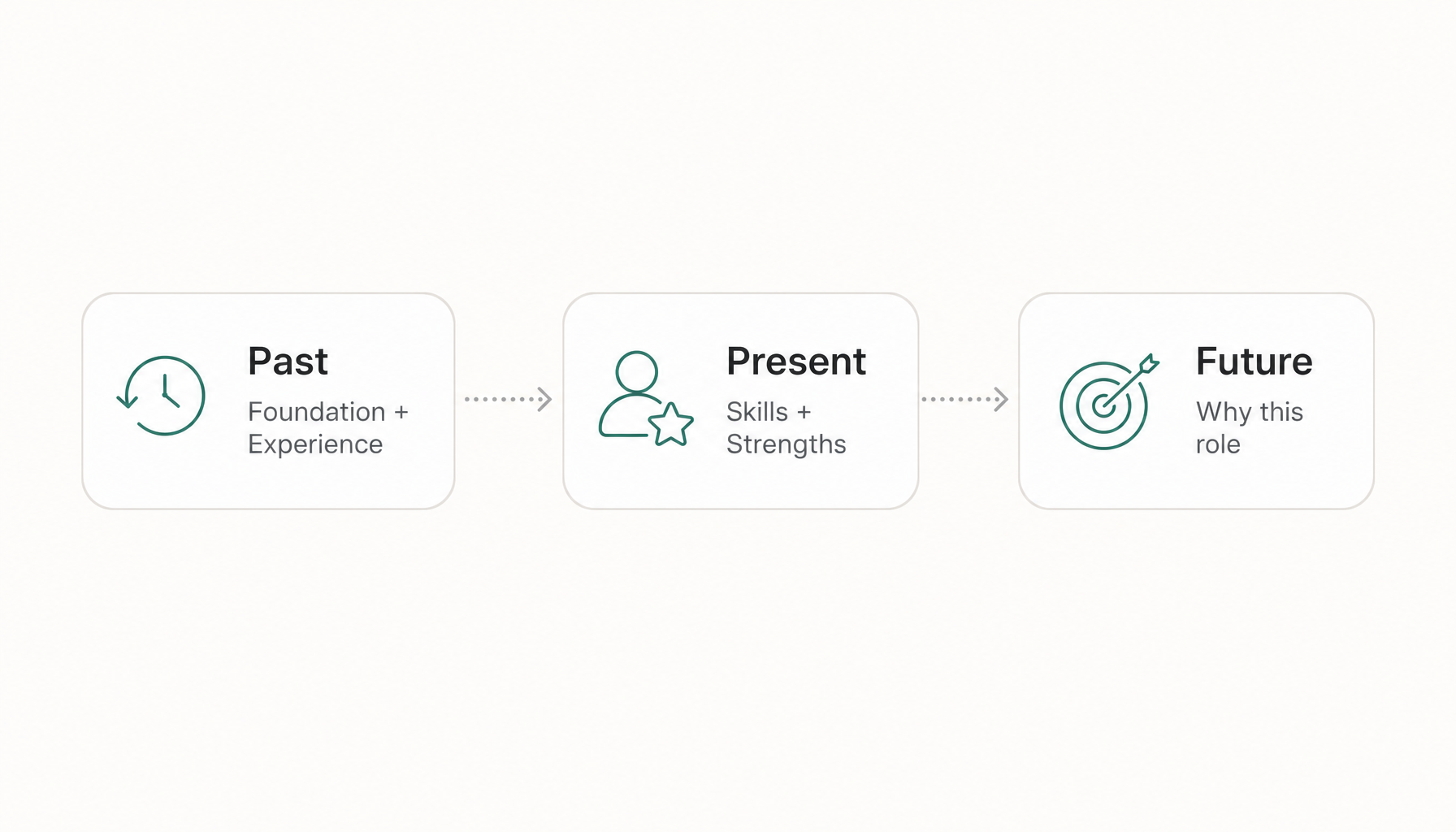
Here's why this works: it gives your career a narrative arc. Humans process stories better than bullet points. The interviewer walks away thinking, "That person makes sense for this role" — which is exactly the feeling you want to create before a single technical question lands.
Critical rule: Each section should be 2–3 sentences maximum. This isn't your autobiography. It's a trailer.
How to Tailor Your Answer to the Specific Job
The biggest mistake candidates make is preparing one generic answer and using it everywhere. Your "tell me about yourself" should shift based on what the job description prioritizes.
Here's the process:
- Identify the top 3 skills or requirements from the job description.
- Anchor your Past section around experience that proves one of those skills.
- Frame your Present section around a second skill, ideally your strongest current capability.
- Point your Future section directly at the role's core mission.
For example, if a product manager role emphasizes cross-functional collaboration, data-driven decisions, and go-to-market strategy, those three themes should appear in your answer — not project management methodology or Agile certifications that the posting barely mentions.
The challenge most people face is figuring out which keywords and requirements actually matter most versus which ones are filler. Before crafting your answer, try pasting the job description into Resume Inspector — it's free, no credit card needed — and you'll instantly see which keywords and skills the employer weighted most heavily. Those are the themes to weave into your introduction.
This is also where your resume and your interview answer should align. If your resume emphasizes the same keywords you're saying out loud, you create a consistent narrative that builds recruiter confidence. If there's a disconnect — you talk about leadership but your resume lists only individual contributor work — that mismatch raises flags.
Word-for-Word Examples for Different Career Situations
Experienced Professional (Marketing Manager → Senior Marketing Manager)
"I've spent the last six years in B2B marketing, starting at a 50-person SaaS startup where I built the demand gen function from zero to a $2M pipeline. Currently, I lead a team of four at [Company], where we've increased qualified leads by 40% year-over-year through account-based marketing and content strategy. I'm looking to take on a larger team and broader strategic ownership, which is exactly what drew me to this senior role — particularly your focus on expanding into the enterprise segment."
Why it works: Specific numbers. Clear progression. The future connects directly to their job description.
New Graduate (No Full-Time Experience)
"I just completed my degree in computer science at [University], where I focused on machine learning coursework and spent two semesters as a research assistant building NLP models for sentiment analysis. Outside class, I led a team of three in a campus hackathon where we built a recommendation engine that won second place. I'm looking for a role where I can apply that ML foundation to real production systems, and your team's work on personalization is exactly the kind of problem I want to solve."
Why it works: Substitutes work experience with projects and research. Still follows Past → Present → Future. Connects to their specific product.
Career Changer (Teacher → UX Designer)
"I spent five years as a high school teacher, which gave me deep experience in understanding how people learn, breaking complex information into digestible steps, and running usability-style testing with my curriculum every semester. Over the past year, I completed a UX design certification through [Program], redesigned the onboarding flow for a local nonprofit's app, and ran user research with 30 participants. I'm ready to bring that research-first mindset into a full-time design role, and your team's emphasis on accessibility aligns perfectly with my background in inclusive education."
Why it works: Reframes teaching as UX-relevant (not a random pivot). Shows concrete transition steps. Ties the career change to their values.
Common Mistakes That Kill First Impressions
Starting with "Well, I was born in..." — Nobody needs your origin story. Start at the point your professional life became relevant to this job.
Reciting your resume line by line — They've already read it (or they haven't, and a list won't help either way). Your answer should tell a story, not replicate a document.
Being too humble or too vague — "I've done a bit of everything" tells them nothing. Pick 2–3 specific strengths and own them with evidence.
Forgetting the Future section — Without it, your answer explains the past but doesn't explain why you're sitting in this particular chair. The Future section is what makes them think, "Yes, this makes sense."
Going over two minutes — I've watched hiring managers mentally check out at the 90-second mark. Tighter is always better. If they want more detail, they'll ask.
How to Practice Until It Sounds Natural (Not Rehearsed)
Reading your answer silently and saying it out loud are completely different experiences. Here's the practice method I recommend:
- Write it out fully — every word. This forces clarity.
- Read it aloud three times — notice where you stumble or sound stiff.
- Reduce it to bullet points — Past (one phrase), Present (one phrase), Future (one phrase).
- Practice from bullets only — this lets you vary the exact wording while keeping the structure. It sounds conversational instead of memorized.
- Record yourself on your phone — listen back. Are you under 90 seconds? Do you sound like you're talking to a human or reading a teleprompter?
- Practice with a different job description — if you can adapt the formula on the fly with a new posting, you've internalized the structure.
The goal isn't word-perfect delivery. It's structural confidence — knowing you'll hit Past, Present, Future regardless of nerves.
Quick Checklist Before Your Interview
- Your answer is under 90 seconds when spoken aloud
- You've identified the top 3 keywords/skills from the job description
- Your Past section includes at least one specific metric or achievement
- Your Present section highlights a skill that matches their top requirement
- Your Future section names something specific about this role or company
- You've practiced aloud at least five times (from bullets, not script)
- Your resume tells the same story your answer tells — no contradictions
Before you walk in, run a quick gut check: does your resume actually reflect the same keywords you plan to say in person? If you're not sure, the free fit analysis tool lets you paste the job description and see exactly where your resume aligns and where it doesn't — useful for making sure your spoken narrative and written materials tell the same story.
Your "tell me about yourself" answer is the opening frame for the entire interview. Get it right, and every question that follows feels like a natural continuation. Get it wrong, and you spend the next 40 minutes trying to recover from a scattered first impression. Use the formula. Tailor it to the job. Practice until the structure is invisible. Then walk in and tell them exactly who you are — and why you're the obvious choice.