How to Answer the Salary Expectations Question (Without Leaving Money on the Table)
"What are your salary expectations?"
Six words that have cost candidates tens of thousands of dollars. Not because they gave the wrong number, but because they didn't understand what was actually happening in that moment.
After eight years of recruiting across tech, finance, and healthcare, I watched candidates answer this question thousands of times. The ones who handled it well weren't the ones who memorized a clever deflection. They were the ones who understood the dynamics at play and chose a strategy that matched their specific situation.
Why the Salary Expectations Question Is Actually a Negotiation Trap
Here's the uncomfortable truth: the salary expectations question exists to establish an anchor. Whoever names a number first sets the range that all subsequent negotiation revolves around.
If you say "$85,000" and the company budgeted $110,000 for the role, you just saved them $25,000. They won't correct you. They'll smile, nod, and move on.
If you say "$130,000" and their ceiling is $110,000, you risk being screened out before you've had a chance to demonstrate your value.
This isn't inherently malicious — companies have budgets and need to avoid wasting time on candidates they can't afford. But it is asymmetric. They know their budget. You don't.
What Interviewers Are Really Trying to Find Out
Interviewers ask this question for three distinct reasons, and your answer should depend on which one is driving the question:
- Budget alignment — They need to confirm you're in the ballpark before investing six more hours of interview time.
- Self-awareness gauge — They want to see if you understand your market value relative to the role's level.
- Anchoring advantage — They want you to name the floor so they can offer just above it.
A recruiter asking on a phone screen is almost always reason #1. A hiring manager asking in a final round is often reason #3. Knowing the difference changes your response entirely.
Should You Give a Number First? The Case for and Against
Every career blog says "never give a number first." That's oversimplified.
When deflecting makes sense:
- You're early in the process and don't fully understand the role's scope
- The company hasn't shared their budget range
- You have competing offers that might shift your expectations
When naming a range makes sense:
- You're in a hot market and your number is likely higher than their budget (this forces them to stretch or disqualify early — both save your time)
- You've done rigorous market research and know exactly where you stand
- You're applying to a role where compensation is standardized (government, union, academia)
- The company has already shared their range and you're confirming alignment
The dogma of "never go first" can backfire. If you deflect three times, you sound evasive. If you give a well-researched range backed by data, you sound like someone who knows their worth.
How to Research Your Market Value Before the Interview
"Do your research" is useless advice without specifics. Here's the actual process:
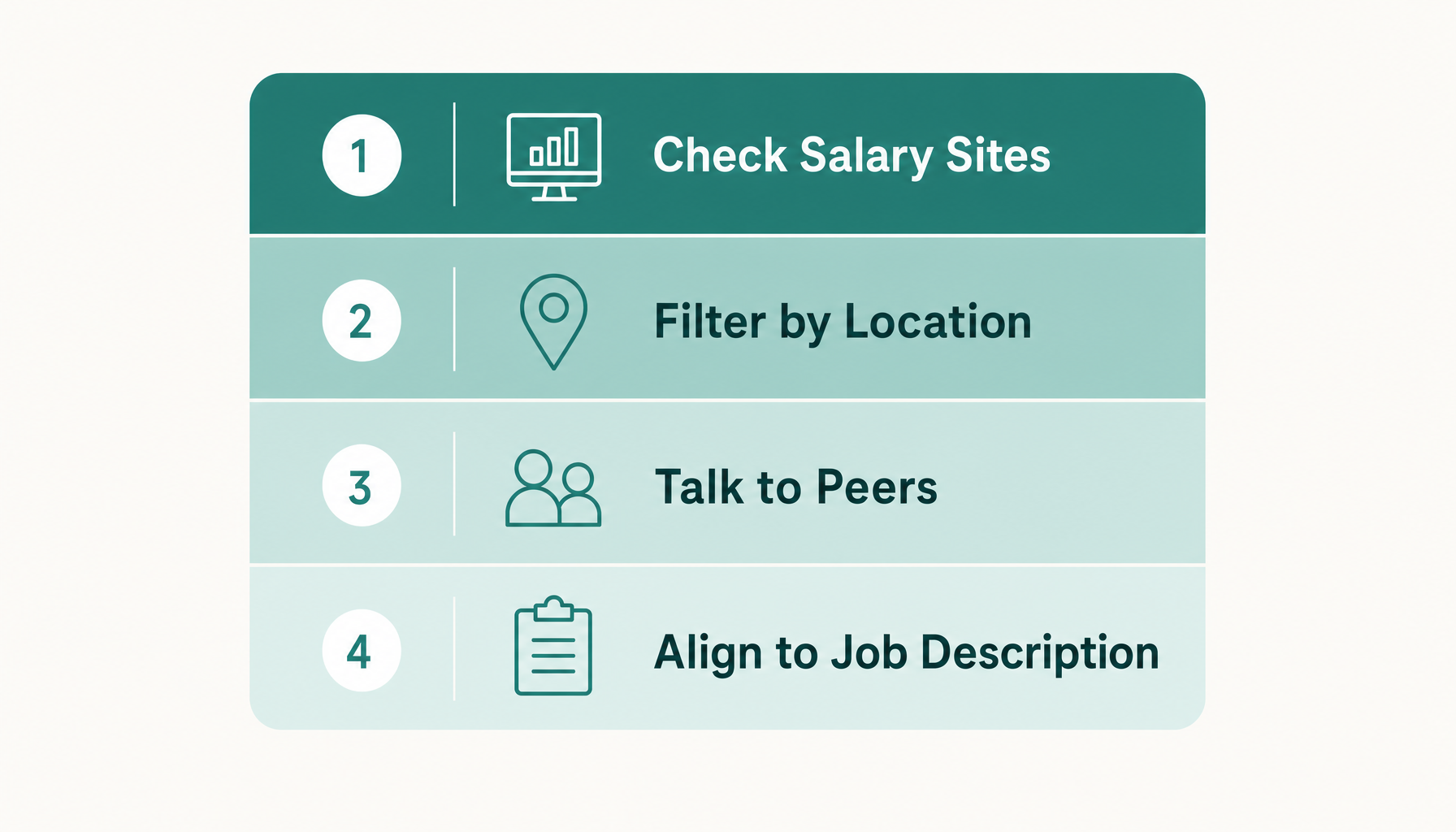
- Check Levels.fyi, Glassdoor, and Payscale for the exact title and company (or comparable companies by size/stage/industry).
- Filter by location — a Senior Product Manager in Austin and San Francisco are different markets by $30K-$50K.
- Talk to people in the role — LinkedIn messages to people with the same title at similar companies yield real numbers. Most people will share ranges if you ask respectfully.
- Factor in total compensation — base, bonus, equity, 401(k) match, and benefits all matter. A $95K base with 20% bonus and $30K in equity is different from $110K base with no bonus.
- Align with the specific job description — a "Senior Engineer" building internal tooling and one leading a platform team have different market rates even at the same company.
That last point matters more than people realize. Your salary confidence should be proportional to how well your experience actually matches what the role requires. Before the interview, paste the job description into Resume Inspector — it's free, no credit card needed — and you'll see exactly how your experience maps to what they're asking for. Knowing your fit score gives you data-backed confidence when the money conversation arrives. A candidate who can say "I bring 8 of the 10 skills you listed" negotiates from a fundamentally different position than one guessing at their relevance.
Word-for-Word Scripts for Every Scenario (Phone Screen, First Round, Final Round)
Phone screen (recruiter asking for budget alignment):
"Based on my research for this role's level and location, I'm targeting a total compensation range of $X to $Y. But I'm flexible depending on how the overall package is structured — I'd love to learn more about the full benefits picture as we move forward."
First round (hiring manager testing self-awareness):
"I've been researching compensation for [title] at companies of your size and stage in [city], and the range I'm seeing is $X to $Y. I'd want to understand the full scope of the role before landing on a specific number, but that range feels right based on what I know so far."
Final round (anchoring play):
"Given what I've learned about the role's scope, the team I'd be managing, and the impact you're expecting in the first year, I'd be targeting $X to $Y. That reflects both the market rate and the specific complexity of this position."
Notice how each script escalates in specificity. By the final round, you've earned the right to name a precise range because you can justify it with role-specific knowledge.
How to Deflect Without Sounding Evasive
If you genuinely don't have enough information yet, here's how to redirect without creating friction:
"I'd like to learn more about the role's responsibilities and how success is measured before I land on a number. Could you share what the budgeted range is for this position?"
This works because it's honest, collaborative, and puts the ball back in their court. Most recruiters will share their range if you ask directly.
What doesn't work: "I'd prefer not to discuss compensation at this stage." That's adversarial and signals you'll be difficult to work with.
When They Push Back: Handling Follow-Up Pressure
Some interviewers won't accept a deflection. They'll say things like:
- "We need a number to move forward."
- "Even a ballpark would help."
- "What are you making now?" (illegal to ask in many states in 2026, but it still happens)
If they insist on a number: Give a range that's 10-15% wider than your actual target. If you want $105K, say "$100K to $120K depending on the full package." This gives you negotiation room while appearing cooperative.
If they ask your current salary: "I'm focused on what this role is worth in the current market rather than anchoring to my previous compensation. Based on my research, the range for this level is $X to $Y."
If they name a range below your floor: "I appreciate the transparency. That's below what I'm targeting based on my market research and the scope of this role. Is there flexibility in the budget, or is that a hard ceiling?" This keeps the door open without caving.
Remote, Hybrid, and Relocation Roles: How Location Changes Your Answer
In 2026, location-based pay is still the norm at most companies. Here's how to handle it:
- Remote role, company in high-cost city: Research whether they pay based on company HQ or employee location. Ask directly: "Do you adjust compensation based on candidate location?"
- Relocation required: Factor in cost-of-living difference and state tax implications. Moving from Texas to California for the same salary is effectively a pay cut.
- Hybrid with flexibility: If you're splitting time between a low-cost home and high-cost office, some companies split the difference. Ask how they calculate it.
Name your range based on where the work happens, not where you happen to live — unless the company has explicitly stated a location-adjusted pay policy.
Common Mistakes That Cost Candidates Thousands
Anchoring too low out of fear. Candidates terrified of being screened out name a "safe" number 20% below their market value. The company accepts immediately — and you spend two years underpaid.
Giving a single number instead of a range. A single number is a ceiling. A range gives you negotiation space.
Ignoring total compensation. Base salary is one component. I've seen candidates turn down a $100K offer for a $105K offer — while the first included $40K in equity and the second included nothing.
Not asking about the range first. Many candidates answer the salary question without ever asking what the company budgeted. You're allowed to ask. It's not rude. It's standard.
Negotiating before they want you. The best time to discuss money is after they've decided you're the one. If you're aggressive on salary in a first-round screen, you have zero leverage.
Quick Checklist: Before Your Next Interview
Use this before any conversation where salary might come up:
- Research salary ranges on at least three sources (Levels.fyi, Glassdoor, peer conversations)
- Identify your floor (the minimum you'd accept) and your target (what you actually want)
- Determine your total compensation priorities (base vs. equity vs. flexibility)
- Practice your script out loud — twice
- Know your state's laws on salary history questions
- Paste the job description into a free ATS check to see which keywords you're missing — so your resume and talking points are airtight before you ever get to the salary question
That last step matters more than you'd think. When you know exactly which of their requirements you match — and which gaps you'll need to address — you negotiate from informed confidence rather than hope. Run the analysis free, no credit card needed, and walk into that interview knowing precisely where you stand.
The salary expectations question isn't a trick if you're prepared for it. It's a trap only when you're caught off guard. Research your number, choose the right strategy for your scenario, and remember: the person who understands the game best wins it.